
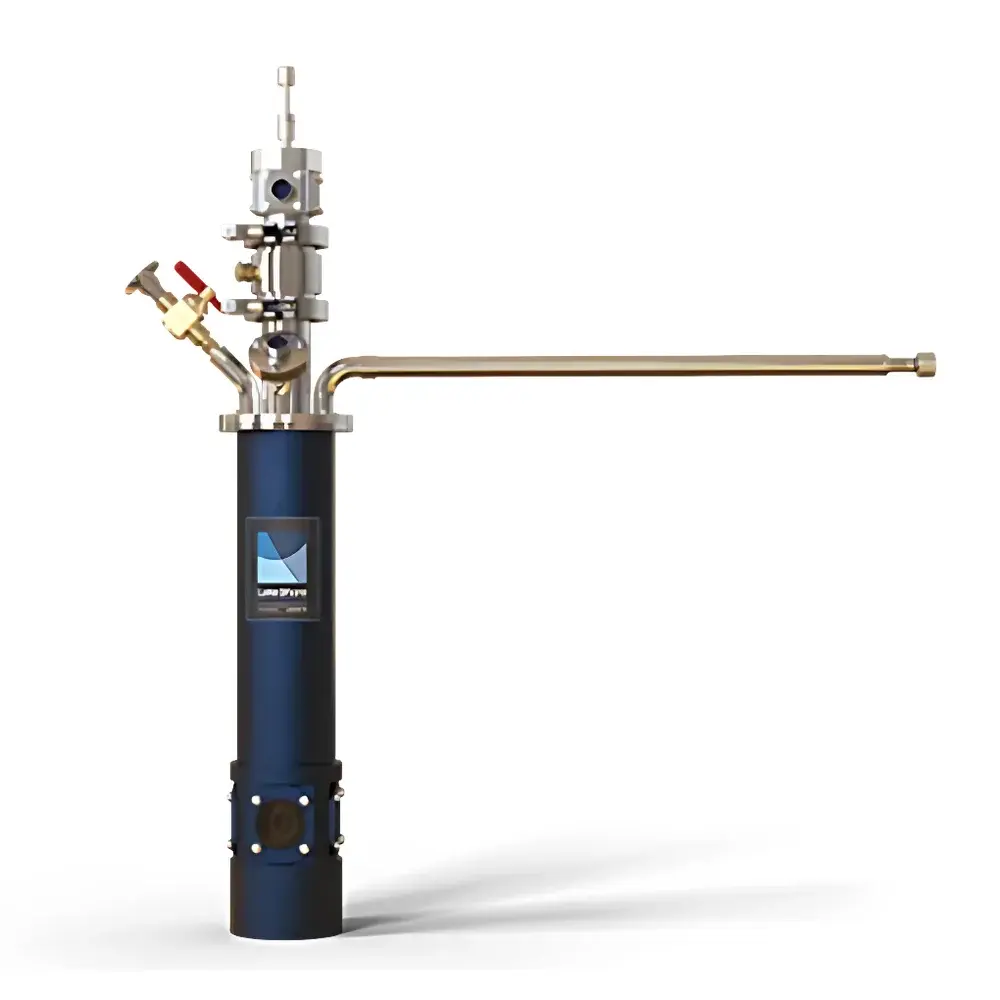
Lake Shore STVP-100 Series Continuous-Flow Cryogenic Thermostat
| Brand | Lake Shore |
|---|---|
| Origin | USA |
| Manufacturer Status | Authorized Distributor |
| Origin Category | Imported |
| Model | STVP-100 |
| Pricing | Upon Request |
| Cooling Medium | Liquid Helium or Liquid Nitrogen |
| Temperature Range | <2 K to 325 K (LHe), 65 K to 325 K (LN₂) |
| Temperature Stability | ±50 mK |
| Sample Environment | Continuous-flow cryogenic vapor |
| Cool-down Time to 5 K | 30 min |
| Optical Window | Optional |
| Top-Loading Configuration | Yes |
| Rotatable Sample Stage | Yes |
| Mounting Orientation | Vertical (required below 4.5 K) |
| Helium Consumption | 0.5 L (cooldown from RT to 4.2 K), 1.3 L/h (steady-state @ 5 K) |
| Height | 762 mm |
| Internal Sample Chamber Diameter | 38.1 mm |
| Sample Insertion Depth | 31 mm |
| Optical Window Block Size | 82.6 mm square |
| Weight (unit only) | 7 kg |
| Shipping Weight (unit + transfer line) | 61 kg |
| Shipping Dimensions | 1905 × 990.6 × 431.8 mm |
Overview
The Lake Shore STVP-100 Series Continuous-Flow Cryogenic Thermostat is a high-precision, vertically oriented cryostat engineered for low-temperature physical property measurements under controlled, stable thermal conditions. It operates on the continuous-flow principle, where liquid helium (or liquid nitrogen) is delivered via an efficient transfer line to a heat exchanger near the sample stage, generating a steady, laminar stream of cold vapor that directly envelops the specimen. This design eliminates conductive thermal anchoring constraints—making it uniquely suited for thermally fragile, non-adherent, or geometrically irregular samples such as powders, suspensions, thin films, and low-thermal-mass liquids. Unlike bath-type cryostats, the STVP-100 avoids immersion in cryogen, thereby minimizing mechanical stress, condensation artifacts, and thermal gradients across the sample volume. Its operational range spans from sub-2 K up to 325 K (with liquid helium) or 65–325 K (with liquid nitrogen), and when integrated with the optional RGC helium recirculation system, enables fully cryogen-free operation across the entire temperature span—critical for long-duration experiments requiring minimal intervention and reduced operational cost.
Key Features
- Continuous-flow vapor-cooling architecture ensures uniform thermal environment and rapid thermal response without sample submersion
- Top-loading sample chamber enables tool-free, rapid sample exchange—reducing system downtime and contamination risk
- Modular sample probe design supports interchangeable inserts: standard electrical, four-probe, plug-in, and optical sample stages
- Integrated rotation capability (optional) for angular-dependent measurements including magneto-optical Kerr effect (MOKE) or polarized Raman spectroscopy
- Vertical mounting orientation maintained during operation below 4.5 K to ensure stable vapor flow dynamics and gravitational phase separation
- Low helium consumption profile: 0.5 L for cooldown from room temperature to 4.2 K; 1.3 L/h at steady-state 5 K operation
- Compact footprint (762 mm height, 7 kg net weight) with robust stainless-steel vacuum jacket and multilayer radiation shielding
Sample Compatibility & Compliance
The STVP-100 accommodates a broad spectrum of sample geometries and physical states—including loose powders, colloidal dispersions, microcrystalline aggregates, and thin-film substrates mounted on standard carriers. Its vapor-cooled sample environment minimizes thermal shock and interfacial freezing, preserving native sample morphology during cooldown. Electrical characterization is supported via customizable feedthrough options: DC, BNC, SMA, and triaxial connectors—each rated for ultra-low-noise performance down to 2 K. For optical experiments, optional window blocks (82.6 mm square) accept AR-coated fused silica, CaF₂, sapphire, or polyethylene windows—covering transmission bands from X-ray through UV–Vis–NIR to THz. All vacuum and pressure interfaces comply with ISO-KF 40 and CF-63 standards. The system is compatible with GLP/GMP-aligned laboratory workflows when paired with validated temperature logging software and calibrated Pt-100/Carbon-Glass sensors traceable to NIST standards.
Software & Data Management
Temperature control is managed via Lake Shore’s proprietary CryoSoft™ platform, supporting PID tuning, ramp-and-soak profiles, and real-time monitoring of heater power, sensor resistance, and vapor pressure. The system logs timestamped temperature, pressure, and auxiliary channel data at user-defined intervals (10 ms to 10 s resolution), exporting to CSV or HDF5 formats for post-processing. When interfaced with third-party measurement systems (e.g., PPMS, QD DynaCool, or custom lock-in setups), CryoSoft provides IEEE-488 (GPIB), USB-TMC, and Ethernet-based SCPI command support. Audit trails, user access levels, and electronic signatures are available under optional 21 CFR Part 11-compliant configuration—enabling full regulatory traceability for pharmaceutical, materials qualification, or defense-related applications.
Applications
- Transport property measurements (resistivity, Hall effect, thermopower) on nanomaterials and quantum dot assemblies
- Low-temperature photoluminescence and time-resolved spectroscopy of perovskite thin films and 2D semiconductors
- Magnetic susceptibility and AC susceptibility studies of molecular magnets and spin-crossover complexes
- In-situ XRD and XAS experiments requiring precise thermal stabilization below 10 K
- THz time-domain spectroscopy (THz-TDS) of superconducting gap evolution in iron-based compounds
- Calibration of cryogenic radiation detectors (e.g., TES, MKIDs) requiring sub-50 mK stability over >24 h
FAQ
Can the STVP-100 operate without liquid helium?
Yes—when coupled with the Lake Shore RGC series helium recirculation cryocooler, the STVP-100 achieves continuous, cryogen-free operation from <2 K to 325 K.
What vacuum level is required for optimal performance?
A base pressure ≤1 × 10⁻⁶ Torr is recommended prior to cooldown; the system includes dual-stage vacuum gauging (capacitance manometer + ion gauge) for real-time monitoring.
Is the optical window compatible with UHV environments?
Standard optical window flanges use metal-sealed ConFlat (CF) interfaces rated for UHV (≤1 × 10⁻¹⁰ Torr); window materials must be selected per outgassing specifications.
How is temperature calibrated below 4 K?
Primary calibration uses a calibrated Cernox® CX-1050 sensor traceable to the ITS-90 scale; secondary verification is performed via superconducting transition references (e.g., In, Sn, Pb).
Can I integrate my own data acquisition hardware?
Yes—the STVP-100 provides isolated analog voltage outputs (0–10 V) for temperature, pressure, and heater current, along with TTL-compatible status triggers for synchronization with external DAQ systems.



