
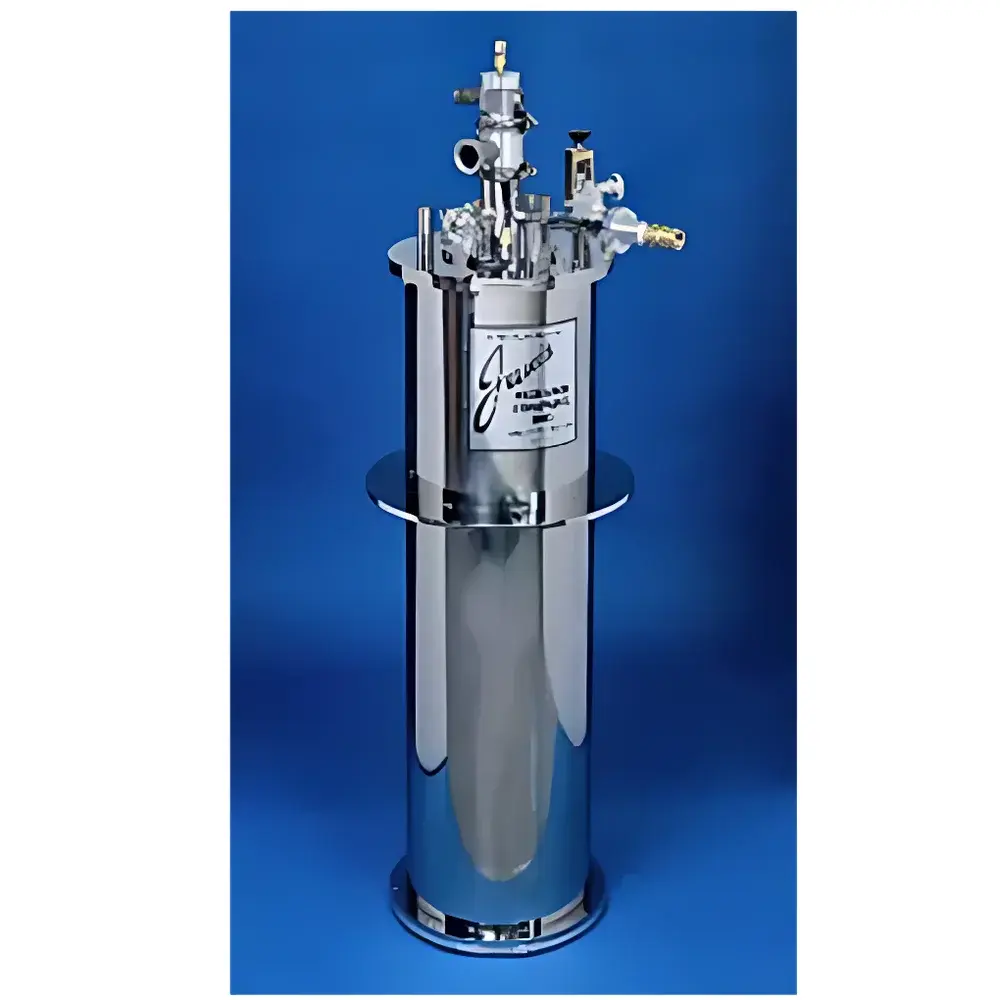
Lake Shore OptiMag Wet Superconducting Magnet System
| Brand | Lake Shore |
|---|---|
| Origin | USA |
| Manufacturer Type | Authorized Distributor |
| Origin Category | Imported |
| Model | OptiMag |
| Pricing | Upon Request |
| Magnetic Field Range | 6–12 T (up to 16 T with optional configurations) |
| Temperature Range | 1.5–325 K |
| Sample Bore Diameter | 1.25–1.75 in |
| Helium Dewar Volume | 12 L |
| Hold Time (Static Cryogenic) | ~60 h |
| Field Homogeneity | ±0.5% to ±0.001% over 1 cm Ø sphere |
| Optical Access | Axial (bottom or top), along field direction |
| Cooling Environment | Continuous-flow cryogen or vacuum |
| Compatible Configurations | Vector magnet (2–3 independent coils), horizontal-field, Mössbauer-compatible vertical-drive with top-loaded source/absorber |
| Optional Add-ons | M81 Synchronous Source Transport Measurement System, M91 Fast Hall Probe System, He-3 Insert (<1.4 K), Lambda-point refrigerator (for 9–16 T systems) |
Overview
The Lake Shore OptiMag Wet Superconducting Magnet System is a high-performance, cryogen-cooled superconducting magnet platform engineered for precision magnetic property characterization under controlled low-temperature and high-field conditions. Based on NbTi or Nb3Sn superconducting coil technology, the OptiMag employs liquid helium immersion cooling to achieve stable, persistent-mode magnetic fields ranging from 6 T to 12 T standard—and up to 16 T in specialized configurations—while maintaining exceptional field homogeneity and thermal stability. Its core architecture integrates a 12-liter liquid helium dewar with axial optical access aligned parallel to the magnetic field axis, enabling simultaneous magneto-optical, magneto-transport, and Mössbauer spectroscopic measurements. Unlike dry (cryocooler-based) systems, the wet design ensures superior thermal coupling, lower base temperatures (down to 1.5 K), and higher field stability over extended hold times (~60 hours static). The system supports both vertical solenoid and configurable vector-field geometries via modular multi-coil arrangements, making it suitable for anisotropic studies, spin orientation control, and vector-field-dependent quantum transport experiments.
Key Features
- Field strength options: 6–9 T (standard OM series), 10–12 T (high-field OM variants), and up to 14–16 T with Lambda-point refrigeration or He-3 insert integration
- Field homogeneity: Tunable from ±0.5% to ±0.001% over a 1 cm diameter spherical volume—optimized for high-resolution NMR, µSR, and Mössbauer applications
- Temperature range: Continuously adjustable from 1.5 K to 325 K using either liquid helium flow, closed-cycle refrigeration, or Lambda-point cooling
- Dual optical access: Axial bottom-loading or top-loading optical paths aligned with the field direction; compatible with IR, visible, UV, and X-ray transmission
- Sample environment flexibility: Supports continuous-flow cryogen, high vacuum, or controlled-atmosphere operation—ideal for powders, liquids, thin films, and irregularly shaped specimens
- Modular coil architecture: 2-coil or 3-coil vector configurations enable programmable horizontal, tilted, or rotating field vectors without mechanical reorientation
- Mössbauer-ready design: Includes top-access cryostat geometry with dual-stage cold finger, indium-sealed sapphire or Mylar windows, and integrated source/absorber mounting for velocity-driven spectroscopy at helium temperatures
Sample Compatibility & Compliance
The OptiMag accommodates diverse sample formats—including single crystals, polycrystalline pellets, thin-film heterostructures, colloidal suspensions, and gas-phase cells—within its 1.25–1.75 inch bore. All internal components are fabricated from non-magnetic, ultra-high-vacuum (UHV)-compatible materials (e.g., OFHC copper, titanium, and G-10 fiberglass) to minimize eddy-current interference and thermal stress. The system complies with ISO 17025-relevant calibration traceability protocols for field and temperature sensors. When equipped with optional M81 or M91 measurement modules, it supports ASTM D4066 (electrical resistivity of magnetic materials), ASTM E1036 (Hall effect measurements), and IEC 60404-5 (magnetic properties of permanent magnets). Data acquisition workflows meet GLP/GMP documentation requirements when paired with Lake Shore’s certified software packages and 21 CFR Part 11-compliant audit trail functionality.
Software & Data Management
Control and data acquisition are managed through Lake Shore’s proprietary CryoSoft™ platform, which provides synchronized coordination of magnet current, temperature setpoints, optical stage positioning, and external instrumentation (e.g., lock-in amplifiers, source meters, spectrometers). The software supports scripting (Python API), real-time field/temperature ramp profiling, and automated sequence execution for multi-parameter sweeps (e.g., R(T,H), ρ(H,θ), Hall coefficient vs. field angle). All raw and processed datasets are stored in HDF5 format with embedded metadata—including sensor calibration coefficients, timestamped environmental logs, and instrument configuration snapshots—to ensure full reproducibility and FAIR (Findable, Accessible, Interoperable, Reusable) compliance. Optional integration with LabVIEW, MATLAB, or Python-based analysis pipelines enables custom modeling of quantum oscillations, critical field mapping, and anisotropic magnetoresistance fitting.
Applications
- Quantum transport studies: Shubnikov–de Haas oscillations, quantum Hall effect, Berry curvature mapping in 2D materials
- Magneto-optical spectroscopy: Faraday/Kerr rotation, Zeeman splitting, magneto-PL under high field
- Mössbauer spectroscopy: Nuclear hyperfine interactions in ferro-/antiferromagnetic oxides, metallic glasses, and biological iron complexes
- Superconductivity research: Upper critical field (Hc2) determination, vortex lattice imaging, flux pinning analysis
- Magnetic phase diagram mapping: First-order transitions, metamagnetic jumps, spin reorientation in rare-earth compounds
- Spintronics device characterization: Tunnel magnetoresistance (TMR), spin-transfer torque (STT), domain wall dynamics
FAQ
What is the difference between “wet” and “dry” superconducting magnet systems?
A wet system uses liquid cryogens (typically helium) for direct immersion cooling of the superconducting coil, yielding lower base temperatures, higher field stability, and longer hold times. Dry systems rely on mechanical cryocoolers, offering convenience but typically at the expense of ultimate temperature, field homogeneity, and thermal noise floor.
Can the OptiMag be configured for vector magnetic fields?
Yes—select models integrate two or three independently powered superconducting coils, enabling precise synthesis of horizontal, tilted, or continuously rotating magnetic vectors without sample repositioning.
Is the system compatible with Mössbauer spectroscopy?
Yes—the standard OptiMag includes a top-loading cryostat geometry with indium-sealed optical windows, cold-stage source/absorber mounts, and sub-Kelvin temperature stability required for high-resolution velocity-driven Mössbauer measurements.
What temperature ranges are achievable with optional inserts?
With a He-3 insert, base temperatures below 1.4 K are attainable; with a Lambda-point refrigerator, the system operates from 1.5 K up to 325 K across the full field range.
Does Lake Shore provide calibration and service support outside the U.S.?
Yes—Lake Shore maintains an international network of authorized service centers and offers factory-certified calibration services traceable to NIST standards, including on-site field mapping and temperature sensor validation.



