Lake Shore GR Series Germanium Resistance Thermometers
| Brand | Lake Shore |
|---|---|
| Origin | USA |
| Manufacturer Status | Authorized Distributor |
| Origin Category | Imported |
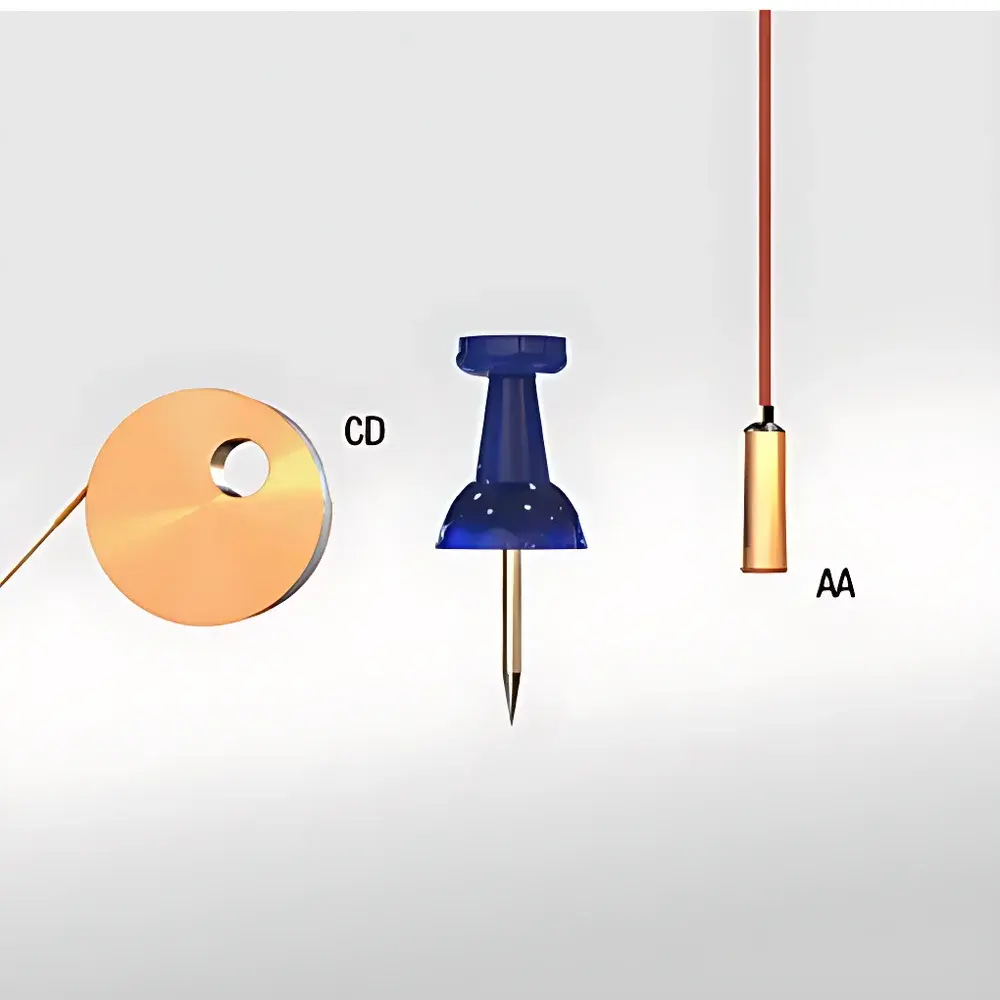
| Model | GR-50-AA / GR-300-AA / GR-1400-AA |
| Pricing | Upon Request |
Overview
Lake Shore GR Series Germanium Resistance Thermometers are precision cryogenic temperature sensors engineered for use as secondary standard thermometers in ultra-low-temperature environments. Based on the semiconductor resistance behavior of doped germanium, these devices operate on the fundamental principle that electrical resistivity increases exponentially as temperature decreases below ~100 K—enabling high-resolution measurements across a broad cryogenic range from <0.05 K to 100 K. Unlike metallic resistance thermometers (e.g., platinum RTDs) or diode-based sensors, germanium thermometers exhibit exceptionally high dR/dT sensitivity at sub-4.2 K temperatures—making them the preferred choice for applications demanding sub-millikelvin stability and repeatability in dilution refrigerators, adiabatic demagnetization refrigerators (ADR), and superconducting magnet systems. Their intrinsic physical response is governed by variable-range hopping conduction in heavily doped germanium crystals, resulting in reproducible, hysteresis-free resistance–temperature characteristics when properly calibrated.
Key Features
- Secondary standard-grade accuracy and long-term stability, traceable to NIST-certified calibration protocols
- High thermal sensitivity: dR/dT exceeds 104 Ω/K below 1 K—enabling sub-mK resolution in closed-cycle and liquid helium cryostats
- Excellent short-term repeatability: ±0.5 mK at 4.2 K; ±10 mK/year at 77 K
- Radiation-hardened design: validated for operation in high-dose ionizing radiation environments (e.g., particle detector cryogenics, fusion diagnostics)
- Multiple calibrated models optimized for distinct low-temperature regimes: GR-50-AA (0.05–5 K), GR-300-AA (0.3–100 K), GR-1400-AA (1.4–100 K)
- Low-power excitation compatibility: recommended excitation voltages range from 20 µV (0.05–0.1 K) to ≤10 mV (>1 K), minimizing self-heating (<10−7 W at 4.2 K)
- Fast thermal response: 200 ms at 4.2 K; ~3 s at 77 K (dependent on mounting configuration and thermal anchoring)
Sample Compatibility & Compliance
GR series thermometers are compatible with standard cryogenic sample holders, OFHC copper cold fingers, and stainless-steel thermal shields. They require direct thermal anchoring via conductive epoxy or indium solder for optimal performance. These sensors are not suitable for use in magnetic fields exceeding 0.01 T due to magnetoresistive effects in germanium that compromise calibration integrity. All models comply with ASTM E220–22 (Standard Test Method for Calibration of Thermocouples by Comparison Techniques) for low-temperature reference sensor validation. Calibration certificates include full uncertainty budgets per ISO/IEC 17025:2017 requirements and support GLP/GMP audit trails when paired with Lake Shore’s certified calibration services. Units are supplied with individually measured resistance–temperature curves—no generic standard curves are applicable.
Software & Data Management
Lake Shore’s CryoSoft™ and Temperature Control Software Suite supports seamless integration of GR thermometers into automated cryogenic measurement platforms. The software enables real-time resistance-to-temperature conversion using user-loaded calibration files (DAT format), supports multi-channel acquisition with programmable excitation sequencing, and logs timestamped data with full metadata (excitation voltage, filter settings, thermal history). All calibration files include full covariance matrices for propagation-of-error analysis. For regulated environments, optional FDA 21 CFR Part 11-compliant configurations provide electronic signatures, audit trails, and role-based access control—validated for use in QC/QA laboratories performing cryogenic qualification testing under ISO 17025 or IEC 61000-4-21 compliance frameworks.
Applications
- Primary temperature monitoring in dilution refrigerators and ADR systems operating below 100 mK
- Cryogenic sensor calibration labs requiring secondary-standard traceability between 0.05 K and 100 K
- Quantum computing hardware characterization (qubit cooldown verification, coherence time mapping)
- Superconducting detector arrays (TES, MKIDs) where thermal stability <1 mK is critical
- Nuclear physics experiments involving irradiated cryostats (e.g., neutrino detectors, dark matter search apparatus)
- Materials science studies of quantum phase transitions, heavy fermion systems, and topological insulators
FAQ
Can GR thermometers be used above 100 K?
No. Above 100 K, germanium’s dR/dT becomes negligible and highly nonlinear; resistance changes are insufficient for accurate measurement. Platinum RTDs or silicon diodes are recommended for 100–300 K ranges.
Why is magnetic field exposure prohibited?
Germanium exhibits significant magnetoresistance below 10 K, introducing field-dependent deviations in R(T) that invalidate calibration. Use carbon-glass or ruthenium oxide sensors in magnet-coupled cryostats.
What excitation level should I use for optimal signal-to-noise ratio at 0.1 K?
Use 63 µV excitation—sufficient to overcome Johnson noise while maintaining self-heating below 10−10 W, preserving thermal equilibrium at ultra-low temperatures.
Is factory calibration included with purchase?
Uncalibrated units ship without calibration data. Calibrated versions (e.g., GR-300-AA-0.3D) include NIST-traceable calibration over specified range, with full uncertainty reporting and ISO/IEC 17025 certificate.
How often should recalibration be performed?
Annual recalibration is recommended for metrology-critical applications. Stability data shows drift <±1 mK/year at 4.2 K and <±15 mK/year at 77 K under controlled thermal cycling conditions.