
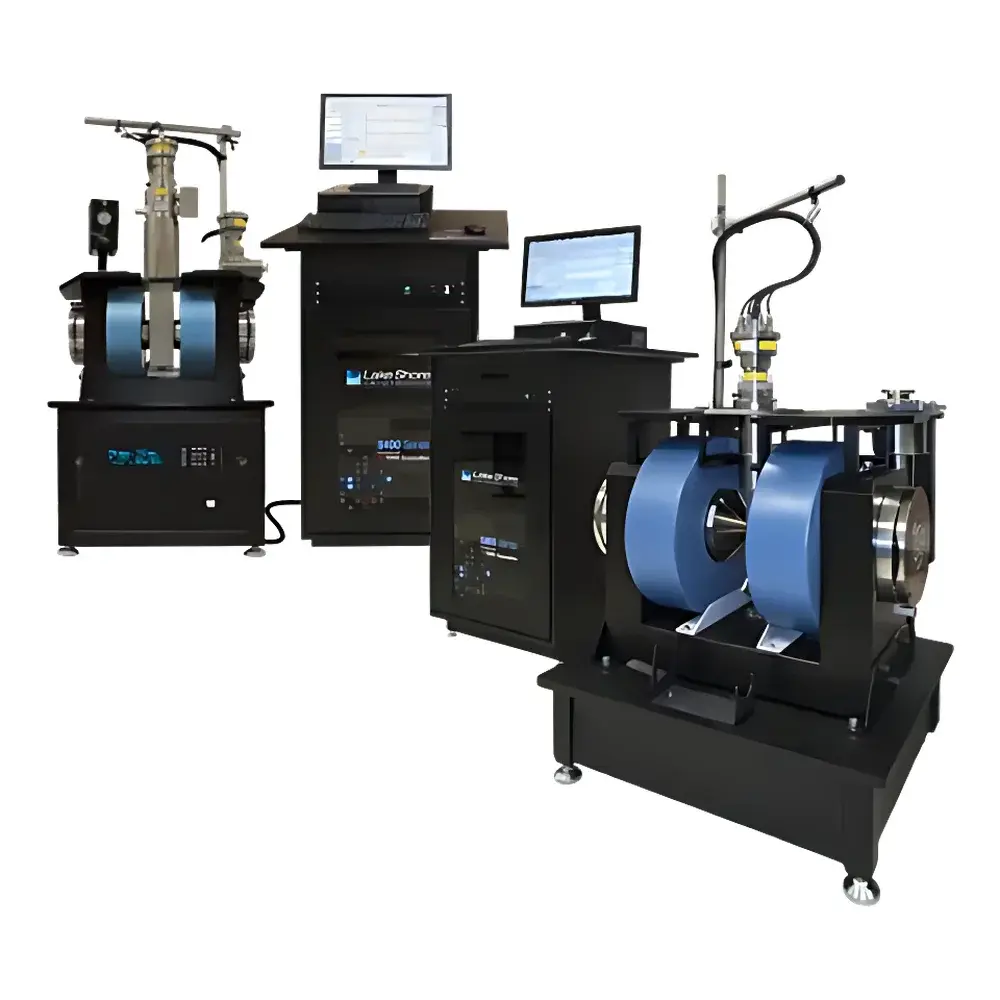
Lake Shore 8400 Series AC/DC Hall Effect Measurement System
| Brand | Lake Shore |
|---|---|
| Origin | USA |
| Model | 8400 Series |
| Magnetic Field Range | Up to 2.23 T (DC), 1.44 T (AC, 50 mm gap) |
| Temperature Range | 10 K–1273 K (with optional cryostats/furnaces) |
| Mobility Range | 1×10⁻³ to 1×10⁶ cm²/V·s (AC/DC) |
| Resistivity Range | 1×10⁻⁵ to 1×10⁵ Ω·cm |
| Standard Resistance Range | 0.5 mΩ–10 MΩ |
| High-Resistance Option | up to 200 GΩ |
| Low-Resistance Option | down to ~0.5 µΩ |
| AC Frequencies | 0.05 Hz and 0.1 Hz |
| Sample Geometry Support | Van der Pauw, Hall bar, 4-point probe |
Overview
The Lake Shore 8400 Series AC/DC Hall Effect Measurement System is a precision-engineered platform for comprehensive carrier transport characterization of semiconductor, thermoelectric, photovoltaic, organic electronic, and novel two-dimensional materials. It implements dual-mode Hall effect metrology—combining high-stability DC magnetic field measurements with low-frequency AC field excitation—to resolve carrier properties across an exceptionally broad mobility spectrum (1×10⁻³ to 1×10⁶ cm²/V·s). Unlike conventional DC-only systems, the AC measurement capability enables accurate determination of Hall coefficient and mobility in low-mobility materials (<1 cm²/V·s), where thermoelectric offsets, contact resistance asymmetry, and thermal drift severely compromise DC-based results. The system operates on the fundamental principles of the Hall effect under controlled Lorentz force conditions, with simultaneous four-point resistivity and Hall voltage acquisition synchronized to magnetic field polarity reversal (DC) or sinusoidal modulation (AC). Its modular architecture supports integration with variable-temperature stages—including closed-cycle cryostats (10 K–400 K), liquid nitrogen inserts (77 K), and high-temperature furnaces (up to 1273 K)—ensuring full thermodynamic mapping of carrier concentration, type, mobility, and scattering mechanisms.
Key Features
- Simultaneous AC and DC Hall measurement modes for extended mobility coverage, including sub-1 cm²/V·s materials such as metal oxides, perovskites, conductive polymers, and chalcogenides
- Configurable magnetic field generation: electromagnet options with 50 mm or 100 mm pole diameters; maximum DC field up to 2.23 T (50 mm poles, 25 mm gap); AC field up to 1.44 T (100 mm poles, 50 mm gap)
- Ultra-low-noise current sourcing and voltage measurement: <5 nV RMS noise floor in low-resistance mode (<0.1 Ω samples); 10 MΩ)
- Multi-range resistance measurement: standard 0.5 mΩ–10 MΩ (±0.075% accuracy); high-resistance option up to 200 GΩ (±5% at 200 GΩ); low-resistance option down to ~0.5 µΩ
- Full Van der Pauw and Hall bar geometry support with automated lead switching and polarity reversal sequences compliant with ASTM F76 and ISO 9277
- Integrated bipolar power supply: ±35 V / ±70 A (2.5 kW) for standard configuration; ±75 V / ±135 A (9.1 kW) for high-field variant
- Modular thermal environment support: 10 K–400 K closed-cycle cryostat (optical or non-optical variants), 77 K liquid nitrogen insert, and 300 K–1273 K high-temperature furnace with ±1% temperature accuracy at 1273 K
Sample Compatibility & Compliance
The 8400 Series accommodates standard sample geometries including 10 mm × 10 mm × 3 mm wafers and optional 50 mm diameter discs. Contact configurations support both lithographically defined Hall bar patterns and manually wired Van der Pauw structures. All electrical measurements adhere to NIST-traceable calibration protocols and satisfy requirements for GLP-compliant laboratories. The system’s data acquisition firmware implements audit-trail logging per FDA 21 CFR Part 11 when operated with Lake Shore’s certified software suite. Measurement uncertainty budgets are documented per ISO/IEC 17025 guidelines, and Hall coefficient determinations align with ASTM F76-22 (Standard Test Method for Measuring Resistivity and Hall Coefficient) and IEC 62025-2 (Semiconductor devices — Hall effect measurement methods). Magnetic field uniformity is characterized over 1 cm³ volumes: ±0.05% (100 mm poles, 25 mm gap) and ±0.15% (100 mm poles, 50 mm gap), ensuring spatial consistency critical for thin-film and heterostructure analysis.
Software & Data Management
Control and analysis are performed via Lake Shore’s proprietary CryoSoft™ software, a Windows-based application supporting real-time parameter monitoring, script-driven experiment sequencing, and automated temperature/magnetic field ramping. Data export conforms to HDF5 and CSV formats, enabling direct ingestion into MATLAB, Python (NumPy/Pandas), or OriginLab environments. The software includes built-in carrier transport models—single-band, multi-band, and two-carrier fitting algorithms—for extracting carrier concentration, effective mass, and scattering time from temperature-dependent Hall and resistivity datasets. All measurement sessions generate timestamped metadata logs containing instrument configuration, environmental conditions, calibration status, and operator ID—supporting full traceability in regulated QA/QC workflows. Optional network licensing enables centralized deployment across multi-user laboratory networks with role-based access control.
Applications
- Characterization of emerging photovoltaic absorbers (e.g., CIGS, perovskites, organic-inorganic hybrids) under operational thermal profiles
- Thermoelectric material optimization via Seebeck-Hall correlation studies across 10–1000 K
- Gate-tunable carrier density mapping in 2D materials (graphene, TMDs) using back-gated van der Pauw devices
- Process development monitoring for semiconductor epitaxy (MBE, MOCVD), including dopant activation efficiency and compensation ratio quantification
- Fundamental charge transport studies in strongly correlated oxides (e.g., VO₂, LaCoO₃) exhibiting metal-insulator transitions
- Quality assurance of transparent conductive oxides (ITO, AZO) used in display and touch panel manufacturing
FAQ
What distinguishes AC-mode Hall measurement from traditional DC-mode operation?
AC-mode employs low-frequency (0.05 Hz or 0.1 Hz) magnetic field modulation to reject thermoelectric offset voltages and contact potential drift, enabling reliable Hall signal extraction in low-mobility, high-resistivity, or thermally unstable samples where DC methods fail.
Can the 8400 Series perform measurements under vacuum or controlled atmosphere?
Yes—the system is compatible with vacuum-compatible cryostats and high-temperature furnaces rated for operation under inert gas (N₂, Ar) or vacuum (10⁻⁶ Torr), subject to appropriate feedthrough and sealing configurations.
Is the system suitable for production-line QA testing?
While optimized for R&D, its automated scripting, calibration traceability, and 21 CFR Part 11–compliant software make it deployable in GMP-regulated environments for incoming material verification and process validation.
How is magnetic field homogeneity verified and maintained?
Field uniformity is factory-characterized using Hall probe mapping over defined volumes and documented in the system certificate; users may revalidate using Lake Shore’s calibrated Hall sensors and included field-mapping utilities.
What level of technical support and calibration services does Lake Shore provide?
Lake Shore offers global field service, annual performance verification, NIST-traceable calibration certificates, and application engineering support—including custom measurement protocol development and data interpretation workshops.




