Lake Shore DT-670 Silicon Diode Temperature Sensor
| Brand | Lake Shore |
|---|---|
| Origin | USA |
| Model | DT-670 |
| Temperature Range | 1.4 K to 500 K |
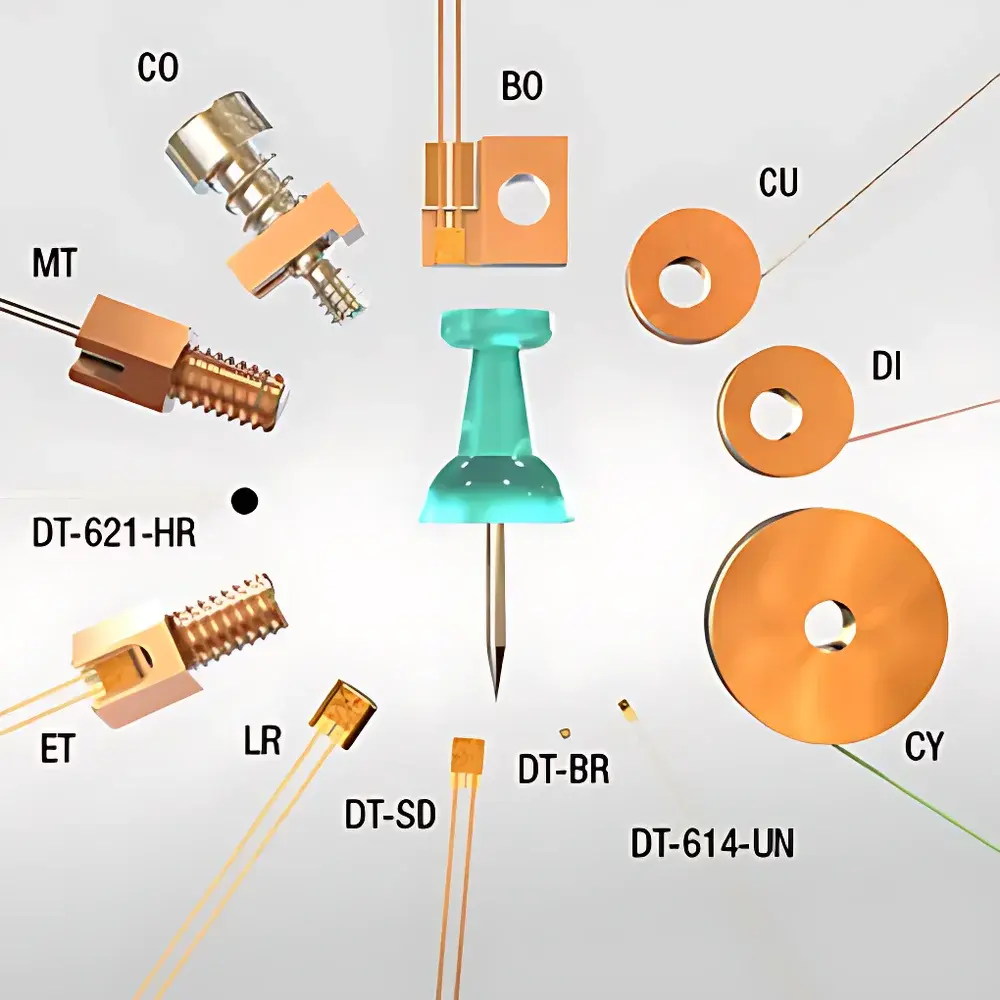
| Packaging Options | SD (hermetically sealed, sapphire-mounted), bare die (DT-670E-BR), non-magnetic (DT-621-HR) |
| Calibration Options | standard curve compliance (DT-670), full-range calibrated (DT-670-SD), low-temperature calibrated down to 1.4 K |
| Tolerance Bands | A, B, C, D (for 1.4–500 K), E (30–300 K), plus B/E bare-die variants |
| Forward Bias Current | 10 µA |
| Output Signal | monotonic voltage drop (0.1–6 V) |
| Mounting Compatibility | indium solderable, UHV-compatible, thermal-cycle robust |
Overview
The Lake Shore DT-670 Silicon Diode Temperature Sensor is a precision cryogenic and ambient-temperature measurement device engineered for high reproducibility and long-term stability in demanding physical science and engineering environments. Based on the well-established principle of p-n junction forward voltage dependence on temperature—measured under a constant 10 µA bias current—the DT-670 delivers a robust, monotonic, and instrument-friendly analog output signal ranging from ~0.1 V at 500 K to ~6 V at 1.4 K. Unlike thermistors or RTDs, silicon diodes offer superior linearity over wide spans and minimal self-heating when operated at microampere-level excitation. The DT-670 series adheres strictly to the standardized Lake Shore DT-670 voltage-vs.-temperature response curve, enabling interchangeability across units without individual calibration for many applications—particularly within the 30 K to 500 K range. For ultra-high-precision requirements—including quantum computing dilution refrigerator stages, superconducting RF filter characterization, and synchrotron beamline cryostats—the fully calibrated DT-670-SD variant provides traceable accuracy across its entire 1.4 K–500 K operating envelope.
Key Features
- Wide operational range: 1.4 K to 500 K, with multiple tolerance bands (A–D for general cryogenics; E for enhanced 30–300 K accuracy)
- SD package: hermetically sealed construction featuring a sapphire substrate, Kovar leads, and gold-tin eutectic bonding—engineered for mechanical durability, thermal-cycle resilience (>1000 cycles between 4 K and 300 K), and compatibility with ultra-high vacuum (UHV) systems
- Bare-die option (DT-670E-BR): smallest available footprint in the Lake Shore silicon diode family, enabling sub-millisecond thermal response times—ideal for focal-plane array thermal monitoring and high-speed transient cryogenic diagnostics
- Non-magnetic variant (DT-621-HR): optimized for magnetic resonance, SQUID magnetometry, and other low-field applications where ferromagnetic contamination must be eliminated
- Indium-solderable base: permits direct thermal anchoring to samples or cold stages without calibration drift—validated per ASTM E220 and IEC 60751 traceability protocols
- Low power dissipation: <1 µW at 10 µA bias, minimizing sensor self-heating and ensuring measurement fidelity in thermally isolated systems
Sample Compatibility & Compliance
The DT-670 is compatible with diverse cryogenic platforms including closed-cycle refrigerators, liquid helium cryostats, adiabatic demagnetization refrigerators (ADRs), and optical cryo-coolers. Its SD packaging meets ISO 9001-certified manufacturing standards and conforms to NASA-STD-8739.3 for electronic component cleanliness in space-qualified instrumentation. For regulated laboratory environments, the DT-670 supports GLP/GMP-compliant data acquisition when integrated with Lake Shore’s Crossbow software suite, which maintains full audit trails per FDA 21 CFR Part 11 requirements. Traceable calibration certificates (NIST-traceable reference standards) are available upon request for DT-670-SD units, covering the full 1.4 K–500 K range with uncertainty budgets compliant with ISO/IEC 17025.
Software & Data Management
Lake Shore’s proprietary Crossbow™ software provides native support for DT-670 sensors via USB- or Ethernet-connected temperature monitors (e.g., Model 372 AC Resistance Bridge, Model 336 Temperature Controller). Real-time voltage-to-temperature conversion uses the embedded DT-670 polynomial coefficients (6th-order, NIST-validated), with optional user-defined curve loading for custom calibrations. Data logging includes timestamped readings, statistical summaries (min/max/mean/std dev), and export to CSV, HDF5, or MATLAB .mat formats. All configurations and calibration history are stored in encrypted metadata fields, satisfying electronic record integrity requirements under 21 CFR Part 11. Remote monitoring and alarm thresholds can be configured via RESTful API endpoints for integration into LabVIEW, Python (PyVISA), or enterprise SCADA systems.
Applications
- Cryogenic instrumentation in quantum information science: qubit chip stage monitoring, dilution refrigerator mixing chamber thermometry
- Materials science: specific heat and thermal conductivity measurements requiring stable, low-drift reference sensors
- Photonics & RF engineering: thermal management of HTS filters, Josephson junction arrays, and infrared detector arrays
- Accelerator physics: beamline cryomodule temperature profiling under high-radiation conditions
- Standards laboratories: secondary reference thermometry in ITS-90 realization experiments below 20 K
- Industrial process control: semiconductor wafer chill plates, superconducting magnet quench detection loops
FAQ
What is the difference between DT-670-SD and DT-670E-BR?
The DT-670-SD is the hermetically sealed, sapphire-mounted version optimized for mechanical robustness and long-term stability; the DT-670E-BR is an unencapsulated bare die designed for minimal thermal mass and fastest possible response—suitable only for controlled mounting environments.
Can the DT-670 be used in ultra-high vacuum (UHV) systems?
Yes—the SD package is UHV-compatible (<1×10⁻¹⁰ Torr outgassing rate per ASTM E595) and features welded Kovar leads and glass-sealed feedthroughs.
Is calibration required for operation between 20 K and 500 K?
No—units conforming to the standard DT-670 curve require no individual calibration in this range. Below 20 K, calibration is recommended; DT-670-SD units include full-range calibration data down to 1.4 K.
How does self-heating affect measurement accuracy?
At 10 µA bias, self-heating is <10 nK in typical copper-mount configurations. The SD package’s thermal shunt design further reduces conductive heating from leads, preserving measurement fidelity even at 500 K.
Are there non-magnetic alternatives for use near SQUIDs or MRI magnets?
Yes—the DT-621-HR variant replaces Kovar leads with pure nickel-copper alloy and omits magnetic materials in both substrate and encapsulation, meeting ASTM A342 Class 1 permeability specifications.