
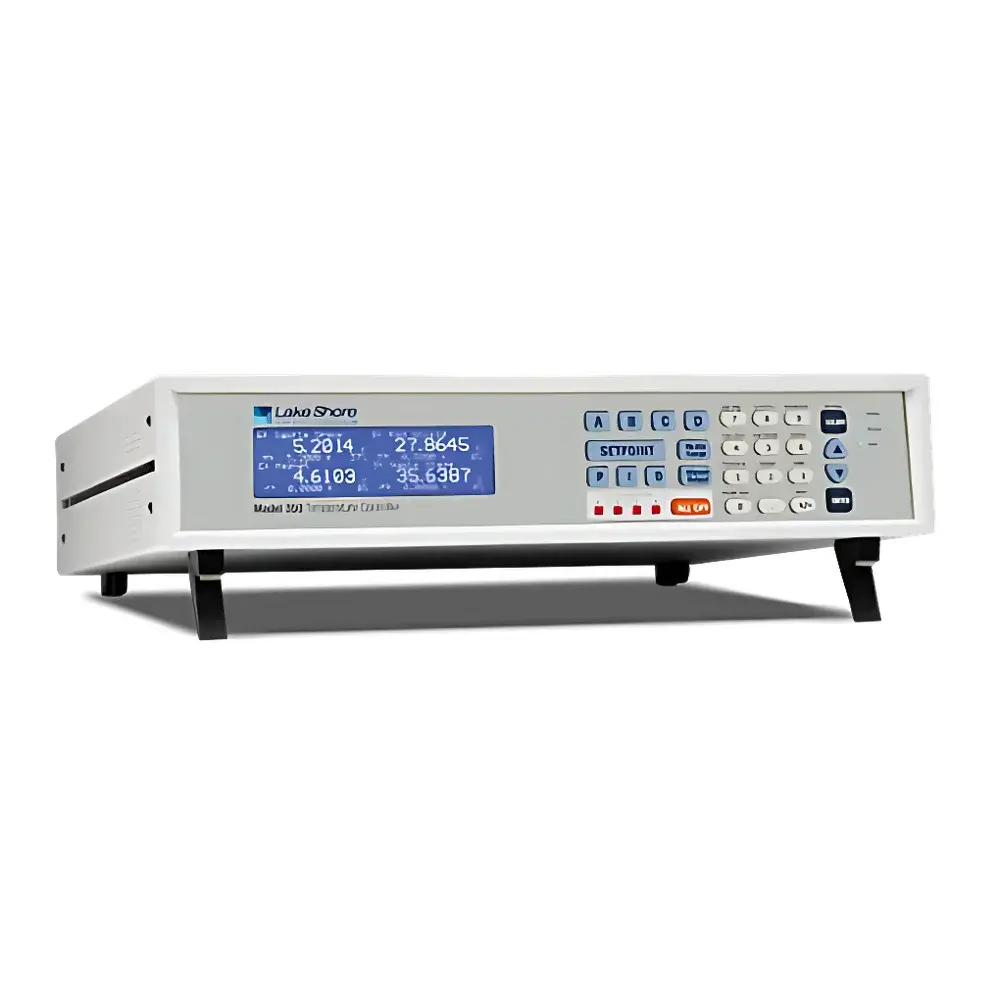
Lake Shore Model 350 Temperature Controller
| Brand | Lake Shore |
|---|---|
| Origin | USA |
| Model | 350 |
| Input Channels | 4 (expandable to 8 with Scan Option) |
| Sensor Compatibility | Cernox®, Rox™, DT-470, DT-670, PT-100/1000, carbon-glass, germanium, silicon diodes, thermocouples (with option cards), capacitive sensors |
| Measurement Range | 10 mK to 1000 K (sensor-dependent) |
| Excitation Current | As low as 10 nA for Cernox® |
| Noise Performance | Ultra-low-noise input circuitry optimized for ≤100 mK operation |
| Control Outputs | 4 independent PID-controlled outputs — Output 1: 75 W (25 Ω load), Output 2: 1 W (100 Ω load), Outputs 3 & 4: ±10 V analog (1 W max, 100 mA) |
| PID Auto-tuning | Per-loop, real-time adjustment |
| Current Reversal | Eliminates thermoelectric offset in resistive sensors |
| Compliance | CE certified |
| Interface | RS-232, USB, Ethernet (LXI-compliant) |
| Display | 240 × 64 pixel graphical LCD (8 × 40 characters), LED backlit |
| Data Logging | Local buffer + remote streaming at up to 10 Hz per active channel |
Overview
The Lake Shore Model 350 Temperature Controller is an engineered precision instrument designed explicitly for ultra-low temperature (ULT) environments—particularly those operating down to 100 mK—such as 3He cryostats, dilution refrigerators, and adiabatic demagnetization refrigerators (ADRs). Its architecture centers on high-fidelity, low-noise resistance thermometry, leveraging proprietary input circuitry that enables excitation currents as low as 10 nA. This capability is critical when interfacing with high-sensitivity, low-thermal-mass sensors such as Lake Shore’s Cernox® thin-film resistive thermometers, where self-heating must be minimized to preserve measurement integrity below 1 K. The Model 350 implements digital PID control with real-time auto-tuning, current reversal for thermoelectric error compensation, and full support for industry-standard calibration curves—including DT-470, DT-670, PT-100, and custom user-defined 200-point tables. It meets CE regulatory requirements and is built to maintain stability and repeatability under continuous operation in magnetically shielded, vibration-isolated, and vacuum-integrated cryogenic systems.
Key Features
- Ultra-low-noise 24-bit analog-to-digital conversion optimized for sub-kelvin sensor signals, enabling resolution better than 10 µK (dependent on sensor noise floor and thermal anchoring)
- Four independently configurable input channels—supporting resistive (4-wire differential), diode, thermocouple (with optional 3060 card), and capacitive (with optional 3061 card) sensors—expandable to eight inputs using the 3062 scan option
- Dual heating outputs: Output 1 delivers up to 75 W into a 25 Ω load (suitable for primary stage heaters); Output 2 provides 1 W into 100 Ω (optimized for sample-stage or secondary thermal regulation)
- Analog outputs 3 and 4 function as programmable ±10 V PID-controlled sources or monitoring channels, supporting external actuators, magnetic field supplies, or lock-in reference synchronization
- Current reversal mode eliminates thermoelectric EMF errors inherent in platinum, carbon-glass, and Cernox® sensors—essential for achieving <±10 mK accuracy below 4 K
- Onboard SoftCal™ correction improves DT-470 accuracy to ±0.25 K between 30 K and 375 K; extends similar calibration enhancements to platinum RTDs across 70–325 K
- Front-panel graphical LCD with adjustable contrast, keyboard lock, and real-time display of setpoint, measured temperature, heater output (%), and PID parameters
Sample Compatibility & Compliance
The Model 350 accommodates a broad spectrum of cryogenic sensors without hardware modification—provided appropriate option cards are installed. Its input isolation architecture ensures galvanic separation between sensor inputs and chassis ground, reducing ground-loop interference in multi-instrument setups. Sensor types include Cernox® (10 mK–475 K), Rox™ silicon diodes (1.4–475 K), DT-470/670 (1.4–475 K), and standard platinum RTDs (70–325 K). For thermocouple-based measurements, the optional 3060 card supports E-, K-, T-, and AuFe vs. Cr types with cold-junction compensation. All firmware and communication protocols comply with IEEE 488.2 and LXI Class C specifications. While not FDA-certified per se, the Model 350 supports audit-trail-capable remote logging via Ethernet or RS-232—enabling traceability required under GLP and GMP frameworks when integrated into regulated research or materials qualification workflows.
Software & Data Management
Lake Shore provides the free, cross-platform CryoSoft™ application for configuration, real-time monitoring, scripting, and data export (CSV, MATLAB .mat). The Model 350 supports SCPI command syntax over all interfaces, allowing seamless integration into LabVIEW, Python (PyVISA), or MATLAB automation suites. Internal memory buffers store up to 16,000 timestamped readings per channel; data can be streamed continuously at 10 Hz per active input (or 5 Hz when current reversal is enabled). Firmware updates are performed via USB or Ethernet, preserving all user calibration curves and system settings. Remote access supports simultaneous connections from multiple clients, with role-based read/write permissions configurable via IP whitelisting—critical for shared-facility environments such as university quantum labs or national nanotechnology centers.
Applications
- Stabilized temperature control of quantum computing qubit platforms (3He and dilution refrigerator stages)
- In situ calibration and feedback regulation for scanning tunneling microscopy (STM) and atomic force microscopy (AFM) cryostats
- Thermal management of superconducting detectors (TES, MKIDs) requiring sub-millikelvin stability
- Materials characterization under extreme cryogenic conditions—e.g., Hall effect, magnetotransport, and specific heat measurements
- Long-duration physics experiments demanding >99.9% uptime and drift <50 µK/hour over 72-hour intervals
- Integration into automated test systems for semiconductor cryo-probers and wafer-level reliability testing
FAQ
What sensor types does the Model 350 support natively without add-on cards?
It natively supports 4-wire resistive sensors (Cernox®, DT-series, Pt100/Pt1000, germanium, carbon-glass), silicon diodes (GaAlAs, Si), and capacitive sensors—all via standard 6-pin DIN or screw-terminal inputs.
Can the Model 350 control more than one temperature zone simultaneously?
Yes—it features 10 programmable PID zones per control loop, each with independent P/I/D coefficients, ramp rates (0.001–100 K/min), and heater output limits—enabling coordinated multi-stage thermal profiling.
Is current reversal available on all resistive input channels?
Yes, current reversal is implemented per-channel and applies to all supported resistive sensor types, including Cernox®, platinum, and carbon-glass thermometers.
Does the Model 350 support 21 CFR Part 11 compliance for pharmaceutical or clinical research?
While the hardware itself is not Part 11-certified, its Ethernet interface enables integration with validated third-party data acquisition software that provides electronic signatures, audit trails, and user access controls meeting FDA requirements.
How is sensor calibration managed across multiple instruments in a shared cryogenic facility?
Each Model 350 stores up to 39 user-defined 200-point calibration curves locally. Calibration files can be exported/imported via USB or network, ensuring consistent temperature reporting across distributed systems without reliance on centralized servers.





