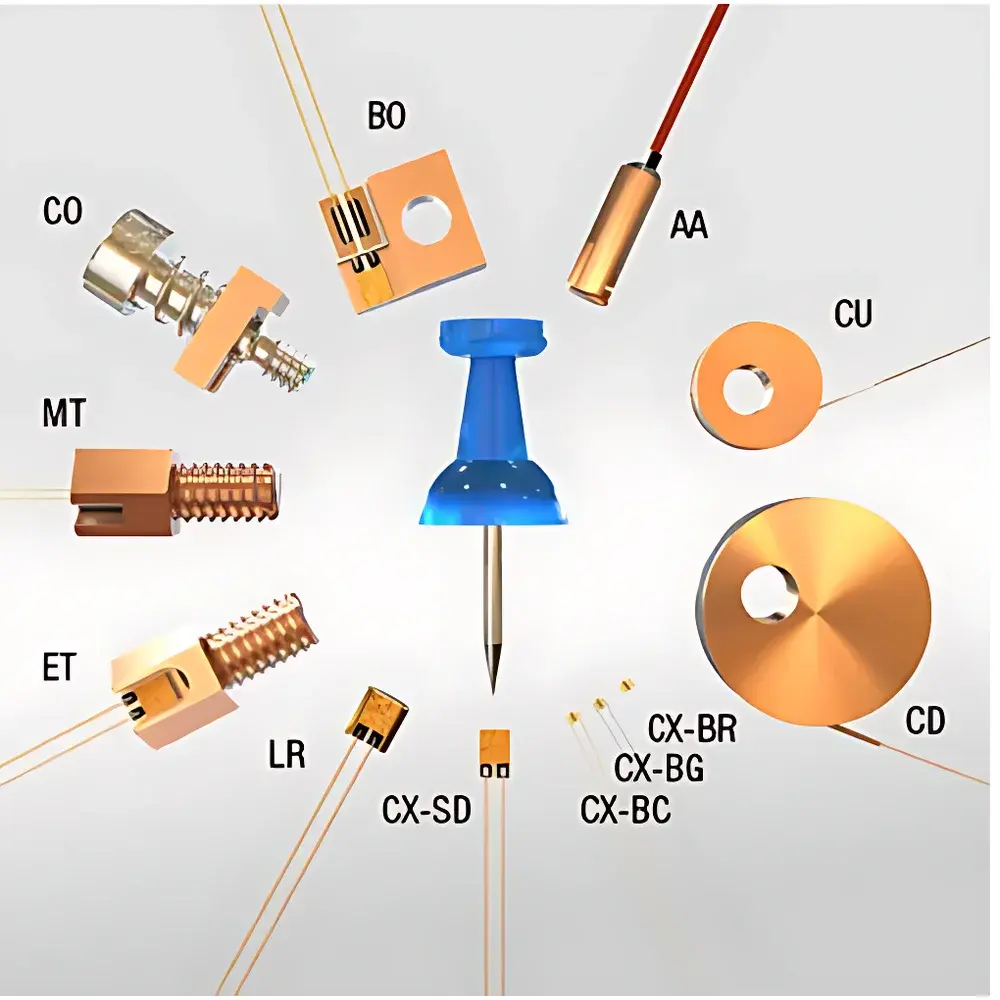
Lake Shore Cernox® Thin-Film Cryogenic Temperature Sensors
| Brand | Lake Shore |
|---|---|
| Origin | USA |
| Model | Cernox® |
| Temperature Range | 0.1 K to 420 K |
| Magnetic Field Error | Negligible above 30 K |
| Radiation Hardness | High |
| Thermal Response Time | As low as 1.5 ms @ 4.2 K (BC/BR/BG) |
| Encapsulation Options | SD (hermetic, sapphire-based), AA, BC, BG, BR, CD, ET, LR, MT, CO, CU, HT variants |
| Excitation Recommendation | 20 µV (0.1–0.5 K), 63 µV (0.5–1 K), ≤10 mV above 1.2 K |
| Power Dissipation | ~10⁻⁵ W @ 300 K, ~10⁻⁷ W @ 4.2 K, ~10⁻¹³ W @ 0.3 K |
| Long-Term Stability | ±3 mK @ 4.2 K |
| Compliance | Suitable for UHV, GLP/GMP-adjacent cryogenic metrology, ASTM E220, ISO/IEC 17025 traceable calibration workflows |
Overview
Lake Shore Cernox® thin-film resistance temperature detectors (RTDs) are precision cryogenic sensors engineered for high-fidelity thermal metrology across extreme low-temperature environments—from 100 mK to 420 K. Unlike bulk or thick-film thermistors, Cernox® sensors utilize a proprietary metal-oxide thin-film deposition process on thermally optimized substrates, delivering exceptional sensitivity, reproducibility, and stability under demanding physical conditions. Their operation relies on the predictable, monotonic, and highly repeatable resistive response of the Cernox® film to temperature changes—enabling accurate interpolation and extrapolation within calibrated ranges. Designed explicitly for integration into ultra-low-vibration, ultra-high-vacuum (UHV), and high-magnetic-field experimental platforms—including dilution refrigerators, superconducting magnet systems, and space-simulation chambers—Cernox® sensors meet the stringent requirements of quantum computing R&D, condensed matter physics, and advanced materials characterization.
Key Features
- Ultra-Wide Operating Range: Validated performance from 0.1 K to 420 K; Cernox® HT variants extend upper limits to 420 K with sustained accuracy and drift control.
- Minimal Magnetic Field Dependence: Magnetoresistance remains negligible (>30 K) and orientation-independent—critical for measurements inside superconducting magnets (up to 20 T) and hybrid quantum devices.
- Radiation-Hardened Construction: Proven resilience to cumulative ionizing radiation doses exceeding 10⁶ rad(Si), supporting long-term deployment in nuclear instrumentation, space-borne cryocoolers, and accelerator facility diagnostics.
- Sub-Millisecond Thermal Response: Bare-die configurations achieve 1.5 ms time constant at 4.2 K; SD-packaged units maintain <15 ms response—enabling dynamic thermal profiling during fast cooldown or pulsed heating experiments.
- Hermetic Sapphire-Based SD Packaging: Industry-leading SD encapsulation bonds the sensor die directly to a single-crystal sapphire base via laser welding, ensuring vacuum integrity (<1×10⁻¹⁰ mbar·L/s He leak rate), mechanical robustness, and optimal thermal anchoring without calibration shift upon indium soldering.
- Modular Calibration Architecture: Each unit is individually calibrated against NIST-traceable standards; calibration files include full R(T) polynomial coefficients, uncertainty budgets, and temperature-dependent sensitivity (dR/dT) data—compatible with Lake Shore’s CrossTalk™ software and third-party LabVIEW/Python acquisition frameworks.
Sample Compatibility & Compliance
Cernox® sensors are compatible with diverse sample mounting geometries—including direct die bonding, epoxy attachment, spring-loaded clamping, and indium soldering onto copper, aluminum, silicon, or sapphire substrates. The SD package is fully UHV-compatible (outgassing rate <1×10⁻¹² Torr·L/s·cm² per ASTM E595), while AA and BC variants support cryostat feedthrough integration and printed circuit board (PCB) surface-mount assembly. All models conform to material compatibility requirements for ISO 14644 cleanroom environments and satisfy mechanical shock/vibration specifications per MIL-STD-810G. For regulated applications—including FDA-regulated cryobiological storage monitoring or DOE-funded quantum testbeds—Cernox® calibration records support 21 CFR Part 11 audit trails when used with compliant data acquisition systems.
Software & Data Management
Lake Shore’s CryoSoft™ and CrossTalk™ software suites provide native support for Cernox® sensor configuration, real-time resistance-to-temperature conversion using user-loaded calibration files, and automated drift compensation algorithms. Raw resistance values are logged with timestamped metadata (excitation voltage, current, lead resistance compensation mode), enabling post-hoc recalibration and uncertainty propagation analysis. Export formats include CSV, HDF5, and TDMS—ensuring interoperability with MATLAB, Python (SciPy/Pint), and commercial SCADA platforms. Calibration certificates comply with ISO/IEC 17025:2017 requirements and include expanded uncertainties (k=2) across the full operational range, referenced to ITS-90.
Applications
- Quantum device thermal management in dilution refrigerator stages (mK–4 K)
- Thermal mapping of superconducting qubit chips and Josephson junction arrays
- In-situ temperature monitoring during low-temperature XRD, neutron scattering, and ARPES experiments
- Calibration reference for secondary thermometers in national metrology institutes
- Long-duration thermal stability validation in space-qualified cryocoolers (e.g., for JWST instrument subsystems)
- Real-time feedback control in magnetic field sweep experiments requiring simultaneous B- and T-stabilization
FAQ
Is individual calibration required for each Cernox® sensor?
Yes. Due to inherent thin-film process variation, every Cernox® unit is factory-calibrated over its specified range and shipped with a unique NIST-traceable certificate containing R(T) coefficients and uncertainty data.
Can Cernox® sensors be used in high-vacuum or ultra-high-vacuum environments?
Yes. The SD package is hermetically sealed and certified for UHV service; other packages (e.g., BC, AA) are suitable for HV/UHV when properly baked and outgassed per system protocols.
What excitation level should I use to minimize self-heating error?
Use 20 µV below 0.5 K, 63 µV between 0.5–1 K, and ≤10 mV above 1.2 K. Power dissipation remains below 10⁻¹³ W at 0.3 K—critical for minimizing thermal perturbation in nanoscale samples.
How does Cernox® compare to germanium RTDs?
Cernox® offers broader range (0.1–420 K vs. Ge’s typical 0.3–100 K), superior stability (<±3 mK drift @ 4.2 K over 12 months), faster response, and negligible magnetic field dependence—making it the preferred choice for modern quantum infrastructure.
Are custom calibration ranges available?
Yes. Lake Shore offers application-specific calibrations—including sub-100 mK extensions, narrow-range high-resolution curves (e.g., 1.4–4.2 K), and multi-point irradiation-stability validation reports—upon request.