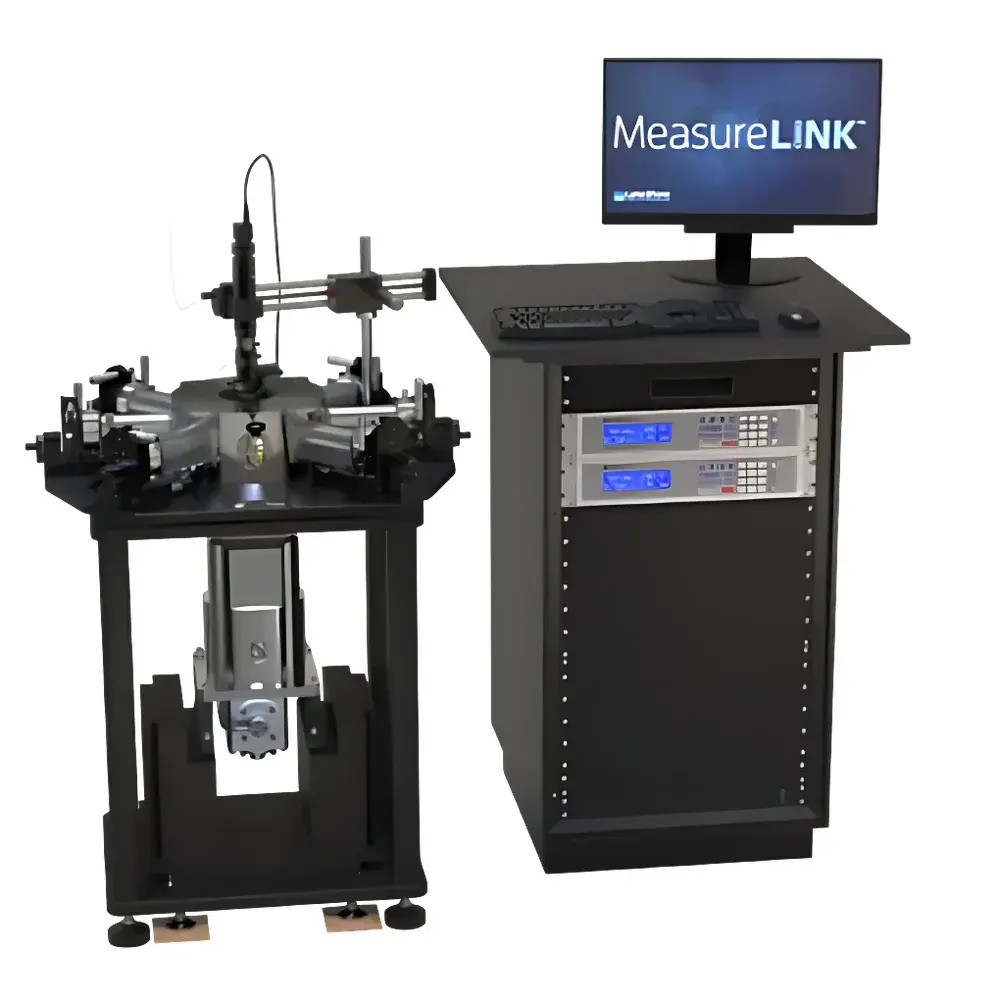
Lake Shore CRX-4K Helium-Free Cryogenic Probe Station
| Brand | Lake Shore |
|---|---|
| Origin | USA |
| Model | CRX-4K |
| Temperature Range | 4.5 K to 350 K (optional up to 675 K) |
| Base Temperature | 4.5 K (2-probe configuration) |
| Vacuum Base Pressure | <1×10⁻⁵ Torr |
| Pumping System | TPS-FRG turbomolecular pump set |
| Sample Diameter | Standard 51 mm (2"), optional 102 mm (4") |
| Max Probe Count | 6 |
| DC/RF Probe Insulation | >100 GΩ |
| Microwave Frequency Range | DC to 67 GHz |
| Fiber-Optic Integration | Supported |
| Vibration Level | <1 µm |
| Landing Area | 25.4 mm diameter circle |
Overview
The Lake Shore CRX-4K is a high-precision, helium-free cryogenic probe station engineered for low-temperature electrical, optical, and magneto-transport characterization of semiconductor devices, quantum materials, and nanoscale electronic structures. Unlike traditional liquid-helium-dependent systems, the CRX-4K employs a two-stage closed-cycle cryocooler to achieve stable base temperatures as low as 4.5 K without cryogen refills—enabling unattended operation, reduced operational overhead, and improved experimental reproducibility. Its thermally decoupled dual-stage cooling architecture allows the sample stage to be cooled independently while maintaining the upper stage at an elevated temperature (~50–80 K), significantly suppressing condensation of residual water vapor or hydrocarbons on sensitive organic or 2D material samples. This design is particularly critical for in-situ measurements of field-effect transistors, perovskite photodetectors, superconducting qubits, and molecular electronics where surface contamination directly impacts carrier mobility and interfacial charge transfer.
Key Features
- Helium-free operation with two-stage closed-cycle refrigeration, eliminating dependency on liquid cryogens and associated infrastructure.
- Wide temperature range: 4.5 K to 350 K standard; extended capability to 675 K with optional PS-HTSTAGE (note: incompatible with backside biasing).
- Precise thermal control with multi-zone monitoring: integrated calibrated diode sensors on sample stage, probe arms, and radiation shields ensure traceable, repeatable temperature assignment.
- Ultra-high vacuum (UHV)-compatible chamber with base pressure <1×10⁻⁵ Torr, achieved using a TPS-FRG turbomolecular pump set; typical pump-down time to <1×10⁻³ Torr is ≤30 minutes.
- Modular probe arm configuration: supports up to six fully independent, motorized or manual probe arms—each equipped with temperature-monitoring diodes and thermally anchored to appropriate heat sinks (sample stage or radiation shield).
- DC/RF probe insulation exceeding 100 GΩ enables ultra-low leakage current measurements (<1 fA) essential for gate dielectric integrity testing and subthreshold MOSFET analysis.
- 67 GHz microwave-compatible probe interface with precision coaxial routing and impedance-matched feedthroughs for on-wafer S-parameter extraction.
- Fiber-optic feedthroughs available for integrated electro-optical characterization, including photoluminescence excitation (PLE), cathodoluminescence, and time-resolved spectroscopy under cryogenic conditions.
Sample Compatibility & Compliance
The CRX-4K accommodates wafers up to 102 mm (4-inch) in diameter, with a standard 51 mm (2-inch) measurement zone optimized for device-level probing. The sample stage features kinematic mounting, flatness tolerance <1 µm, and lateral vibration <1 µm RMS—critical for high-resolution nanoprobing and atomic force microscopy (AFM) integration. All internal surfaces are electropolished stainless steel, and the system conforms to ASTM F2627-20 (Standard Guide for Vacuum Systems Used in Semiconductor Manufacturing) for cleanliness and outgassing performance. Vacuum integrity and thermal stability meet requirements for GLP-compliant data acquisition, and optional audit-trail-enabled software modules support 21 CFR Part 11 compliance for regulated R&D environments.
Software & Data Management
Lake Shore’s BlueBox™ control software provides unified instrument orchestration—including temperature ramping, vacuum sequencing, probe positioning, and synchronized data logging from external sources (e.g., SMUs, VNAs, laser drivers). Real-time PID tuning, multi-sensor averaging, and programmable hold profiles enable complex thermal protocols such as thermal cycling stress tests or phase-transition mapping. Export formats include CSV, HDF5, and MATLAB-compatible binaries. Optional LabVIEW and Python APIs allow integration into automated test sequences compliant with IEEE 1620-2019 (Standard for Semiconductor Test Automation).
Applications
- Low-temperature IV/CV characterization of GaN HEMTs, SiC MOSFETs, and GaAs pHEMTs.
- Magneto-transport studies (Hall effect, Shubnikov–de Haas oscillations) under applied magnetic fields up to 0.19 T (with optional annular magnet).
- Quantum device validation: coherence time measurement of superconducting qubits, single-electron transistor (SET) operation, and Majorana nanowire transport.
- Organic semiconductor physics: charge carrier freeze-out analysis, trap-state spectroscopy, and exciton dissociation dynamics in OPVs and OLEDs.
- 2D material metrology: layer-resolved conductivity mapping of graphene, MoS₂, and WSe₂ heterostructures via four-point probe and gated transport.
- Reliability testing: temperature-accelerated life testing (TALT) and bias-temperature instability (BTI) evaluation under cryogenic bias conditions.
FAQ
What is the lowest base temperature achievable with six probe arms installed?
With six probe arms mounted and thermally anchored, the base temperature is 6.0 K, with active temperature control ranging from 6.5 K to 350 K.
Is backside electrical biasing supported when using the high-temperature stage (PS-HTSTAGE)?
No—PS-HTSTAGE installation precludes backside biasing due to mechanical and thermal interface constraints.
Can the system be configured for in-situ optical access during low-temperature operation?
Yes—standard optical viewports (UV-VIS-NIR broadband transmission) and optional fiber-optic couplers support confocal microscopy, photoluminescence, and Raman spectroscopy down to 4.5 K.
What vacuum pumping time is required to reach operating pressure before cooldown?
The system achieves <1×10⁻³ Torr in ≤30 minutes; full UHV conditions (<1×10⁻⁵ Torr) are reached within 1–2 hours depending on chamber history and bakeout status.
How is thermal drift minimized during long-duration DC measurements?
Thermal stability is maintained via multi-sensor feedback, active radiation shielding, and probe arm thermal anchoring—resulting in ±10 mK stability over 1-hour intervals between 10 K and 100 K.