
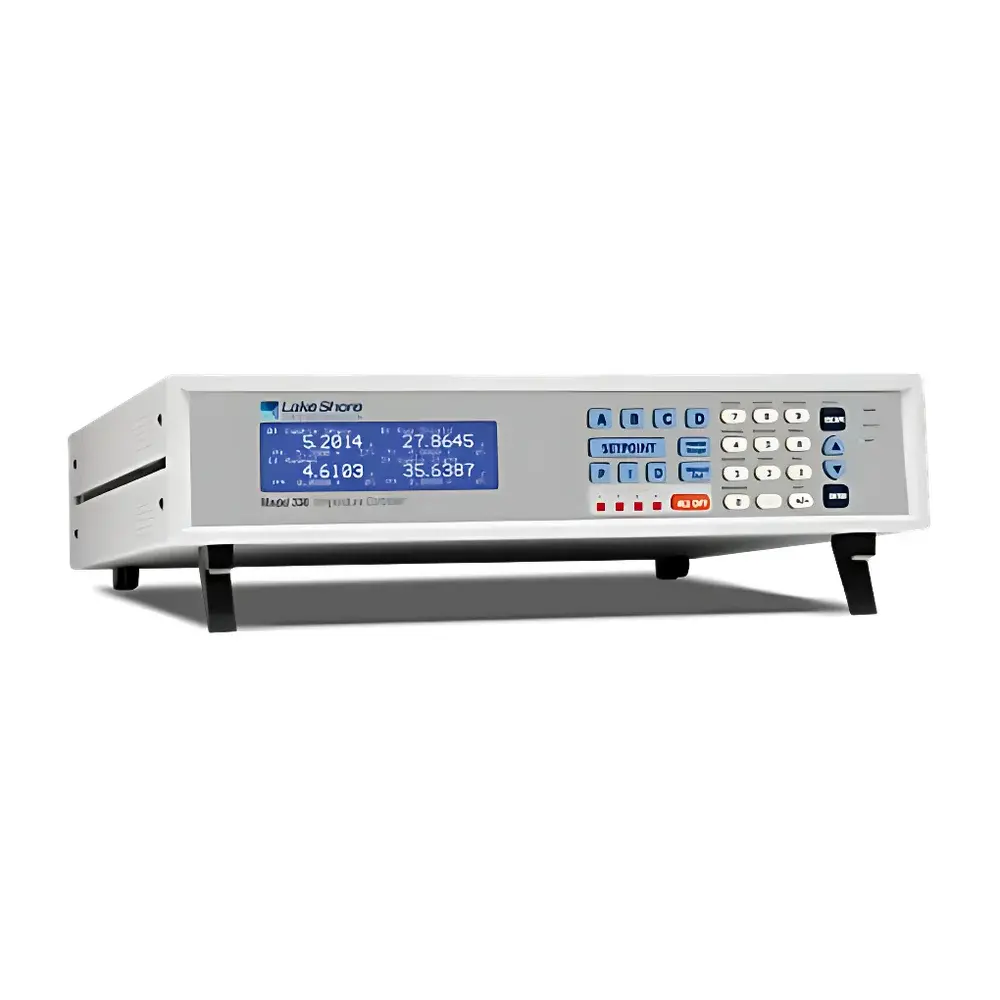
Lake Shore Model 336 Temperature Controller
| Brand | Lake Shore |
|---|---|
| Origin | USA |
| Model | 336 |
| Sensor Inputs | 4 (expandable to 8 with Scan Option) |
| Control Outputs | 4 (2 high-power, 2 low-power) |
| Max Heating Power | 150 W (100 W + 50 W) |
| Temperature Range | 0.3 K to 1505 K |
| PID Control | Digital, Auto-Tuning & Zone-Based |
| Supported Sensors | Diodes, RTDs (Pt100, Pt1000, Carbon-Glass, Cernox®, Rox™), Thermocouples (DT-470, DT-670, E, K, T, AuFe/Cr), Capacitance (with option card) |
| Interface | Ethernet, USB, IEEE-488 (GPIB) |
| Analog Output | ±10 V, 16-bit, 0.3 mV RMS noise |
| Display | 240 × 64 pixel graphical LCD |
| Compliance | GLP/GMP-ready architecture, supports audit trail via software logging |
Overview
The Lake Shore Model 336 Temperature Controller is a high-precision, multi-channel cryogenic and high-temperature control system engineered for demanding laboratory and industrial applications requiring stable, traceable, and reproducible thermal management across an exceptionally wide operational range—from 300 mK to 1505 K. Built upon a digitally implemented proportional-integral-derivative (PID) control architecture with real-time auto-tuning and zone-based sensor switching, the Model 336 delivers closed-loop temperature regulation optimized for ultra-low-noise environments typical of quantum device characterization, superconducting magnet testing, dilution refrigerator integration, and materials science research. Its four isolated sensor inputs support simultaneous connection of heterogeneous temperature transducers—including silicon/GaAlAs diodes, platinum RTDs (100 Ω/1000 Ω), doped germanium, Cernox® and Rox™ sensors, and multiple thermocouple types—enabling seamless transition between cryogenic and high-temperature regimes without manual reconfiguration. The controller’s dual high-power heating outputs (100 W and 50 W, each configurable for 25 Ω or 50 Ω loads) and two auxiliary low-power outputs provide flexible thermal actuation strategies, while its 24-bit analog-to-digital conversion and current-reversal excitation eliminate thermoelectric offset errors in resistive sensor measurements.
Key Features
- Four independently configurable sensor inputs supporting diodes, RTDs, thermocouples, and capacitance sensors (with optional cards: 3060 for thermocouples, 3061 for capacitance, 3062 for 8-channel scanning)
- Dual high-power heater outputs: 100 W (2 A @ 50 V, 25 Ω load) and 50 W (1.41 A @ 35.4 V, 25 Ω load), both featuring 16-bit DAC resolution and <0.12 µA RMS current noise
- Two additional PID-controlled outputs supporting manual, ramp, monitor, or zone-based operation with full parameter independence per channel
- Zone-based auto-switching across 10 user-defined temperature regions—each with unique PID gains, heater scaling, ramp rates (0.1–100 K/min), and active sensor mapping—ensuring continuous, gap-free control from millikelvin to >1500 K
- SoftCal™ calibration enhancement for DT470 diodes (±0.25 K accuracy from 30–375 K) and platinum RTDs (±0.25 K from 70–325 K), stored as user-defined 200-point curves (up to 39 curves)
- Current-reversal excitation on resistive inputs to nullify thermal EMF-induced measurement drift
- Real-time digital PID auto-tuning (per loop), adjustable P/I/D parameters (P: 0–1000, I: 1–1000 s⁻¹, D: 0–200%), and programmable ramp profiles
- Front-panel graphical LCD (240 × 64 pixels) with customizable channel labeling, dual-unit display (K/°C/V/Ω), and real-time visualization of setpoint, output %, and PID status
Sample Compatibility & Compliance
The Model 336 is designed for integration into regulated scientific workflows compliant with Good Laboratory Practice (GLP) and Good Manufacturing Practice (GMP) frameworks. While the instrument itself does not carry FDA 21 CFR Part 11 certification out-of-the-box, its deterministic control logic, non-volatile parameter storage, timestamped analog output logging (via external DAQ), and deterministic Ethernet/USB/GPIB command-response behavior enable validation under ISO/IEC 17025 and ASTM E2877-22 (Standard Guide for Thermal Stability Testing). Sensor compatibility spans industry-standard cryogenic references (e.g., DT-470, DT-670 per ASTM E1137/E1137M), high-temperature platinum RTDs (IEC 60751), and thermocouple types conforming to NIST ITS-90 and ASTM E230. Input isolation meets IEC 61010-1 safety requirements for measurement circuits interfacing with cryostats and vacuum systems. All firmware updates are version-controlled and documented in Lake Shore’s publicly available release notes.
Software & Data Management
The Model 336 operates natively via SCPI-compliant ASCII commands over Ethernet (TCP/IP), USB (virtual COM port), or IEEE-488, enabling seamless integration with LabVIEW, Python (PyVISA), MATLAB, and custom C/C++ applications. Lake Shore’s free CrossLink™ software provides GUI-based configuration, real-time trending, script-driven ramp sequences, and CSV export of time-stamped sensor readings and heater outputs. For audit-trail compliance, third-party data acquisition systems can log all SCPI transactions—including parameter changes, setpoint modifications, and alarm events—with system-level timestamps. The ±10 V analog output (16-bit, ±2.5 mV absolute accuracy) supports secondary control loops or integration with PLCs and SCADA systems. Firmware updates are delivered via signed binary packages with SHA-256 checksum verification, ensuring integrity in validated environments.
Applications
- Cryogenic characterization of superconductors, topological insulators, and 2D materials in dilution refrigerators and adiabatic demagnetization systems
- Thermal stabilization of optical cavities, atomic clocks, and quantum memory platforms requiring sub-millikelvin stability
- High-temperature annealing and phase-transition studies of ceramics, alloys, and battery cathode materials up to 1500 K
- Multi-zone thermal profiling in semiconductor wafer probing stations and MEMS reliability test chambers
- Calibration laboratory reference-grade temperature control for sensor intercomparison against NIST-traceable standards
- Automated material property mapping (e.g., resistivity, Hall effect, specific heat) requiring synchronized temperature ramping and data acquisition
FAQ
What is the lowest temperature the Model 336 can measure and control?
The Model 336 supports continuous measurement and closed-loop control down to 300 mK when used with appropriate negative-temperature-coefficient sensors such as Cernox® or carbon-glass thermometers.
Can the Model 336 automatically switch between different sensor types during a single temperature sweep?
Yes—the Zone feature allows users to define up to 10 temperature intervals, each assigned a specific sensor input and independent PID parameters, enabling fully automated cross-sensor transitions from 0.3 K to 1505 K.
Does the Model 336 support thermocouple inputs without additional hardware?
No—thermocouple support requires the optional 3060 Thermocouple Card installed in the rear expansion slot.
Is the ±10 V analog output galvanically isolated?
No—the analog output shares common ground with the chassis; for isolated signal routing, external isolation amplifiers are recommended.
How is sensor calibration data stored and managed?
Up to 39 user-defined 200-point calibration curves can be saved internally in non-volatile memory and recalled per input channel; SoftCal™ corrections are embedded directly into curve interpolation logic.




