
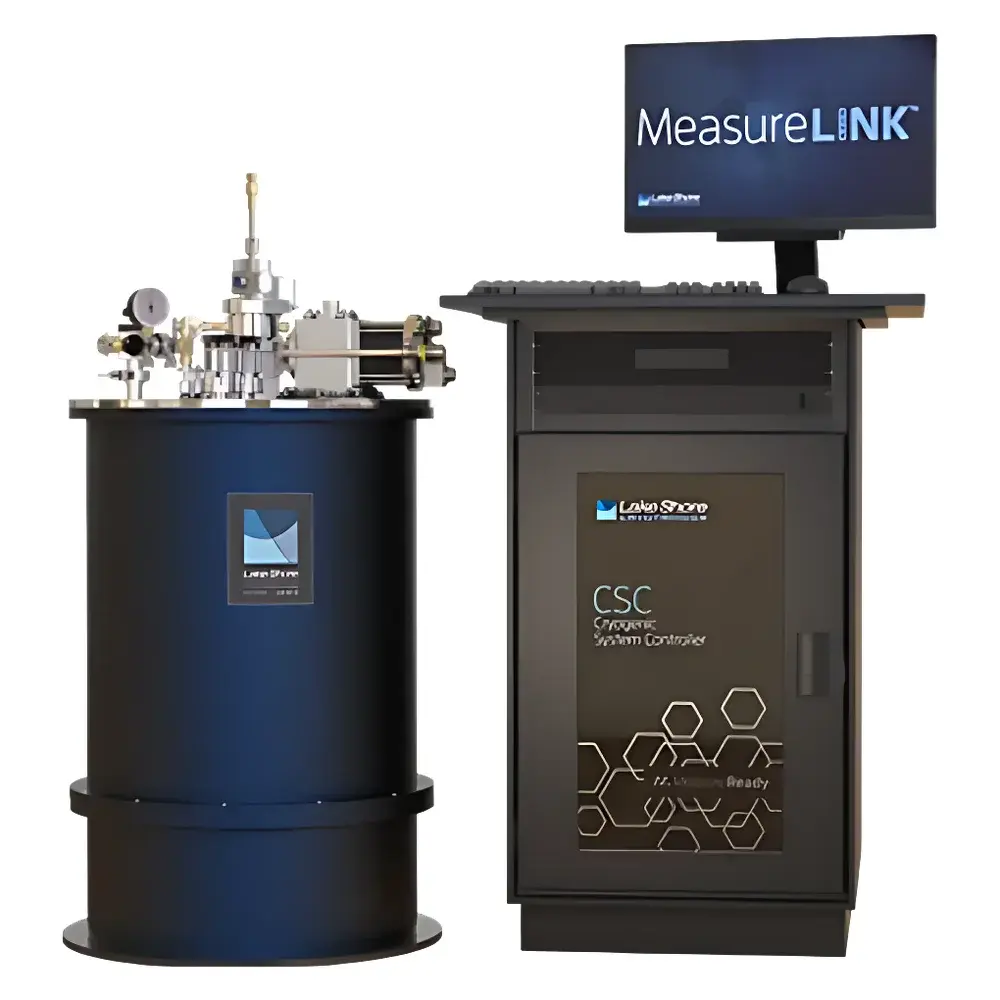
DryMag Cryogen-Free Superconducting Magnet System by Lake Shore
| Brand | Lake Shore |
|---|---|
| Origin | USA |
| Model | DryMag |
| Temperature Range | 1.5 K to 300 K (420 K optional) |
| Magnetic Field | Up to 12 T vertical, up to 7 T horizontal |
| Cooling Method | Closed-cycle cryocooler with static helium exchange gas |
| Sample Environment | Top-loading, gas-cooled sample space |
| Optical Access | Optional bottom or horizontal viewport |
| Rotation Options | Single-axis (vertical) or dual-axis (vertical + horizontal) sample rotation |
| Base Temperature | ≤1.5 K |
| Initial Cool-down Time | ~24 h |
| Temperature Stability | ±50 mK |
| Sample Exchange Time | 90 min |
| Cryocooler Maintenance Interval | 10,000 h (Gifford-McMahon) or 20,000 h (pulse tube) |
| Optional Add-ons | He-3 insert (300 mK), electrical feedthroughs, M81-SSM source-measure unit, M91 FastHall controller, MeasureLINK software suite |
Overview
The DryMag Cryogen-Free Superconducting Magnet System by Lake Shore is an engineered solution for high-field, low-temperature physical property characterization without reliance on liquid helium. It integrates a high-efficiency closed-cycle cryocooler with a persistent-mode superconducting magnet to deliver stable magnetic fields and precisely controlled thermal environments. The system operates on the principle of conductive and convective heat transfer via static helium exchange gas—eliminating boil-off losses while maintaining uniform thermal coupling across heterogeneous samples. Unlike traditional wet systems, DryMag achieves base temperatures ≤1.5 K through multi-stage cooling stages and optimized thermal anchoring of the sample stage, magnet coil, and radiation shields. Its top-loading architecture places the sample directly within the cold, static helium environment, ensuring consistent thermal equilibration for solids, powders, liquids, and geometrically irregular specimens. Designed for integration into advanced condensed matter physics and materials science laboratories, DryMag supports both fundamental research and industrial R&D requiring reproducible, long-duration measurements under variable field and temperature conditions.
Key Features
- Cryogen-free operation with no liquid helium handling, refills, or associated infrastructure
- Temperature range from ≤1.5 K to 300 K standard; extended high-temperature option to 420 K (sample-stage only in optical configurations)
- Vertical field configuration up to 12 T; horizontal field up to 7 T in split-pair geometry
- Top-loading sample access with static helium exchange gas cooling for uniform thermalization
- Dual-channel temperature control using calibrated Cernox™ sensors and resistive heaters mounted on copper sample holder and cavity
- Optional optical access: bottom viewport compatible with solenoid magnets; side viewport compatible with 7 T split-pair systems
- Rotational sample stages: single-axis (vertical) or dual-axis (vertical + horizontal) for angular-dependent transport and magnetotransport studies
- Integrated vacuum-compatible electrical feedthroughs supporting DC, low-frequency AC, and RF measurements
Sample Compatibility & Compliance
DryMag accommodates diverse sample forms—including single crystals, thin films, polycrystalline powders, colloidal suspensions, and soft organic materials—without requiring specialized mounting fixtures. Its gas-cooled design avoids thermal gradients common in conduction-cooled systems, enabling reliable specific heat, thermal conductivity, and magnetostriction measurements. All vacuum and cryogenic components comply with ASME BPVC Section VIII and ISO 21028-1 for low-temperature pressure equipment. Electrical measurement modules (M81-SSM, M91) are designed to meet IEC 61000-4 electromagnetic compatibility standards. Software workflows support audit trails and electronic signatures per FDA 21 CFR Part 11 when configured with appropriate IT controls. System documentation conforms to GLP/GMP-aligned record retention protocols for regulated material qualification.
Software & Data Management
Lake Shore’s MeasureLINK software provides unified instrument control, automated sequence execution, and real-time data visualization for DryMag-integrated measurements. It natively communicates with the M81-SSM Synchronized Source-Measure Unit and M91 FastHall Controller to coordinate field sweeps, temperature ramps, current sourcing, and voltage acquisition with sub-millisecond timing resolution. Data export follows HDF5 and CSV formats with embedded metadata (field, temperature, timestamp, instrument settings). Remote monitoring and scripting via Python API enable integration into lab-wide automation frameworks. All measurement logs include checksum-verified timestamps and user-authenticated session records, satisfying traceability requirements for ISO/IEC 17025-accredited testing laboratories.
Applications
- Quantum transport characterization: Hall effect, Shubnikov–de Haas oscillations, quantum Hall regimes
- Magnetization dynamics: AC susceptibility, magnetic relaxation, spin-glass transitions
- Thermoelectric property mapping: Seebeck coefficient, Nernst effect, thermal conductivity under field
- Superconductor critical current density (Jc) determination via transport and magnetization methods
- Topological material studies: Berry curvature extraction, chiral anomaly detection
- Low-temperature dielectric spectroscopy and ferroelectric hysteresis under magnetic field
- Optical magnetometry integration via optional viewports for magneto-optical Kerr effect (MOKE) and Faraday rotation
FAQ
Does DryMag require periodic helium refills?
No—DryMag operates entirely without liquid cryogens. It uses a closed-cycle cryocooler with helium gas recirculation; only routine maintenance of the cryocooler compressor is required.
Can the system be upgraded to 420 K after purchase?
Yes—the high-temperature option is field-installable and requires replacement of the sample stage heater, sensor, and thermal shielding assembly.
What is the typical cooldown time from 300 K to base temperature?
Approximately 24 hours under standard operating conditions, depending on thermal load and initial vacuum quality.
Is the He-3 insert compatible with all DryMag configurations?
The 300 mK He-3 insert is mechanically and thermally integrated only with non-optical, vertical-field DryMag systems equipped with extended cold-finger length and dedicated pumping ports.
How is temperature stability maintained during magnetic field sweeps?
Active feedback between the dual-channel temperature controller and the sample-stage heater compensates for eddy-current heating and magnetocaloric effects, holding stability within ±50 mK even during 1 T/min field ramps.



