
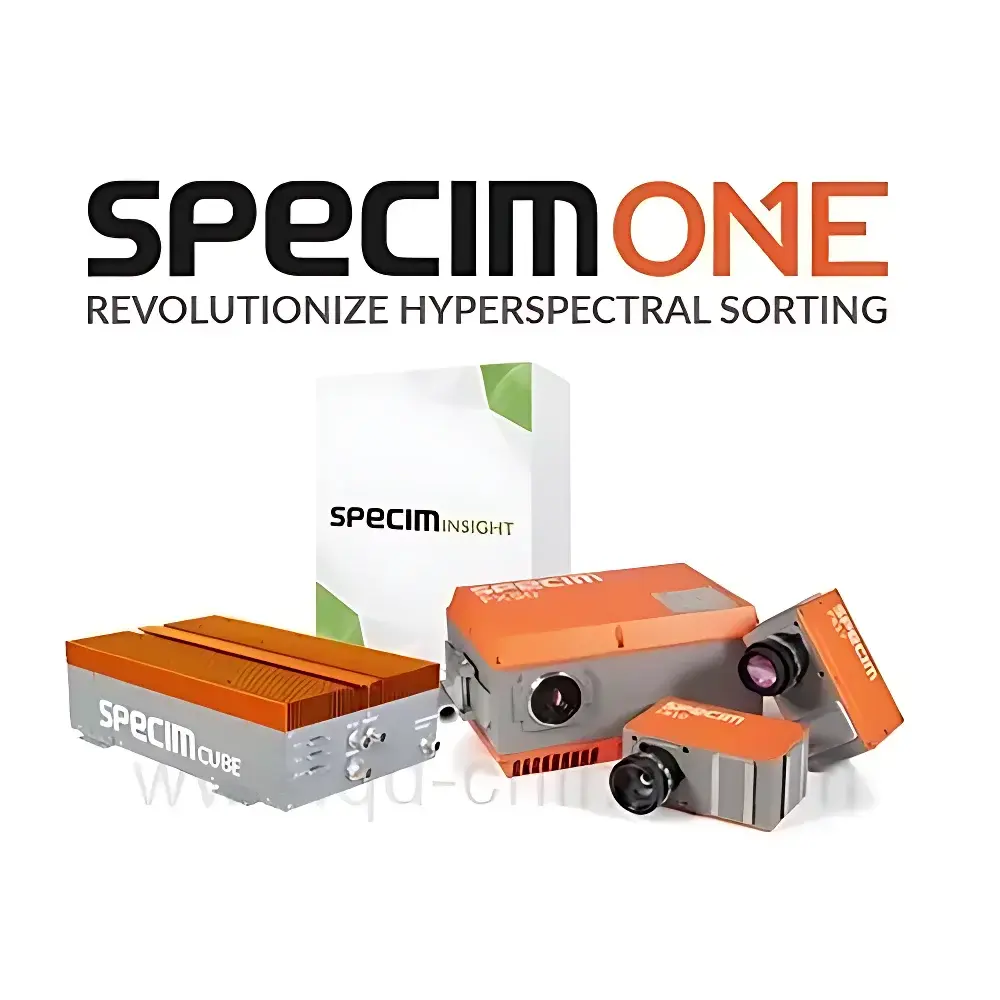
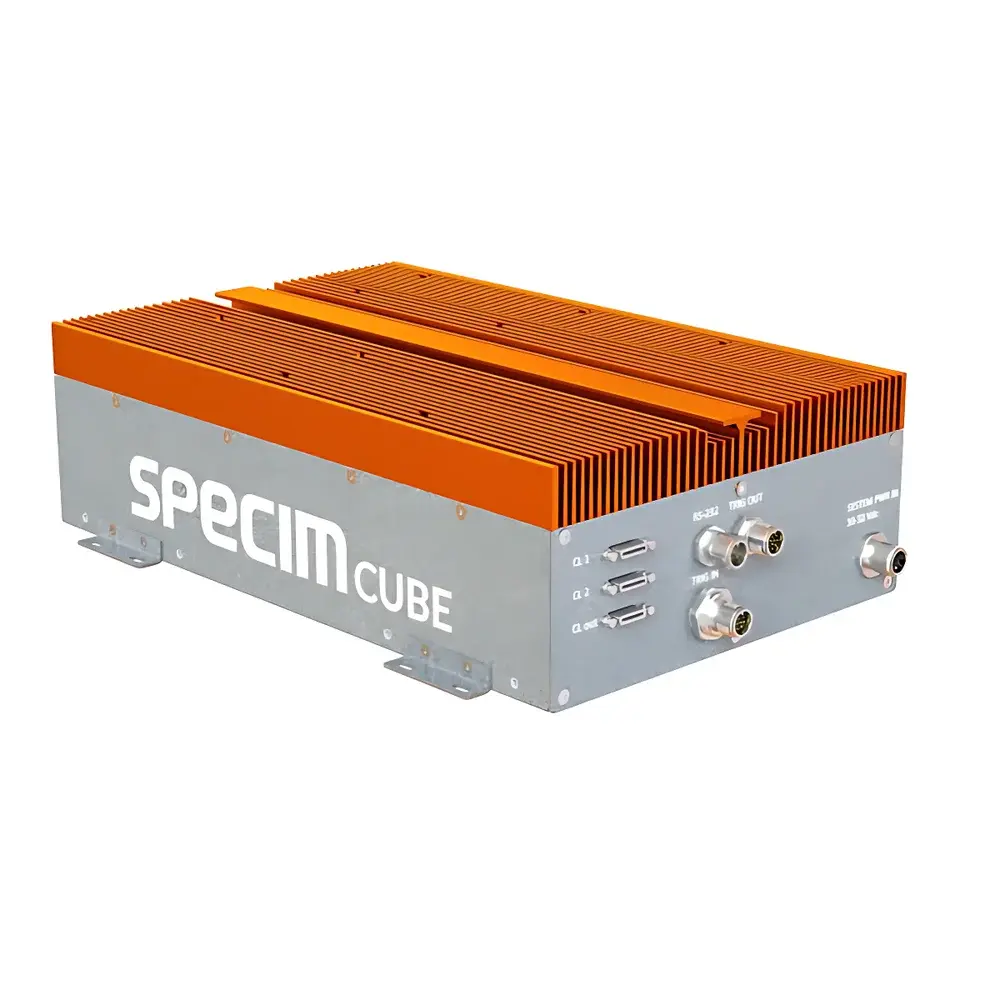
Specim SpecimONE Industrial Online Hyperspectral Sorting System
| Brand | SPECIM |
|---|---|
| Country of Origin | Finland |
| Model | SpecimONE |
| Operating Principle | Push-broom |
| Imaging Method | Dispersive |
| Deployment | Ground-based |
| Spectral Range | 400–1000 nm (FX10) |
| Spectral Resolution | 35 nm (FX10) |
| Spatial Resolution | 8 × 8 µm (FX10) |
| Field of View (TFOV) | 38° |
| Instantaneous Field of View (IFOV) | 640 pixels (FX50) |
| Frame Rate | 380 Hz (FX50, full spectrum) |
| Camera Interface | CameraLink (SDR) |
| Real-time Processing Unit | SpecimCUBE (NVIDIA Jetson AGX Xavier) |
| Data Output | GigE Vision (RGB8, Mono12, Mono12Packed) |
| Compliance | CE, FCC, RoHS 3 |
| Operating Temperature | −10 °C to +60 °C |
| Humidity | 95% RH at 40 °C (non-condensing) |
| Power Input | 9–36 V DC |
| Dimensions (W × L × H) | 190 × 300 × 90 mm |
| Weight | 4.6 kg |
Overview
The Specim SpecimONE Industrial Online Hyperspectral Sorting System is a turnkey, production-grade hyperspectral imaging platform engineered for real-time material identification and automated sorting in continuous industrial processes. Built upon the push-broom scanning principle—where spectral data are acquired line-by-line as the sample moves beneath the sensor—the system delivers spatially resolved reflectance or emissivity spectra across hundreds of contiguous narrowband channels. Unlike conventional RGB or multispectral vision systems, SpecimONE captures full spectral signatures (e.g., 400–1000 nm for FX10, 900–1700 nm for FX17, or 2.7–5.3 µm for FX50), enabling discrimination of materials with nearly identical visual appearance but distinct molecular absorption features. Its dispersive optical architecture ensures high radiometric fidelity, low stray light, and intrinsic wavelength calibration stability—critical for long-term repeatability in unattended operation. Designed explicitly for integration into conveyor-based manufacturing, recycling, food processing, and pharmaceutical production lines, SpecimONE bridges the gap between laboratory-grade spectroscopy and ruggedized factory-floor deployment.
Key Features
- Modular hardware-software architecture comprising Specim FX-series push-broom cameras (FX10/FX17/FX50), SpecimINSIGHT offline modeling software, and SpecimCUBE real-time inference engine
- High-speed acquisition: up to 670 Hz frame rate (FX17, full-spectrum), supporting line speeds exceeding 3 m/s on standard conveyor belts
- Factory-calibrated spectral response with NIST-traceable validation options; stable spectral resolution (≤8 nm) and pixel-to-pixel radiometric uniformity
- GigE Vision-compliant output (Mono12/Mono12Packed/RGB8) enabling seamless interoperability with PLCs, motion controllers, and industrial vision frameworks (e.g., HALCON, Sherlock)
- SpecimCUBE processing unit based on NVIDIA Jetson AGX Xavier SoC—optimized for deterministic low-latency inference (<5 ms end-to-end pipeline latency under typical load)
- Support for multiple classification algorithms: Partial Least Squares Discriminant Analysis (PLS-DA), Principal Component Analysis (PCA), and Spectral Angle Mapper (SAM), all accelerated via GPU-accelerated libraries
- MROI (Multiple Regions of Interest) capability for concurrent analysis of heterogeneous zones within a single field of view—essential for mixed-stream sorting applications
- Web-based CameraOS UI for remote configuration, live monitoring, model switching, and diagnostic logging without host PC dependency
Sample Compatibility & Compliance
SpecimONE accommodates diverse sample types—including granular plastics, bulk foodstuffs, mineral ores, pharmaceutical tablets, and organic waste—without physical contact or sample preparation. Its non-destructive optical interrogation enables 100% inline inspection with no throughput penalty. The system meets essential industrial regulatory expectations: CE marking confirms compliance with EU Machinery Directive 2006/42/EC and EMC Directive 2014/30/EU; FCC Part 15 Class A certification verifies electromagnetic compatibility in industrial environments; RoHS 3 compliance ensures restricted substance control per Directive 2015/863/EU. While not inherently FDA 21 CFR Part 11 compliant out-of-the-box, audit trails, user access controls, and electronic signature support can be implemented via third-party MES/SCADA integration layers adhering to GMP/GLP workflows. All FX-series cameras undergo factory spectral calibration using certified reference sources traceable to national metrology institutes.
Software & Data Management
SpecimINSIGHT serves as the offline model development environment, running on Windows 10 (64-bit) with support for ENVI-compatible data formats (.hdr/.raw). It provides interactive spectral library management, supervised training with cross-validation, confusion matrix generation, and ROC curve analysis. Trained models are exported in optimized binary format compatible exclusively with SpecimCUBE’s embedded runtime. SpecimCUBE operates CameraOS—a lightweight, real-time Linux distribution—ensuring deterministic scheduling and memory isolation. Data persistence includes onboard 256 GB eMMC storage for buffered logging, while streaming outputs comply with GenICam v3.3 and GigE Vision 2.0 standards. External synchronization supports encoder-triggered acquisition and hardware-timed I/O (4 isolated trigger inputs, 4 isolated outputs), facilitating precise spatiotemporal alignment with mechanical actuators or pneumatic ejectors. All firmware and application updates are delivered via secure HTTPS OTA mechanism with SHA-256 signature verification.
Applications
- Plastic recycling: Identification and separation of black PET, PVC, PS, and PP by polymer-specific C–H and C=O vibrational bands in SWIR (FX17) and MWIR (FX50)
- Food quality assurance: Detection of foreign materials (e.g., rubber, glass, stones), bruising in fruits, moisture mapping in grains, and mycotoxin screening via spectral anomaly detection
- Pharmaceutical manufacturing: Verification of tablet coating uniformity, API concentration gradients, and counterfeit drug identification using spectral fingerprint matching
- Mineral processing: Lithological classification of crushed ore streams based on Fe–OH, Al–OH, and clay mineral absorption features
- Agricultural product grading: Sugar content estimation in citrus, dry matter in potatoes, and ripeness staging in tomatoes using VIS-NIR spectral indices
- Waste stream sorting: Differentiation of biodegradable vs. synthetic packaging, textile fiber type identification (cotton/polyester/nylon), and battery component recovery
FAQ
Is SpecimONE suitable for integration into existing PLC-controlled production lines?
Yes—SpecimCUBE provides native GigE Vision support and exposes discrete I/O signals (RS-232/485, CAN bus, isolated digital triggers) compatible with major industrial automation protocols including Modbus TCP and EtherNet/IP via gateway adapters.
Can classification models be updated without stopping the production line?
Yes—SpecimCUBE supports hot-swapping of inference models via web UI or REST API; model activation occurs within <100 ms with zero frame loss during transition.
What spectral calibration maintenance is required?
No routine recalibration is needed. Each FX camera ships with factory-applied wavelength and radiometric calibration stored in non-volatile memory. Optional annual NIST-traceable recalibration services are available through authorized SPECIM service centers.
Does SpecimONE support multi-camera synchronization?
Yes—CameraLink timing signals (strobe, exposure enable) and external encoder inputs allow precise geometric registration across multiple Specim FX units mounted on a single gantry or distributed along a wide conveyor.
How is data security handled during remote access and firmware updates?
CameraOS implements TLS 1.2 encryption for all web UI sessions and enforces certificate-pinned HTTPS for OTA updates. Local network access defaults to disabled; SSH and HTTP access require explicit administrator authentication.




