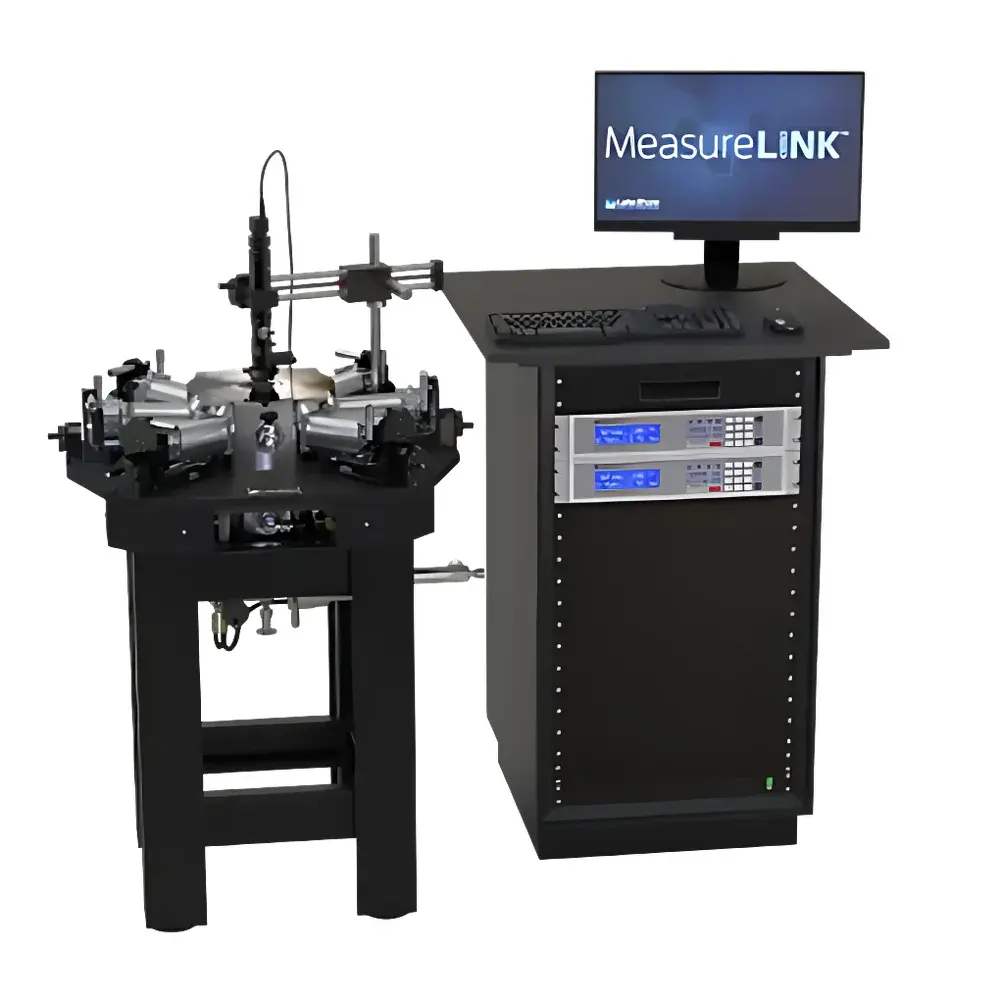
Lake Shore CPX Multi-Function Cryogenic Probe Station
| Brand | Lake Shore |
|---|---|
| Origin | USA |
| Manufacturer Status | Authorized Distributor |
| Product Origin | Imported |
| Model | CPX |
| Pricing | Upon Request |
Overview
The Lake Shore CPX Multi-Function Cryogenic Probe Station is a high-performance, modular cryogenic measurement platform engineered for precision electrical, microwave, and optoelectronic characterization of semiconductor devices, quantum materials, and organic electronic structures under ultra-stable thermal and vacuum conditions. Operating on the principle of closed-cycle or liquid cryogen–cooled thermal anchoring with multi-stage radiation shielding and active temperature control, the CPX enables reproducible, low-noise measurements across an exceptionally wide temperature range—from 1.6 K to 475 K—while maintaining sub-millikelvin thermal stability at base temperatures. Its design integrates fundamental cryogenic engineering principles—including thermal decoupling via split-shield architecture, differential pumping paths, and vibration-isolated sample mounting—to eliminate condensation on hygroscopic samples (e.g., organic semiconductors, perovskites, 2D heterostructures) and ensure integrity during in situ transfer. The system serves as a foundational infrastructure tool for low-temperature transport, Hall effect, gate-dependent capacitance-voltage (C-V), RF S-parameter, and electro-optic probing workflows in academic research labs and advanced device development facilities.
Key Features
- Modular architecture supporting up to six independently positionable probe arms with DC/RF/microwave/fiber-optic compatibility
- Ultra-low base temperature options: 4.3 K (standard), 1.9 K (PS-LT option), or 1.6 K (PS-VLT-CPX option)
- Wide operational temperature range: 1.65 K–400 K (with VLT option) or 4.4 K–475 K (standard configuration)
- Thermal stability: ±5 mK at 4 K; ±15 mK across 10–250 K; ±50 mK up to 475 K (dependent on cooling method and load)
- High-vacuum and ultra-high-vacuum configurations available: PS-HV-CPX achieves <5 × 10⁻⁷ Torr at base temperature
- Load-lock module (PS-LL-CPX): Enables rapid sample exchange without breaking main chamber vacuum (<1 h cycle time)
- Sample stage with ±5° in-plane rotation and optional sub-30 nm vibration isolation (PS-PVIS)
- Standard 51 mm (2″) sample accommodation; optional 102 mm (4″) wafer support
- Integrated temperature monitoring: Up to six calibrated Cernox® or RuO2 sensors distributed across sample stage, radiation shields, and probe arms
- Probe arm thermal management: Probe bases anchored to 4 K shield or sample stage, enabling probe tip temperatures <20 K at base conditions
Sample Compatibility & Compliance
The CPX accommodates rigid substrates (Si, sapphire, quartz), flexible films, exfoliated flakes, and air-sensitive organic thin films—particularly those requiring condensation-free cooldown (e.g., P3HT, spiro-OMeTAD, metal–organic frameworks). Its split-shield thermal architecture allows the sample to remain thermally isolated while radiation shields are actively cooled, minimizing water vapor deposition during cooldown—a critical requirement for reliable I–V and impedance spectroscopy of hydrophilic materials. Vacuum integrity meets ASTM E595 outgassing specifications when equipped with baked stainless-steel chambers and metal-sealed feedthroughs. System design supports GLP-compliant operation through traceable sensor calibration records and configurable audit logs in Lake Shore’s BlueM™ software (optional FDA 21 CFR Part 11 compliance package available).
Software & Data Management
Control and automation are delivered via Lake Shore’s BlueM™ software suite—a Windows-based platform supporting synchronized temperature ramping, vacuum sequencing, probe positioning, and real-time data acquisition from integrated multimeters, SMUs, VNAs, and lock-in amplifiers. BlueM™ provides scriptable measurement routines (Python API), automated thermal cycling profiles with hold-and-soak logic, and native export to HDF5, CSV, and MATLAB formats. All temperature setpoints, vacuum readings, and sensor calibrations are timestamped and stored with metadata tags for full experimental traceability. Optional instrument drivers comply with IVI-C and SCPI standards, enabling integration into LabVIEW or Python-based test executive environments used in semiconductor reliability labs.
Applications
- Low-temperature carrier mobility and effective mass extraction in novel channel materials (e.g., MoS2, black phosphorus)
- Quantum transport studies: Coulomb blockade, Kondo effect, Majorana zero-mode detection
- RF and mmWave characterization of GaN HEMTs and SiGe HBTs up to 67 GHz
- In situ electro-optic probing using fiber-coupled photodiodes or modulators
- Dielectric spectroscopy of ferroelectric and relaxor thin films below 10 K
- Gate-controlled superconducting transition analysis in NbTiN or Al-based Josephson junctions
- Accelerated aging and bias-temperature instability (BTI) testing under cryogenic stress conditions
FAQ
What cryogens does the CPX require?
The CPX operates with either liquid helium (LHe) or liquid nitrogen (LN2) depending on the selected base temperature configuration. Systems equipped with the PS-VLT-CPX option require LHe; standard and PS-LT configurations support either LHe or LN2. Closed-cycle refrigerator integration is also supported upon request.
Can the CPX be integrated with existing semiconductor parameter analyzers?
Yes—the CPX features industry-standard triaxial, SMA, and K-type feedthroughs compatible with Keysight B1500A, Keithley 4200-SCS, and FormFactor Cascade systems. Full hardware abstraction is provided via BlueM™’s IVI-compliant instrument drivers.
Is remote operation supported?
All BlueM™ functions—including temperature control, vacuum monitoring, and probe movement—are accessible over secure LAN/WAN connections using encrypted VNC or RDP sessions. Audit trails and user-role permissions are configurable per GLP/GMP requirements.
What level of vacuum is maintained during sample transfer with the Load Lock option?
With the PS-LL-CPX module, the load lock chamber achieves <1 × 10⁻³ Torr within 10 minutes and maintains <5 × 10⁻⁶ Torr during transfer—sufficient to preserve monolayer integrity for most air-sensitive 2D materials.
Are custom feedthroughs or optical access ports available?
Yes—Lake Shore offers application-specific vacuum feedthroughs including fiber optic collimators (FC/APC, SMA905), multi-channel microwave probes (GSG, GS), and laser entry windows (UV–IR broadband AR-coated fused silica).