
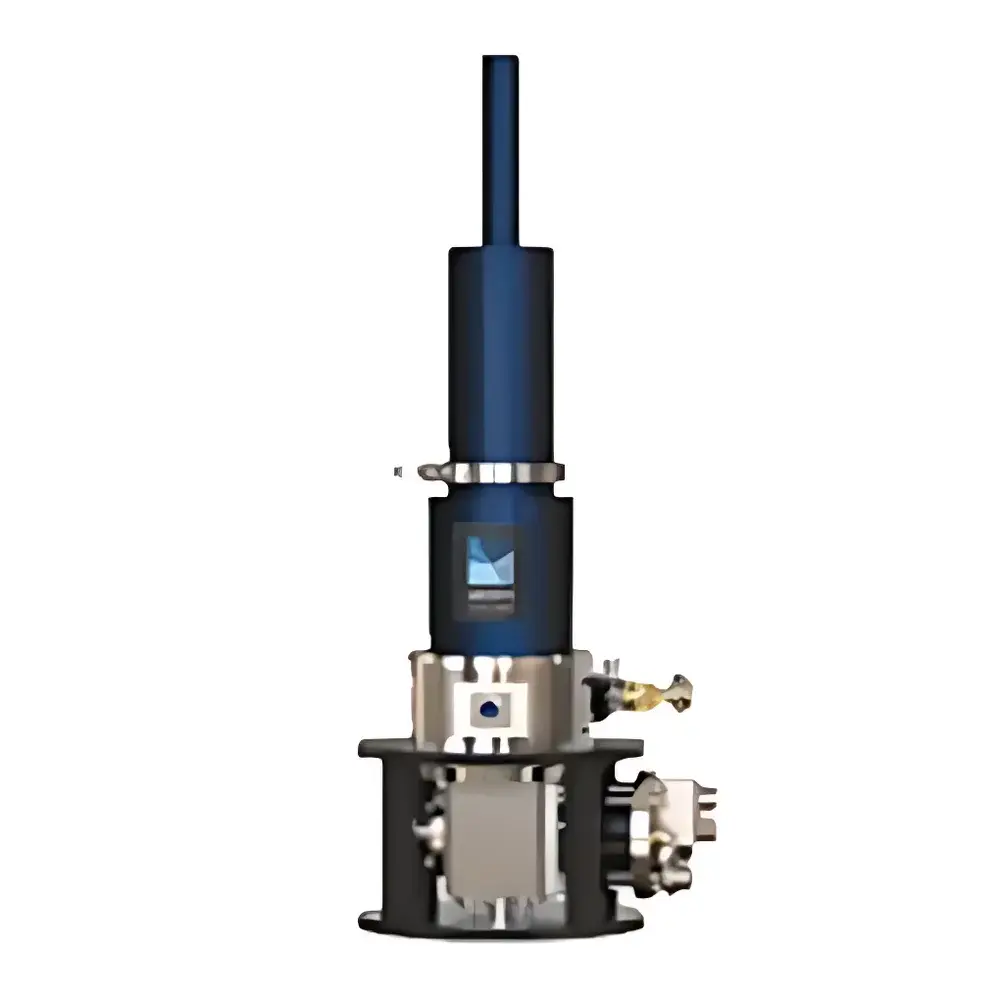
Lake Shore CCS-300ST Compact Cryogenic Thermostat
| Brand | Lake Shore |
|---|---|
| Origin | USA |
| Model | CCS-300ST |
| Cooling Type | Closed-Cycle Refrigeration |
| Temperature Range | <4 K to 325 K |
| Sample Environment | High Vacuum |
| Typical Temperature Stability | ±50 mK |
| Cooling Time | 1.5–2.5 h |
| Design | Compact, Magnet-Compatible |
| Optical Window | None |
| Cold Head Mounting | Flexible (Arbitrary Orientation) |
| Approximate Weight | 17–30 kg |
| Recommended Cryocooler Maintenance Interval | 13,000 h |
Overview
The Lake Shore CCS-300ST Compact Cryogenic Thermostat is a closed-cycle, helium-free cryogenic platform engineered for precision low-temperature electrical transport measurements in space-constrained laboratory environments. Unlike traditional liquid-helium dewars, the CCS-300ST integrates a high-reliability pulse-tube or Gifford-McMahon cryocooler to achieve base temperatures below 4 K without cryogen refills—enabling continuous, unattended operation over extended experimental cycles. The sample stage resides in a high-vacuum environment (<1×10⁻⁵ Torr typical), minimizing conductive and convective heat loads while ensuring thermal isolation essential for sensitive DC and low-frequency AC measurements. Its compact cylindrical form factor (diameter ≤150 mm, height 71–99 cm) is specifically optimized for integration with superconducting magnets, vector magnets, and custom probe stations where radial and axial space are limited. The system supports variable temperature operation from <4 K up to 325 K with active PID control, delivering ±50 mK short-term stability under steady-state conditions—a performance level validated per ASTM E220 and ISO/IEC 17025 traceable calibration protocols.
Key Features
- Helium-free closed-cycle refrigeration eliminates dependency on liquid cryogens, reducing operational cost and logistical complexity
- Thermally anchored sample stage operating under high vacuum ensures minimal thermal noise and high signal-to-noise ratio in resistivity, Hall effect, and quantum oscillation measurements
- Modular electrical feedthrough architecture accommodates multi-channel DC, BNC, SMA, and triaxial connectors—fully customizable for four-probe, van der Pauw, or lock-in configurations
- Compact mechanical footprint enables direct mounting inside bore-accessible magnet systems (e.g., 9 T–16 T superconducting solenoids) without compromising field homogeneity
- Cold head orientation is user-selectable (top-, side-, or bottom-mounted), allowing flexible integration into existing cryogenic infrastructure
- Robust stainless-steel vacuum vessel with all-metal seals meets UHV compatibility requirements for ultra-clean surface science applications
Sample Compatibility & Compliance
The CCS-300ST accepts solid, thermally conductive samples—including single crystals, thin films, 2D materials, and microfabricated devices—mounted on interchangeable sample holders (standard electrical, optical, four-probe, and plug-in types). All electrical interfaces comply with IEC 61000-4-8 (power frequency magnetic field immunity) and meet grounding safety standards per UL 61010-1. Vacuum integrity conforms to ISO 10816-3 for vibration-sensitive instrumentation, with mechanical vibration amplitude maintained below 40 nm RMS at the sample position—critical for scanning tunneling microscopy (STM) co-integration or nanoscale transport studies. The system supports GLP/GMP-aligned operation through optional audit-trail-enabled temperature logging and is compatible with FDA 21 CFR Part 11-compliant data acquisition software when paired with certified controllers.
Software & Data Management
Lake Shore’s proprietary CryoSoft™ platform provides real-time temperature monitoring, ramp-rate programming, and multi-zone PID tuning via USB or Ethernet interface. The software exports time-stamped datasets in ASCII and HDF5 formats, supporting direct import into Python (via PyLakeShore), MATLAB, or LabVIEW environments. Optional integration with third-party DAQ systems (e.g., Keysight B2900 series, Keithley 2450) enables synchronized current sourcing and voltage measurement with timestamp alignment at 10 ms resolution. All temperature setpoints, sensor calibrations (DT-670, Cernox®, RuO₂), and cooldown history are stored with SHA-256 checksums for full data provenance—meeting ISO/IEC 17025 clause 7.7 requirements for measurement traceability.
Applications
- Quantum transport characterization: Shubnikov–de Haas oscillations, quantum Hall effect, and topological insulator edge-state mapping
- Magnetoresistance studies under high magnetic fields (up to 16 T) using integrated split-pair or vector magnet configurations
- Low-temperature dielectric spectroscopy of ferroelectric thin films and relaxor materials
- Cryogenic validation of CMOS and SiC power devices for aerospace and quantum computing infrastructure
- In situ electrical testing of epitaxial heterostructures during molecular beam epitaxy (MBE) cooldown sequences
FAQ
Does the CCS-300ST include an optical access window?
No—the CCS-300ST is configured without optical windows to maximize thermal efficiency and vacuum integrity. For optical experiments requiring laser access or imaging, specify the CCS-300S variant.
What vacuum level is maintained during operation?
The system achieves and sustains <1×10⁻⁵ Torr under standard operation; optional turbomolecular pumping upgrades support pressures down to 1×10⁻⁸ Torr for surface-sensitive applications.
Can the CCS-300ST be operated in a vertical or horizontal orientation?
Yes—the cold head mounting position is fully configurable; orientation must be specified at time of order to ensure proper cryocooler oil management and thermal anchoring.
Is remote monitoring supported?
Yes—Ethernet-based communication enables secure remote access via TLS-encrypted CryoSoft™ sessions, including alarm notifications and real-time parameter adjustment.
What is the expected mean time between maintenance (MTBM) for the integrated cryocooler?
Based on accelerated life testing and field data, the recommended preventive maintenance interval is 13,000 hours (≈1.5 years of continuous operation), aligning with ISO 13374-2 condition monitoring guidelines.



