
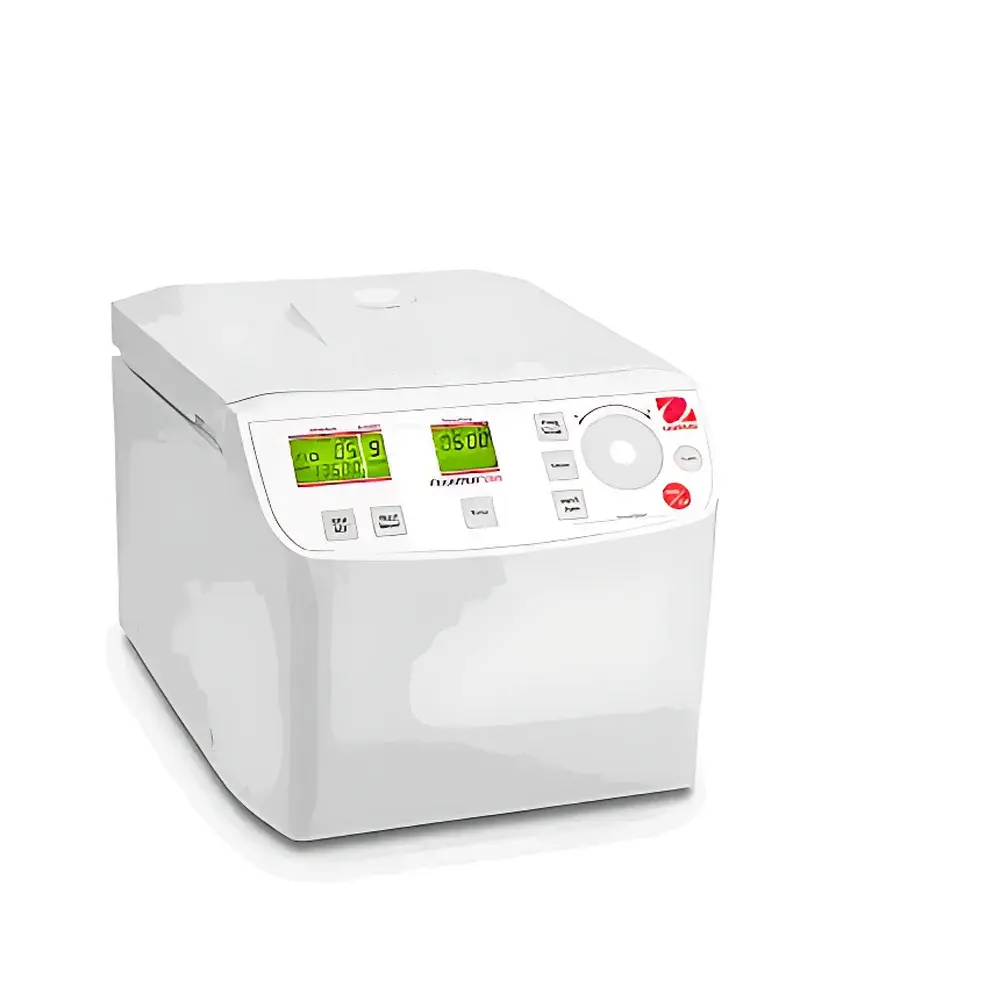
FRONTIER™ 5000 Microcentrifuge
| Brand | OHAUS |
|---|---|
| Origin | USA |
| Manufacturer | OHAUS Corporation |
| Model | FC5513+R01 (230 V) |
| Instrument Type | Benchtop Microcentrifuge |
| Speed Range | 200 – 13,500 rpm |
| Max RCF | 17,317 × g |
| Max Capacity | 24 × 1.5 / 2.0 mL |
| Dimensions | 236 mm × 356 mm × 277 mm |
| Display | Backlit LCD (dual-line) |
| Motor | Brushless DC |
| Noise Level | ≤60 ± 2 dB(A) |
| Safety Certifications | CE, FCC |
| Operating Environment | 2°C – 35°C, ≤80% RH (non-condensing) |
| Weight | 13.1 kg |
| Power | 230 V, 50–60 Hz, 170 W |
| Rotor Types | Fixed-angle 24-place (1.5/2.0 mL), hermetically sealed angle rotor, capillary hematocrit rotor, 18-place spin-column rotor |
| Timer Range | 10 s – 99 h 59 min 59 s, continuous mode |
| Acceleration/Deceleration Programs | 10 each |
| Stored Protocols | 99 |
| Lid Lock | Mechanical interlock |
| Compliance | Designed for GLP-compliant workflows |
Overview
The FRONTIER™ 5000 Microcentrifuge (Model FC5513+R01) is a high-performance, benchtop centrifuge engineered for precision separation of biological macromolecules—including nucleic acids, proteins, and cellular organelles—in research, clinical diagnostics, and quality control laboratories. Utilizing a brushless DC motor architecture, it delivers stable rotational dynamics across its full speed range (200–13,500 rpm), achieving a maximum relative centrifugal force (RCF) of 17,317 × g. Its compact footprint (236 × 356 × 277 mm) and narrow-depth design enable seamless integration into crowded biosafety cabinets, laminar flow hoods, or shared instrumentation benches without compromising accessibility or ergonomic workflow. Unlike portable “palm-sized” microcentrifuges, the FRONTIER™ 5000 is classified as a benchtop instrument—optimized for reproducible, high-throughput processing of up to 24 × 1.5/2.0 mL tubes per run, while maintaining mechanical stability and thermal consistency under extended operational cycles.
Key Features
- Brushless DC motor: Ensures maintenance-free operation, low electromagnetic interference, and consistent torque delivery across all speeds—critical for sensitive nucleic acid pelleting and protein precipitation protocols.
- Mechanical lid interlock system: Prevents accidental lid opening during operation and enforces mandatory deceleration before release—meeting IEC 61010-1 safety requirements for laboratory equipment.
- Dual-line backlit LCD display: Provides real-time visibility of set parameters (rpm/RCF, time, acceleration/deceleration profile) and active status—even in low-light environments such as cold rooms or darkroom imaging setups.
- Programmable protocol storage: Supports up to 99 user-defined methods, each configurable with independent acceleration/deceleration ramps (10 presets each), timer settings (10 seconds to 99 hours), and RCF/rpm selection—enabling standardized SOP execution across multiple users.
- Acoustically optimized housing: Engineered with vibration-damping mounts and aerodynamic rotor chamber geometry to maintain noise output at ≤60 ± 2 dB(A) at 1 m distance—reducing ambient laboratory noise burden during prolonged use.
- Multi-rotor compatibility: Accepts OHAUS-certified fixed-angle rotors for standard microtubes (24 × 1.5/2.0 mL), hermetically sealed variants for biohazard containment, capillary hematocrit rotors (24-position), and 18-place spin-column rotors—ensuring adaptability across DNA purification, serum separation, and column-based assays.
Sample Compatibility & Compliance
The FRONTIER™ 5000 accommodates a broad spectrum of tube formats: 0.2 mL PCR tubes, 0.4–2.0 mL conical microcentrifuge tubes, 5 mL round-bottom tubes (12-place configuration), and calibrated capillaries for hematocrit determination. All compatible rotors are individually balanced and validated for use within the instrument’s certified speed and RCF envelope. The system complies with CE marking requirements under Directive 2014/30/EU (EMC) and 2014/35/EU (LVD), as well as FCC Part 15 Subpart B for electromagnetic emissions. While not refrigerated, its ambient-temperature operation (2–35°C) aligns with ISO/IEC 17025:2017 clause 5.4.2 for environmental condition monitoring in accredited testing laboratories. When deployed in regulated environments (e.g., pharmaceutical QC), the device supports traceable operation through external logging interfaces and adheres to foundational principles of FDA 21 CFR Part 11 when paired with compliant data acquisition software.
Software & Data Management
The FRONTIER™ 5000 operates as a standalone instrument with no embedded operating system or network connectivity. However, its programmable interface enables full method reproducibility and operator accountability: each stored protocol includes user-assigned identifiers, and all parameter changes during runtime are displayed—not logged internally. For audit-trail compliance, laboratories integrate the centrifuge into validated Laboratory Information Management Systems (LIMS) or Electronic Lab Notebooks (ELN) via RS-232 or optional USB-to-serial adapters. Protocol exports and usage logs must be generated externally; the device itself retains no persistent memory beyond power cycling. This architecture ensures deterministic behavior and simplifies validation—particularly relevant for GLP and GMP settings where firmware-level data integrity controls are not required but procedural rigor is mandated.
Applications
- Pelleting of plasmid DNA, genomic DNA, and RNA from lysates prior to column-based purification or downstream enzymatic reactions.
- Clarification of bacterial and mammalian cell lysates to remove insoluble debris before Western blotting or mass spectrometry sample prep.
- Separation of serum/plasma from whole blood using capillary hematocrit rotors in clinical hematology workflows.
- Spin-column processing for solid-phase extraction (SPE), affinity purification, and desalting of peptides and oligonucleotides.
- Routine microvolume sample concentration in proteomics and metabolomics pipelines—where reproducible RCF application minimizes shear-induced denaturation.
- High-speed clarification of immunoprecipitation complexes and subcellular fractions (e.g., mitochondrial pellets) under non-refrigerated conditions.
FAQ
Is the FRONTIER™ 5000 refrigerated?
No. It is an ambient-temperature centrifuge designed for applications where sample cooling is not required or is managed externally (e.g., pre-chilled rotors, cold room placement).
Can I use non-OHAUS rotors with this instrument?
Only OHAUS-certified rotors are validated for mechanical balance, material compatibility, and safety at rated speeds. Use of third-party rotors voids warranty and compromises CE/FCC compliance.
Does it support automatic rotor identification?
No. Rotor selection is manual; users must verify rotor model number and maximum speed rating before initiating runs.
What is the shortest programmable run time?
10 seconds—suitable for quick spin-down of condensation in tube caps or brief pellet consolidation prior to aspiration.
How is calibration verified?
Speed accuracy is factory-verified using NIST-traceable tachometry; routine verification requires external optical tachometer measurement per ISO 8573-1 or internal lab SOPs. No field-adjustable calibration parameters are exposed to end users.



