
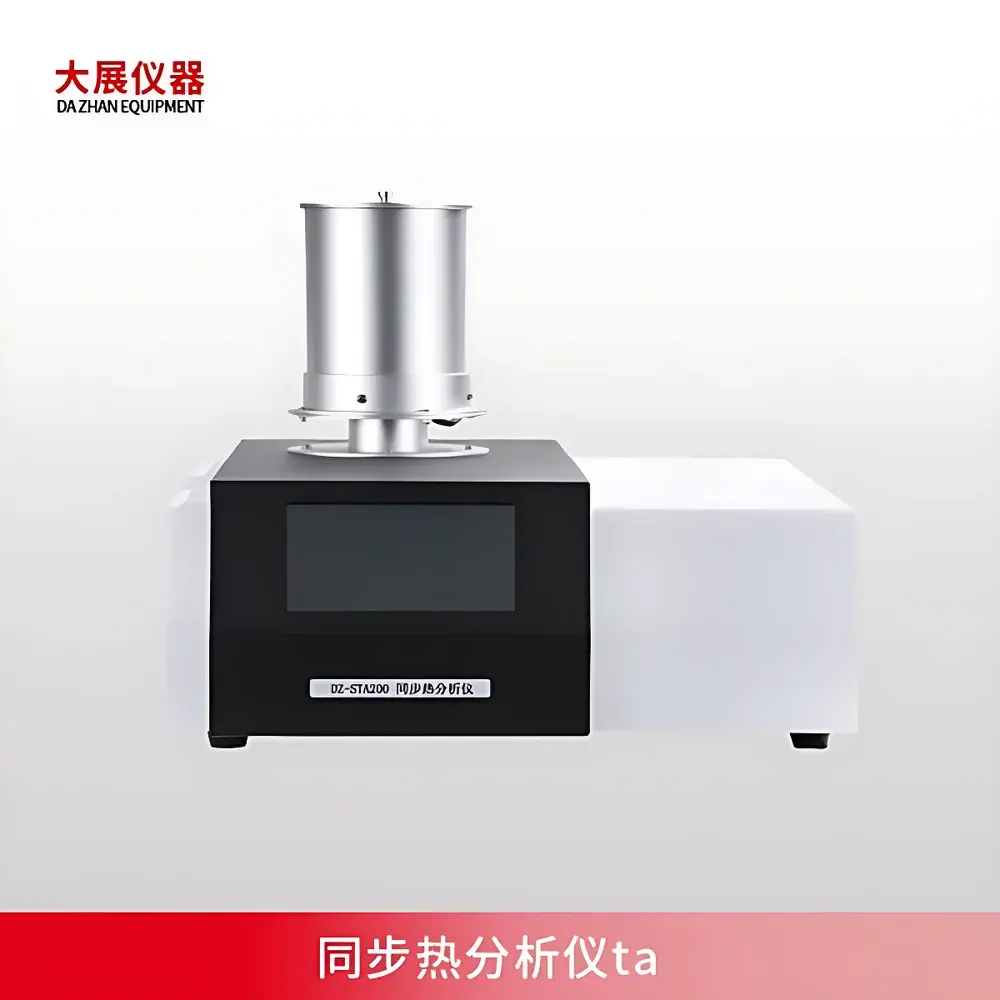
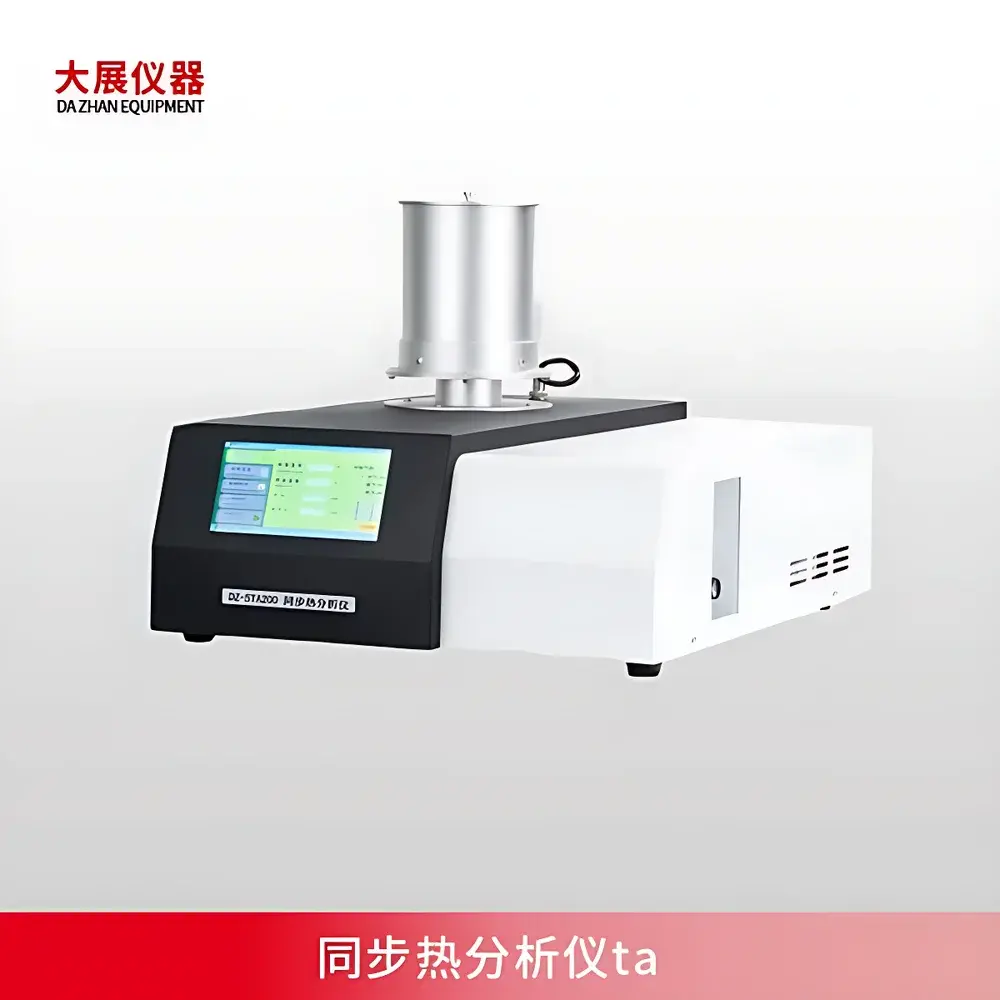
Nanjing Dazhan DZ-STA200 Simultaneous Thermal Analyzer (STA)
| Brand | Nanjing Dazhan |
|---|---|
| Origin | Jiangsu, China |
| Manufacturer Type | Direct Manufacturer |
| Model | DZ-STA200 |
| Temperature Range | Ambient to 1200 °C |
| Heating Rate | 0.1–100 °C/min |
| Max Sample Mass | 5 g |
| Atmosphere Control | Inert, Oxidizing, Reducing |
| TG Sensitivity | 0.1 µg |
| DSC Sensitivity | 0.1 µW |
| DSC Range | ±1000 mW |
| Temperature Resolution | 0.01 °C |
| Temperature Stability | ±0.1 °C |
| Cooling Time (1000 → 100 °C) | ≤15 min |
| Display | 7-inch 24-bit Color Touchscreen |
| Gas Control | Dual-channel Mass Flow Control with Built-in MFCs |
| Data Interface | Standard USB |
Overview
The Nanjing Dazhan DZ-STA200 Simultaneous Thermal Analyzer is an integrated thermogravimetric (TG) and differential scanning calorimetry (DSC) instrument engineered for precision measurement of mass change and heat flow under controlled temperature programs. Based on the principle of simultaneous dual-signal detection—where a single sample experiences identical thermal history while both weight loss/gain (TG) and endo-/exothermic transitions (DSC) are recorded in real time—the DZ-STA200 enables direct correlation between thermal events and associated enthalpic or compositional changes. Designed for laboratory environments requiring reproducible high-temperature characterization up to 1200 °C, it supports rigorous thermal stability assessment, decomposition kinetics, phase transition analysis, oxidation/reduction behavior, and quantitative determination of bound water, volatiles, and inorganic residue. Its architecture adheres to fundamental requirements of thermal analysis methodology as defined in ISO 11358 (polymer thermogravimetry), ASTM E1131 (DSC), and ASTM E1641 (kinetic analysis), ensuring compatibility with internationally accepted data interpretation frameworks.
Key Features
- High-stability furnace with dual-row precious-metal alloy heating elements, minimizing electromagnetic interference and extending operational lifetime at elevated temperatures.
- Ceramic rod–based sensor assembly for the microbalance, offering inherent resistance to oxidation, corrosion, and thermal creep up to 1200 °C.
- Physically decoupled power supply and forced-air cooling system—separated from the main analyzer chassis—to suppress mechanical vibration and thermal crosstalk affecting TG baseline stability.
- Top-opening furnace design enabling rapid sample loading, unloading, and crucible exchange without disturbing calibration or alignment.
- Dual-channel analog-to-digital signal acquisition circuitry optimized for synchronous capture of TG (mass vs. T), DTG (derivative mass), and DSC (heat flow vs. T) signals with synchronized temperature referencing.
- 7-inch 24-bit color capacitive touchscreen interface supporting intuitive navigation, on-device TG calibration (zero/mass point), real-time curve overlay, and parameter preset management.
Sample Compatibility & Compliance
The DZ-STA200 accommodates standard crucible formats including alumina, platinum, and high-purity ceramic vessels (diameter: 5–7 mm), compatible with solids, powders, and thin films. Sample mass range spans 0.1 mg to 5 g, with sub-microgram resolution (0.1 µg) and DSC sensitivity down to 0.1 µW—enabling detection of subtle transitions in catalysts, pharmaceutical polymorphs, and nanocomposites. Integrated dual-gas mass flow controllers support precise switching between inert (N₂, Ar), oxidizing (air, O₂), and reducing (H₂/N₂ mixtures) atmospheres under static or dynamic (up to 200 mL/min) conditions. The system meets essential functional criteria for GLP-compliant thermal analysis workflows, including timestamped audit trails, user-access levels, and raw-data immutability—facilitating alignment with FDA 21 CFR Part 11 readiness when paired with validated software configurations.
Software & Data Management
The embedded intelligent software provides native support for TG, DTG, DSC, and combined TG–DSC overlay visualization. Users may perform baseline correction, peak integration, onset/peak/endpoint temperature assignment, and multi-step kinetic modeling (e.g., Kissinger, Ozawa–Flynn–Wall). Export options include CSV, Excel (.xlsx), and PDF report generation with customizable templates containing instrument metadata, method parameters, and annotated curves. All data files retain original binary acquisition timestamps and are stored with SHA-256 checksum integrity verification. USB interface enables seamless transfer to external PCs running third-party thermal analysis suites (e.g., Netzsch Proteus, TA Universal Analysis) for advanced modeling or regulatory submission packaging.
Applications
- Quantification of crystalline water, adsorbed moisture, and volatile organic content in APIs and excipients per USP <1231>.
- Thermal degradation profiling of polymers, composites, and battery cathode materials under air or N₂.
- Phase transition mapping (melting, crystallization, glass transition) in metallic alloys and shape-memory materials.
- Oxidation onset temperature and activation energy determination for carbon-based materials and catalysts.
- Residue yield analysis for ash content, filler loading, and inorganic impurity screening in ceramics and coatings.
- Reaction enthalpy calculation for solid-state synthesis and decomposition pathways in energetic materials.
FAQ
What types of crucibles are supported by the DZ-STA200?
Alumina, platinum, and high-purity ceramic crucibles (5–7 mm OD) are fully compatible; aluminum crucibles are not recommended above 600 °C.
Does the system support automatic atmosphere switching during a single run?
Yes—dual-channel MFCs allow pre-programmed gas switching (e.g., N₂ → air) at user-defined temperatures or times within one experiment.
Can the instrument be validated for GMP environments?
While the hardware supports core GMP attributes (audit trail, electronic signatures via optional software module), full validation requires site-specific IQ/OQ/PQ protocols aligned with local regulatory expectations.
Is remote monitoring or control possible?
The current firmware does not include Ethernet or Wi-Fi connectivity; remote operation is limited to post-acquisition data review via exported files.
What is the typical recalibration interval for TG and DSC signals?
We recommend annual calibration using certified reference materials (e.g., Ni Curie point, Al melting point, CaC₂O₄·H₂O decomposition) or after major maintenance or relocation.



