
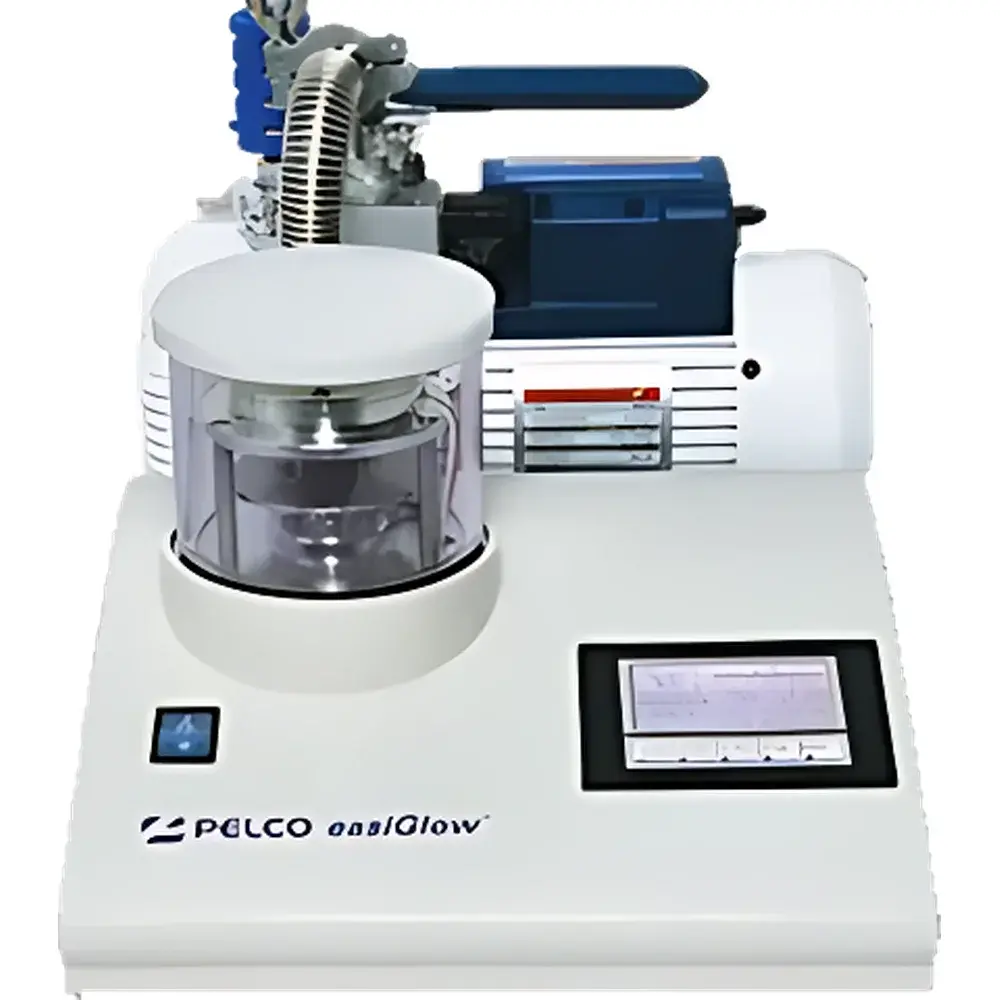
Ted Pella easiGlow Glow Discharge System
| Brand | Ted Pella |
|---|---|
| Origin | USA |
| Model | easiGlow |
| Instrument Type | Imported Plasma Surface Treater |
| RF Power Supply | 120/230 V, 50/60 Hz, 370 W (1/2 hp) |
| Operating Power | 30 W |
| Chamber Dimensions | Ø120 mm × 100 mm H |
| Chamber Volume | ~1.13 L |
| Chamber Material | Borosilicate Glass |
| Working Gas | Ambient Air (also compatible with Ar, O₂, N₂, H₂, NH₃, or custom gas mixtures) |
| Vacuum Range | Atmospheric to 0.01 mbar (Pirani/Penning gauge) |
| Operating Pressure | 1.1–0.20 mbar |
| Discharge Current | 0–30 mA |
| Sample Stage | Ø75 mm (with 25 × 75 mm microscope slide slot) |
| Stage Height Adjustment | 1–25 mm |
| Treatment Time | 0–900 s |
| Control Interface | 3″ Capacitive Touchscreen |
| Operation Modes | Automatic Program Mode / Manual Mode |
| Net Weight | 6.26 kg |
| External Dimensions | 305 L × 292 D × 230 mm H |
Overview
The Ted Pella easiGlow Glow Discharge System is a compact, benchtop plasma surface treatment instrument engineered for precise, reproducible surface functionalization and contamination removal of electron microscopy substrates. It operates on the principle of low-pressure DC or RF-driven glow discharge plasma generation—ionizing ambient or process gases (e.g., air, oxygen, argon) within a sealed glass chamber to produce energetic electrons, ions, and reactive species. These species interact with substrate surfaces at near-room temperature, enabling controlled modification of surface energy without thermal damage. The system is purpose-built for TEM grid preparation: converting hydrophobic carbon films into uniformly hydrophilic supports via negative surface charge induction, significantly improving aqueous sample dispersion, monolayer formation, and particle adhesion—critical for high-resolution cryo-TEM and conventional TEM imaging.
Key Features
- Integrated 3″ capacitive touchscreen interface with intuitive menu navigation, real-time parameter feedback, and persistent program storage for up to 10 user-defined protocols.
- Dual-mode operation: fully automated sequence execution (time, power, gas, pressure) or fine-grained manual control for experimental optimization and troubleshooting.
- Optimized vacuum architecture featuring a high-speed dual-stage rotary vane pump and Penning-type vacuum gauge, achieving stable operating pressure (0.20–1.1 mbar) in under 45 seconds.
- Electrically isolated Ø75 mm conductive sample stage with vertical height adjustment (1–25 mm), ensuring consistent electrode gap and uniform plasma exposure across grids, lacey carbon films, or silicon nitride membranes.
- Borosilicate glass sample chamber (Ø120 × 100 mm H) provides optical transparency for visual plasma monitoring and eliminates metallic outgassing—essential for ultra-clean surface chemistry.
- Gas-flexible design supports ambient air as default working gas, with optional external gas inlets for O₂ (enhanced oxidation), Ar (sputter cleaning), H₂ (reduction), or NH₃ (amine functionalization) under controlled pressure regulation.
Sample Compatibility & Compliance
The easiGlow accommodates standard 3.05 mm TEM grids (copper, nickel, gold), holey carbon films, continuous carbon films, graphene oxide membranes, and silicon-based EM substrates. Its non-thermal, low-energy plasma process preserves delicate nanostructures and biomolecular integrity—validated for use in GLP-compliant TEM core facilities. While not certified to a specific ISO standard, its vacuum integrity (<0.01 mbar base pressure), repeatable discharge current (±0.5 mA), and traceable parameter logging support adherence to ASTM E2785 (Standard Guide for TEM Specimen Preparation) and internal SOPs aligned with ISO/IEC 17025 requirements for measurement traceability. No regulatory submission (e.g., FDA 21 CFR Part 11) is required, as it is a non-diagnostic, non-clinical research tool.
Software & Data Management
The easiGlow operates without proprietary PC software—configuration, execution, and diagnostics are managed entirely via the embedded touchscreen controller. All active parameters (voltage, current, pressure, time, mode) are timestamped and retained in non-volatile memory for post-run review. For laboratory information management system (LIMS) integration, users may manually record protocol IDs, operator initials, and run timestamps in electronic lab notebooks (ELN). Audit trails are maintained through physical logbooks or ELN entries referencing saved protocol names—consistent with GxP-aligned documentation practices where formal electronic signatures are not mandated.
Applications
- Hydrophilization of carbon-coated TEM grids for improved aqueous droplet spreading and vitrification in cryo-EM workflows.
- Surface cleaning of FIB-prepared lamellae to remove hydrocarbon residues prior to high-resolution STEM-EELS mapping.
- Controlled oxidation of graphene or MoS₂ monolayers to tune work function and interfacial charge transfer behavior.
- Activation of PDMS stamps in soft lithography for enhanced ink adhesion during microcontact printing.
- Pre-treatment of ITO or SiO₂ substrates for uniform thin-film deposition in organic electronics R&D.
- Routine decontamination of SEM stubs and sample holders to minimize charging artifacts and secondary electron noise.
FAQ
What gases can be used with the easiGlow besides ambient air?
Oxygen (O₂), argon (Ar), nitrogen (N₂), hydrogen (H₂), and ammonia (NH₃) are commonly employed; gas selection depends on desired surface chemistry—e.g., O₂ for hydrophilic oxidation, Ar for inert sputtering, H₂ for reduction of metal oxides.
Is the glass chamber resistant to aggressive plasma chemistries?
Yes—the borosilicate construction withstands prolonged exposure to oxygen and nitrogen plasmas; however, extended use with fluorine-containing gases (e.g., CF₄) is not recommended due to potential etching.
Can the easiGlow be integrated into an automated sample prep workflow?
While it lacks Ethernet or RS-232 ports, its rapid cycle time (<60 s typical) and programmable repeatability make it suitable for manual integration into multi-step TEM prep lines, including robotic grid handling stations with external trigger inputs (requires optional relay interface kit).
Does the system require routine calibration?
No scheduled calibration is specified by Ted Pella; however, periodic verification of vacuum gauge accuracy (using a calibrated reference gauge) and discharge current linearity (via external ammeter) is recommended annually for critical applications.
How does the easiGlow compare to corona or atmospheric plasma systems for TEM grid treatment?
Unlike atmospheric systems, the easiGlow’s low-pressure glow discharge delivers superior spatial uniformity, lower ion energy dispersion, and higher chemical selectivity—minimizing grid warping and carbon film damage while maximizing hydrophilicity consistency across batches.



