
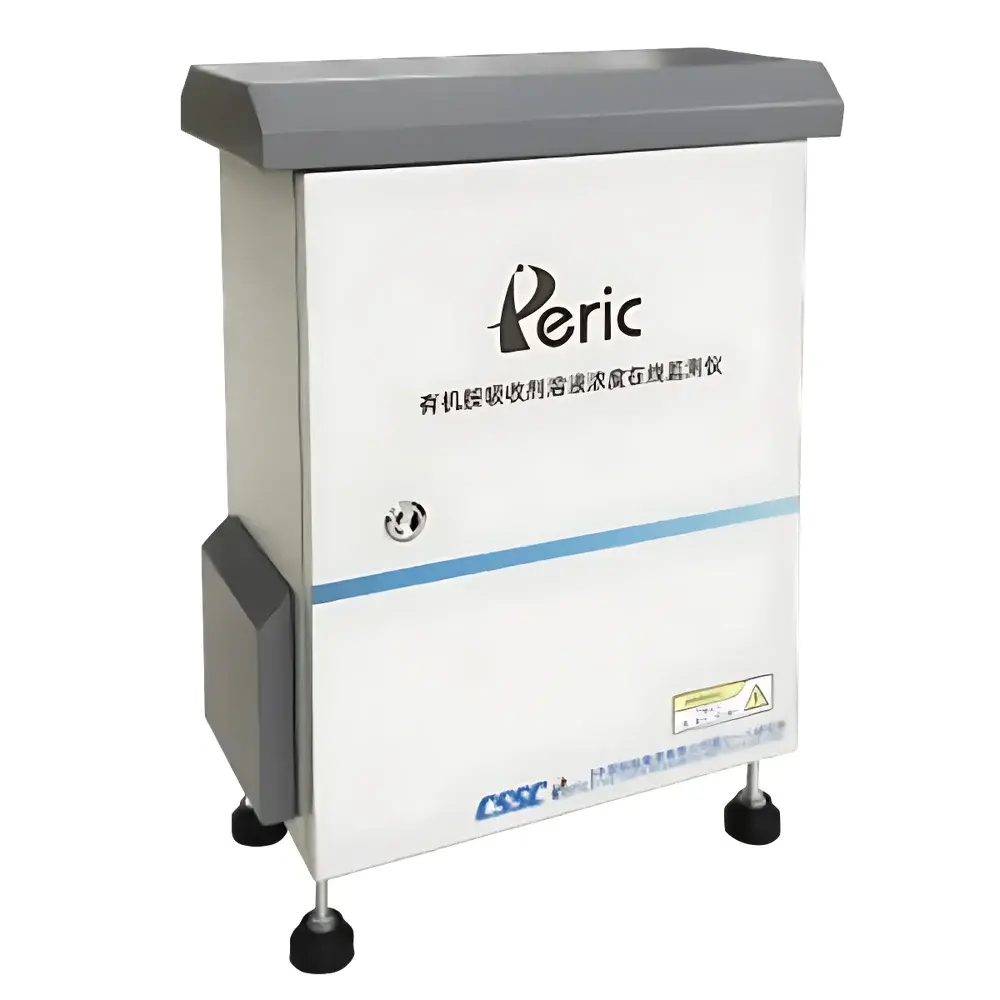
PERIC Custom Raman-Based Online Amine Concentration Monitor Model 9
| Brand | PERIC |
|---|---|
| Origin | Hebei, China |
| Manufacturer Type | Manufacturer |
| Product Category | Domestic |
| Model | Custom 9 |
| Pricing | Upon Request |
| Detection Principle | Laser Raman Spectroscopy |
| Target Analytes | Monoethanolamine (MEA), Diethanolamine (DEA) |
| Concentration Range | 0–55% (w/w) |
| Accuracy | ≤ ±1% FS |
| Response Time | ≤ 30 s |
| Operating Temperature | −10 to 50 °C |
| Operating Humidity | 15–85% RH |
| Probe Configuration | In-situ or Extractive |
| System Architecture | Modular (Separated Spectrometer Unit & Immersion Probe) |
Overview
The PERIC Custom Raman-Based Online Amine Concentration Monitor Model 9 is an industrial-grade, process-integrated spectroscopic analyzer engineered for continuous, real-time quantification of alkanolamine concentrations—specifically monoethanolamine (MEA) and diethanolamine (DEA)—in aqueous solvent streams used in post-combustion carbon capture systems. Leveraging laser-excited Raman spectroscopy, the system operates on the principle that vibrational modes of C–N, N–H, and O–H bonds in amine molecules produce spectrally distinct, concentration-dependent intensity signatures in the 2800–3600 cm−1 and 1000–1500 cm−1 regions. Unlike UV-Vis or NIR methods, Raman detection is minimally affected by water’s strong absorption background, enabling direct measurement in high-water-content amine solutions without sample dilution or reagent addition. The instrument is designed for deployment in marine decarbonization infrastructure—including onboard shipboard carbon capture units—where space constraints, vibration, humidity, and operational continuity demand ruggedized, maintenance-light instrumentation.
Key Features
- In-situ and extractive dual-mode operation: Configurable with a stainless-steel immersion probe (IP68-rated, 316L wetted parts) for direct pipeline or absorber sump insertion, or with a flow-through cuvette cell for pressurized, filtered extractive sampling—ensuring adaptability across vessel layout, piping topology, and safety zoning requirements.
- Modular architecture: Physically decoupled spectrometer unit and optical probe enable independent calibration, servicing, and replacement—reducing mean time to repair (MTTR) and eliminating full-system downtime during routine maintenance.
- Robust environmental tolerance: Certified for continuous operation at ambient temperatures from −10 °C to 50 °C and relative humidity up to 85% RH (non-condensing), with conformal coating on internal PCBs and sealed optical pathways to mitigate salt fog and hydrocarbon vapor exposure typical in marine engine rooms.
- Fast, interference-resistant quantification: Full spectral acquisition and chemometric processing completed within ≤30 seconds, delivering concentration values traceable to NIST-traceable amine reference standards. Built-in temperature and pressure compensation algorithms correct for thermal drift in Raman peak positions and intensities.
Sample Compatibility & Compliance
The system is validated for use with standard aqueous amine solvents including 20–30 wt% MEA, 30–40 wt% DEA, and blended formulations (e.g., MEA/DEA mixtures, sterically hindered amines such as AMP). It accommodates suspended particulates <5 µm and dissolved CO2-loaded carbamate/bicarbonate species without signal quenching or fouling-induced baseline shift—confirmed via 500+ hours of continuous testing in pilot-scale absorber loops. From a regulatory standpoint, the monitor supports compliance with IMO MARPOL Annex VI Tier III emission control area (ECA) reporting frameworks and aligns with ISO 8573-1 (compressed air purity) for extractive sample handling. Data integrity features—including audit-trail-enabled user logins, timestamped raw spectra storage, and write-protected calibration history—facilitate adherence to GLP and ISO/IEC 17025 documentation requirements for process analytical technology (PAT).
Software & Data Management
Control and analysis are managed via PERIC RamanView™ v3.2, a Windows-based SCADA-integrated platform compliant with OPC UA (Unified Architecture) Part 100 and Modbus TCP protocols. The software provides real-time concentration trend visualization, configurable alarm thresholds (high/low, rate-of-change), and automated generation of CSV- and PDF-formatted reports meeting ISO 14064-1 greenhouse gas monitoring plan specifications. All spectral data—including dark current, background, and calibrated intensity vectors—are stored locally on an encrypted SSD with optional cloud synchronization (AWS IoT Core compatible). For regulated environments, optional 21 CFR Part 11 add-on enables electronic signatures, role-based access control, and immutable audit trails covering method changes, calibration events, and user actions.
Applications
- Real-time optimization of lean/rich amine split ratios in CO2 absorber-regenerator cycles
- Early detection of solvent degradation products (e.g., heat-stable salts, oxidation byproducts) via spectral residual analysis
- Corrosion mitigation through dynamic control of amine concentration to maintain pH >9.5 in carbon steel piping
- Verification of solvent reclamation efficiency during distillation or ion-exchange regeneration
- Supporting digital twin integration for model-predictive control (MPC) of marine CCS plants
FAQ
Does the system require periodic recalibration with reference standards?
Yes—initial factory calibration is performed using NIST-traceable MEA/DEA aqueous standards. Field recalibration is recommended every 90 days or after major maintenance; a two-point (0% and 50% w/w) verification protocol is supported in RamanView™.
Can the probe be installed in high-pressure absorber sumps (e.g., >10 bar)?
The standard immersion probe is rated to 16 bar (232 psi) at 50 °C. For higher-pressure applications, custom Hastelloy-C276 probe housings and pressure-balanced optical windows are available upon request.
Is fiber optic cable length limited for remote probe deployment?
Standard delivery includes 10 m armored silica fiber (core/clad 200/220 µm, NA 0.22); extension to 50 m is achievable with low-loss coupling and signal-to-noise ratio (SNR) optimization in firmware.
How does the system handle spectral interference from glycol contaminants or seawater ingress?
RamanView™ employs constrained multivariate curve resolution (MCR-ALS) with pre-loaded spectral libraries for common interferents (ethylene glycol, propylene glycol, NaCl), enabling selective amine quantification even at ≤0.5% v/v contaminant levels.




