
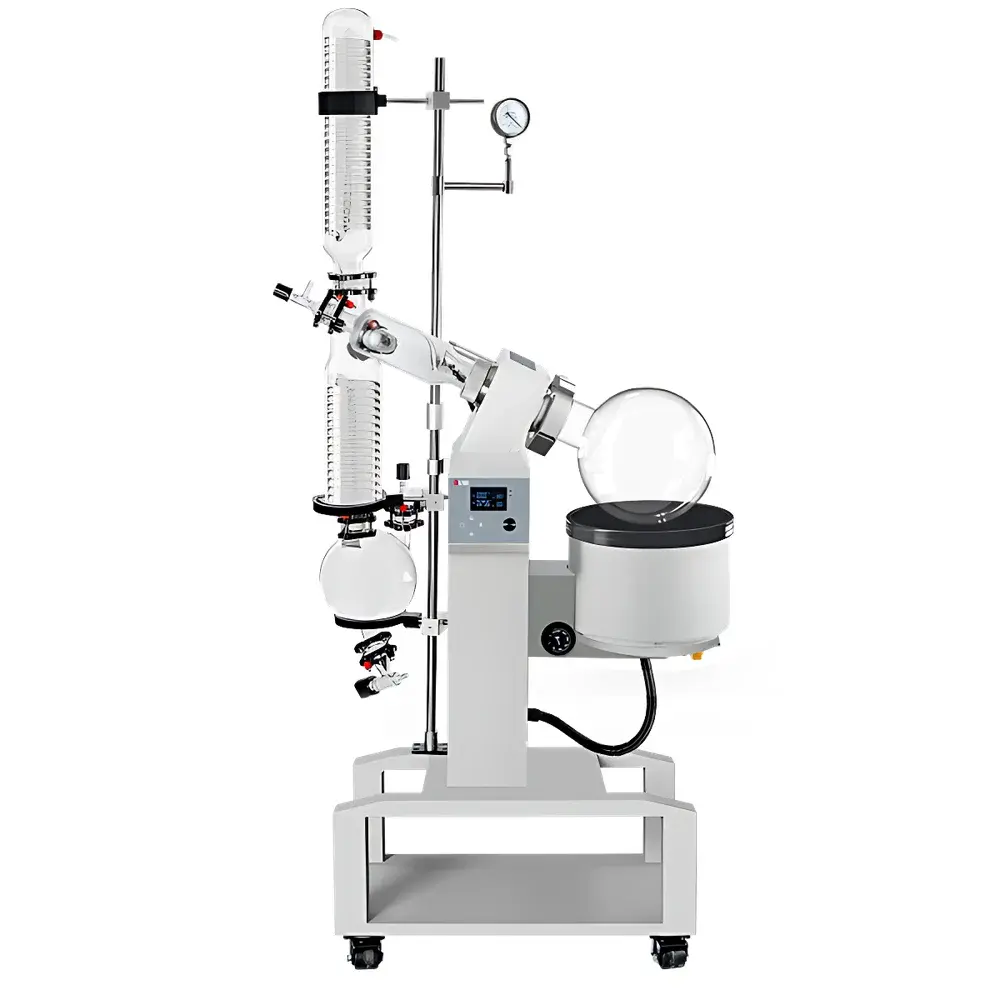
DLAB RE2000-E LCD-Controlled Rotary Evaporator
| Brand | DLAB |
|---|---|
| Origin | Beijing, China |
| Manufacturer Type | Direct Manufacturer |
| Product Origin | Domestic (China) |
| Model | RE2000-E |
| Capacity | 20 L |
| Ultimate Vacuum | 9 mbar |
| Rotation Speed | 20–130 rpm |
| Temperature Range | Water Bath: 20–100 °C |
| Oil Bath | 20–180 °C (optional) |
| Temperature Control Accuracy | ±1 °C |
| Evaporation Rate (Ethanol) | Up to 3.5 L/h |
| Lift Stroke | 180 mm |
| Heating Power | 4000 W |
| Power Supply | 220 V, 50/60 Hz |
| Dimensions (L×W×H) | 900 × 490 × 1320 mm |
| IP Rating | IP20 |
| Safety Protections | Overcurrent, leakage current, overload lift, dry-run, and overtemperature protection |
| Display | LCD (simultaneous readout of temperature, speed, rotation direction, timer) |
| Timer Range | 0–999 min |
| Heating Bath Interior | PTFE-coated |
| Condenser | Dual-layer vertical condenser with anti-backflow design |
| Sealing System | PTFE gaskets |
| Vacuum Interface | Optional vacuum controller compatibility |
| Steam Temperature Sensor | Digital vapor temperature probe |
Overview
The DLAB RE2000-E LCD-Controlled Rotary Evaporator is an industrial-grade, benchtop-to-floor-standing purification system engineered for high-throughput solvent removal, concentration, and recovery in synthetic chemistry, natural product isolation, pharmaceutical development, and quality control laboratories. It operates on the fundamental principle of reduced-pressure distillation: by rotating a sample-containing flask under controlled vacuum and regulated thermal input, the effective surface area for evaporation increases while the boiling point of solvents is lowered—enabling gentle, efficient, and reproducible separation without thermal degradation. Designed for scalability and operational continuity, the RE2000-E integrates precision microprocessor-based PID temperature regulation, programmable rotation control, and automated vertical lift—all synchronized via a dedicated LCD interface that displays real-time parameters including bath temperature, rotational speed, direction, and countdown timer. Its 20 L evaporation capacity, combined with a dual-mode heating system (standard water bath + optional oil bath), supports both routine small-batch work and large-scale preparative applications requiring extended run times and consistent thermal profiles.
Key Features
- Intuitive 4-line LCD interface displaying simultaneous real-time values for temperature, speed, rotation direction (forward/reverse), and timer—eliminating manual parameter cross-checking.
- PID-controlled heating system with ±1 °C accuracy across the full operating range (20–100 °C for water bath; 20–180 °C for optional oil bath), ensuring stable thermal conditions critical for heat-sensitive compounds.
- Motor-driven automatic lift mechanism (180 mm stroke) with smooth, low-noise linear actuation—designed for repeatable positioning and operator safety during flask loading/unloading.
- Reversible rotation (20–130 rpm) optimized for heterogeneous samples containing suspended solids or crystalline precipitates, minimizing bumping and improving mass transfer uniformity.
- Dual-layer vertical condenser with enlarged cooling surface area and integrated anti-backflow geometry—enhancing condensation efficiency and preventing solvent reflux into the evaporation flask.
- PTFE-coated stainless steel heating bath interior resistant to acids, bases, and organic solvents—ensuring long-term corrosion resistance and simplifying cleaning between batches to meet GLP traceability requirements.
- Comprehensive safety architecture: motor overcurrent protection, ground-fault circuit interrupter (GFCI), lift overload cutoff, dry-run detection, and independent overtemperature shutdown—fully compliant with IEC 61010-1 safety standards for laboratory equipment.
Sample Compatibility & Compliance
The RE2000-E accommodates standard 20 L round-bottom flasks (ISO/DIN 29/32 or 35/40 joint sizes) and interfaces seamlessly with common vacuum pumps, cold traps, and fractional collection systems. Its PTFE sealing system and chemically inert bath coating support use with aggressive solvents—including chlorinated hydrocarbons, strong acids (e.g., HCl, HNO₃), and polar aprotic media (e.g., DMF, DMSO)—without seal swelling or metal leaching. The unit meets CE marking requirements per Directive 2014/30/EU (EMC) and 2014/35/EU (LVD), and its electrical insulation and grounding design align with ISO/IEC 17025 environmental testing lab infrastructure guidelines. While not intrinsically rated for Class I Div 1 hazardous locations, it may be deployed in fume hoods certified to ANSI/AIHA Z9.5 for volatile organic compound handling.
Software & Data Management
The RE2000-E operates as a standalone instrument with embedded firmware—no external PC or proprietary software required for basic operation. All setpoints and runtime logs are retained in non-volatile memory and can be reviewed post-run via the LCD interface. For labs implementing electronic record-keeping under FDA 21 CFR Part 11 or EU Annex 11, the optional vacuum controller (DLAB VC-100 series) provides analog/digital output signals (0–10 V / 4–20 mA) compatible with SCADA, LabVIEW, or LIMS integration. Audit trails—including operator ID, start/stop timestamps, vacuum setpoint deviations, and temperature excursions—can be exported via RS-485 or USB-to-serial adapter when paired with third-party data acquisition modules configured for CSV or XML logging.
Applications
- Concentration of natural extract fractions (e.g., botanical ethanol extracts, marine lipid isolates) under mild vacuum to preserve thermolabile terpenes and polyphenols.
- Removal of reaction solvents (THF, dichloromethane, ethyl acetate) following Grignard, Suzuki, or peptide coupling syntheses—especially where solid intermediates require reverse rotation to prevent caking.
- Batch-wise solvent exchange protocols (e.g., DCM → hexane) in polymer synthesis QA/QC workflows, leveraging the auto-switching receiving flask valve for uninterrupted multi-vessel collection.
- Preparative purification of APIs prior to lyophilization or crystallization, where precise bath temperature control (±1 °C) directly influences polymorph selection and residual solvent levels.
- High-volume sample preparation for GC-MS or LC-MS analysis—supporting throughput demands in environmental testing labs processing wastewater or soil extracts.
FAQ
What vacuum level is required to achieve optimal evaporation efficiency with this system?
The RE2000-E achieves maximum solvent removal rate at ≤9 mbar absolute pressure. For low-boiling solvents (e.g., diethyl ether, acetone), operation at 10–30 mbar is typical; for higher-boiling media (e.g., ethylene glycol, glycerol), deeper vacuum (<5 mbar) combined with oil bath heating (up to 180 °C) is recommended.
Can the RE2000-E be integrated into an automated lab platform?
Yes—via optional analog I/O ports (0–10 V temperature/vacuum feedback) and RS-485 Modbus RTU protocol support, enabling synchronization with robotic liquid handlers, vacuum controllers, and central lab management systems.
Is the PTFE bath coating validated for USP Class VI biocompatibility?
The PTFE coating conforms to ASTM F798 for chemical resistance and exhibits no detectable leachables under ISO 10993-12 extraction protocols; however, formal USP Class VI certification applies only to finished medical device components—not laboratory hardware coatings.
Does the unit include documentation for IQ/OQ validation?
DLAB supplies factory calibration certificates (temperature sensor, speed encoder), electrical safety test reports, and a configurable URS template. Full IQ/OQ protocols must be developed in-house or by a qualified third-party service provider per ISO/IEC 17025.
What maintenance intervals are recommended for long-term reliability?
Inspect PTFE seals every 6 months; replace if cracked or compressed >15%. Clean condenser coils quarterly with isopropanol; verify lift motor brush wear annually. Retest temperature accuracy using NIST-traceable thermocouple every 12 months.



