
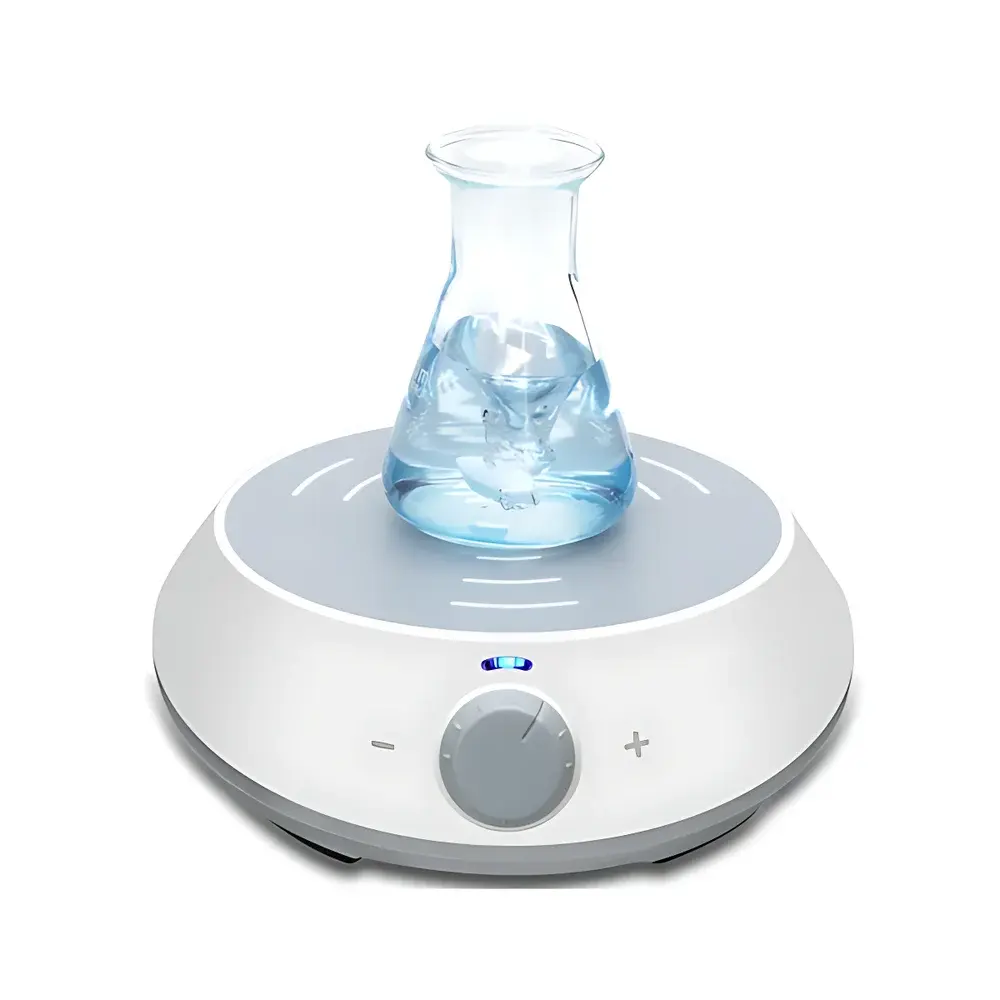
DLAB EcoStir Economy Magnetic Stirrer
| Brand | DLAB |
|---|---|
| Origin | Beijing, China |
| Manufacturer Type | Manufacturer |
| Product Category | Domestic |
| Model | EcoStir |
| Instrument Type | Magnetic Stirrer |
| Maximum Stirring Volume | 1.5 L |
| Speed Range | 300–2000 rpm |
| Temperature Control | None |
| Workplate Diameter | φ120 mm |
| Workplate Material | PET-coated |
| Motor Type | Brushless DC Motor |
| Motor Output Power | 1.2 W |
| Rated Power | 7.2 W |
| Voltage | 100–120 V / 200–240 V, 50/60 Hz |
| Stirring Position | Single |
| Max Stir Bar Length | 40 mm |
| Speed Adjustment | Analog, Stepless |
| Noise Level | Ultra-low |
| Vibration | Negligible |
| Enclosure Protection Rating | IP21 |
| Dimensions (L×W×H) | 145 × 150 × 50 mm |
| Weight | 0.3 kg |
| Operating Environment | 5–40 °C, ≤80% RH |
| Safety Certifications | CE, cTUVus, FCC, Compliant with DIN/EN 60529 |
Overview
The DLAB EcoStir Economy Magnetic Stirrer is a compact, single-position benchtop instrument engineered for precision and reliability in routine laboratory mixing tasks. It operates on the principle of magnetic coupling—where a rotating permanent magnet beneath the chemically resistant workplate induces synchronous rotation of a magnetic stir bar immersed in the sample vessel. This non-contact drive mechanism eliminates mechanical wear, ensures consistent torque transfer, and prevents contamination risks associated with shaft-based stirring systems. Designed for environments where simplicity, durability, and compliance are critical—including environmental testing labs, pharmaceutical QC units, food safety laboratories, and academic teaching facilities—the EcoStir delivers stable rotational performance across its full speed range without thermal drift or speed overshoot. Its brushless DC motor architecture ensures long-term operational stability and zero maintenance over extended service life.
Key Features
- Brushless DC motor with 1.2 W output power—ensures silent operation (<35 dB(A)), minimal vibration, and no carbon brush degradation over time;
- High-energy neodymium-iron-boron (NdFeB) drive magnet system—provides robust torque for viscous aqueous solutions up to 1.5 L volume;
- Stepless analog speed control (300–2000 rpm) with calibrated dial—enables precise adjustment without digital interface complexity;
- PET-coated ceramic-free workplate (φ120 mm)—exhibits exceptional resistance to acids, alkalis, solvents, and oxidizing agents commonly used in water quality analysis and extraction protocols;
- Integrated universal electrode holder—designed to accommodate pH, ORP, conductivity, and dissolved oxygen sensors during real-time electrochemical monitoring;
- IP21-rated enclosure—provides protection against vertically falling solid objects and limited ingress of moisture, suitable for standard lab ambient conditions (5–40 °C, ≤80% RH);
- Certified to international safety standards: CE (EU), cTUVus (North America), FCC (EMC), and fully compliant with DIN/EN 60529 for electrical equipment protection class.
Sample Compatibility & Compliance
The EcoStir supports standard borosilicate glass beakers (50–1000 mL), polypropylene centrifuge tubes, and custom reaction vessels compatible with magnetic stir bars up to 40 mm in length. Its chemical-resistant PET surface maintains integrity when exposed to dilute HCl, NaOH, ethanol, acetone, and hydrogen peroxide—making it appropriate for EPA Method-compliant water testing workflows and USP auxiliary mixing steps. While not intended for GMP production environments requiring audit-ready electronic records, the unit meets baseline requirements for GLP-regulated laboratories performing method development, calibration verification, and routine sample homogenization. No temperature regulation is integrated; users must pair with external heating plates or water baths if thermal control is required.
Software & Data Management
The EcoStir is a standalone analog instrument with no embedded microcontroller, firmware, or connectivity interfaces. As such, it does not generate electronic logs, support remote control, or require software installation. This architecture eliminates cybersecurity vulnerabilities, reduces validation burden in regulated settings, and aligns with FDA 21 CFR Part 11 principles for instruments classified as “non-record-keeping devices.” All operational parameters—including speed setting—are manually controlled and visually verified via the front-panel dial, supporting manual entry into laboratory notebooks or LIMS templates per institutional SOPs.
Applications
- Environmental monitoring: Homogenization of wastewater samples prior to ICP-MS, AAS, or ion chromatography analysis;
- Pharmaceutical QA/QC: Dissolution medium agitation during USP Apparatus 2 (paddle) method validation and excipient compatibility studies;
- Food microbiology: Uniform suspension of bacterial cultures in nutrient broths for colony-forming unit (CFU) enumeration;
- Academic instruction: Demonstration of mass transfer kinetics, redox titration endpoints, and buffer equilibration in undergraduate chemistry labs;
- Brewing & fermentation science: Controlled aeration-free mixing during yeast propagation, wort conditioning, and starter culture preparation.
FAQ
Is the EcoStir suitable for use with corrosive reagents such as concentrated nitric acid?
No. While the PET-coated surface resists common laboratory chemicals (e.g., 1 M HCl, 1 M NaOH, 95% ethanol), it is not rated for prolonged exposure to strong oxidizers like concentrated HNO₃ or hot fuming sulfuric acid. Always consult the material compatibility chart before use.
Can multiple vessels be stirred simultaneously on one unit?
No. The EcoStir is a single-position stirrer. For parallel processing, consider the DLAB MS-H-Pro+ multi-station platform or stackable configurations with independent controls.
Does the unit include a stir bar?
No. Stir bars (e.g., PTFE-coated, oval-shaped, 20–40 mm) must be selected and purchased separately based on viscosity and vessel geometry requirements.
What is the expected service life under continuous daily operation?
With proper handling and avoidance of mechanical impact or thermal shock, the brushless motor and sealed magnetic drive system typically exceed 20,000 hours of cumulative runtime—equivalent to >10 years at 6 h/day usage.
Is calibration required or supported?
Speed calibration is not user-serviceable. DLAB recommends annual verification using an optical tachometer traceable to NIST standards, particularly in ISO/IEC 17025-accredited laboratories performing accredited testing.
Related Products



