
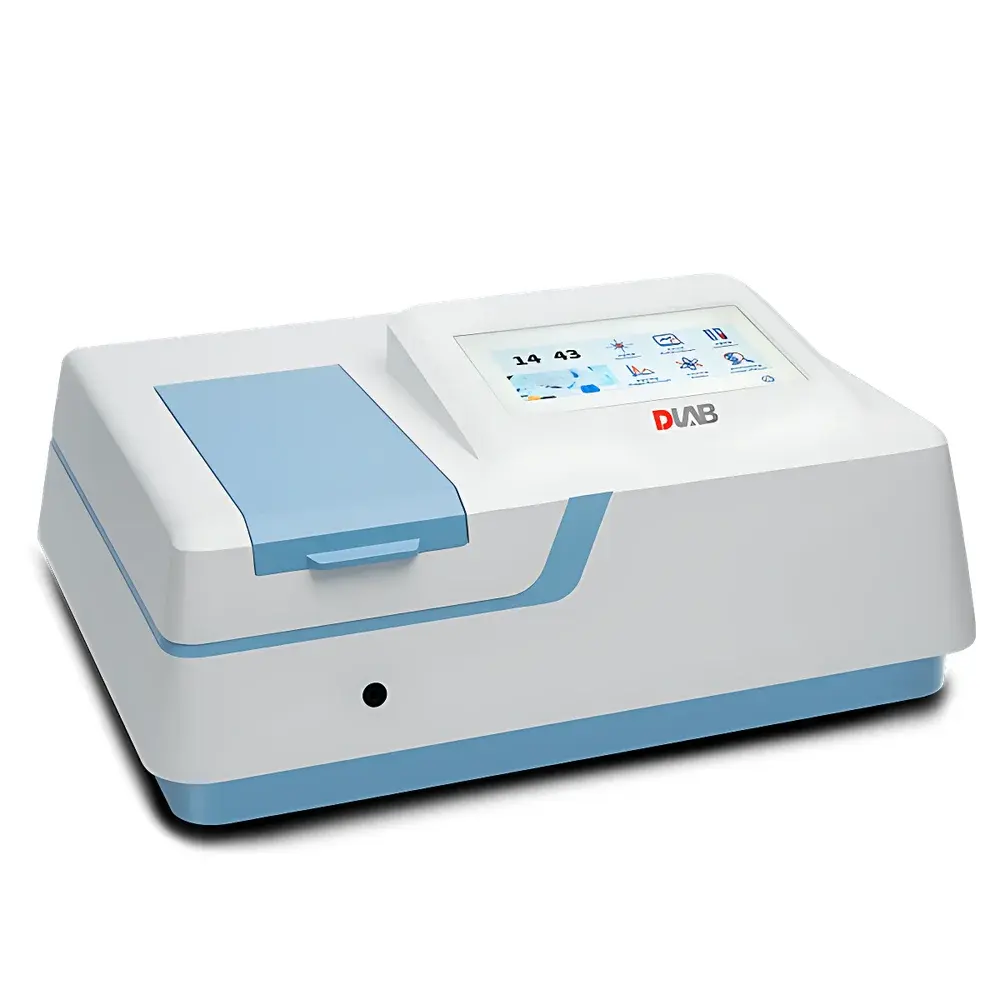
DLAB SP-XUV5102 Dual-Beam Ultraviolet-Visible Spectrophotometer
| Brand | DLAB |
|---|---|
| Origin | Beijing, China |
| Manufacturer Type | Original Equipment Manufacturer (OEM) |
| Instrument Architecture | Dual-Beam |
| Wavelength Range | 190–1100 nm |
| Spectral Bandwidth | 2.0 nm |
| Wavelength Accuracy | ±0.1 nm at 656.1 nm, ±0.3 nm across full range |
| Wavelength Repeatability | ≤0.1 nm |
| Stray Light | ≤0.03% T at 220 nm and 360 nm |
| Photometric Range | –0.3 to 3.0 A, 0–9999 C (Concentration), 0–9999 F (Factor) |
| Photometric Accuracy | ±0.002 A (0–0.5 A), ±0.003 A (0.5–1.0 A) |
| Photometric Repeatability | ±0.001 A (0–0.5 A), ±0.0015 A (0.5–1.0 A) |
| Baseline Stability | ≤0.001 A/h at 500 nm |
| Detector | Digital Photodiode Array |
| Light Source | Hamamatsu Xenon Lamp (Long-Life) |
| Display | 10.1-inch TFT Color Touchscreen (1024 × 600 resolution) |
| Interface | USB port, Printer port |
| Power Supply | 110/220 V AC, 50/60 Hz, 120 W |
| Dimensions (L × W × H) | 570 × 440 × 210 mm |
| Weight | 20 kg |
Overview
The DLAB SP-XUV5102 is a high-performance dual-beam ultraviolet-visible (UV-Vis) spectrophotometer engineered for precision absorbance, transmittance, and concentration measurements across the 190–1100 nm spectral range. Based on a stable dual-beam optical architecture, it continuously compares sample and reference beam intensities in real time—minimizing errors from source drift, detector instability, or environmental fluctuations. The instrument employs a holographic grating monochromator and a digitally calibrated photodiode array detector to ensure low stray light (≤0.03% T), high wavelength fidelity (±0.1 nm at 656.1 nm), and exceptional photometric linearity. Its Hamamatsu xenon lamp provides broad-spectrum output with extended operational lifetime (>2,000 hours), eliminating frequent lamp replacement and associated recalibration downtime. Designed for routine QC/QA labs, academic research, and regulatory-compliant environments, the SP-XUV5102 delivers reproducible data under ISO/IEC 17025, ASTM E275, and USP guidelines.
Key Features
- Dual-beam optical system with real-time background correction for enhanced measurement stability and reduced baseline drift
- 10.1-inch high-resolution color touchscreen interface (1024 × 600) enabling intuitive navigation, method setup, and on-device data review without PC dependency
- Holographic grating monochromator and digital photodiode detection ensuring low noise, high signal-to-noise ratio, and minimal photometric error
- Advanced wavelength drive mechanism delivering ≤0.1 nm repeatability and ±0.3 nm accuracy across full 190–1100 nm range
- Comprehensive built-in measurement modes: Photometric (A/T/C/F), Quantitative Analysis (single/multi-point calibration), Spectrum Scanning, Kinetic Studies, Multi-Wavelength Analysis, and Biomolecular Assays (DNA/RNA/protein A260/A280)
- Robust mechanical design with vibration-damped optical bench, temperature-stabilized cuvette compartment, and electromagnetic shielding for consistent performance in shared lab spaces
Sample Compatibility & Compliance
The SP-XUV5102 accommodates standard 10 mm pathlength quartz or glass cuvettes via its fixed holder, while optional accessories expand capability to specialized applications: automated 8-position cuvette changers, variable-pathlength cells (1–10 cm), micro-volume adapters (down to 2 µL), integrating spheres (for diffuse reflectance/transmittance), temperature-controlled holders (–10 to 100 °C), and solid-sample reflectance modules. All hardware and firmware comply with IEC 61010-1 safety standards and EMC Directive 2014/30/EU. Software functionality supports GLP/GMP workflows per FDA 21 CFR Part 11 requirements—including user role-based access control, electronic signatures, immutable audit trails, and timestamped metadata logging for every measurement event.
Software & Data Management
The optional PC-based DLabSpec software enables advanced spectral processing, kinetic modeling, spectral library matching, and multi-curve overlay analysis. It enforces data integrity through structured project folders, versioned method templates, and encrypted local database storage. Raw spectra, calibration curves, kinetic traces, and report exports (PDF, CSV, XML) retain full traceability to instrument serial number, operator ID, date/time stamp, and environmental parameters (if logged). USB export preserves native formatting for post-acquisition analysis in MATLAB, Origin, or Excel. Internal memory retains ≥10,000 spectra and 500 quantitative methods; power-loss recovery ensures no data corruption during unexpected shutdowns.
Applications
- Pharmaceutical quality control: Assay validation, dissolution testing, excipient interference screening per USP and EP 2.2.25
- Environmental analysis: Nitrate/nitrite, phosphate, COD, and heavy metal quantification using EPA-approved colorimetric methods
- Food & beverage: Carotenoid profiling, anthocyanin content, sulfite detection, and enzyme activity assays (e.g., LDH, ALP)
- Academic research: Ligand-binding studies, protein folding kinetics, nanoparticle size estimation via plasmon resonance, and polymer degradation monitoring
- Clinical biochemistry: Total protein, albumin/globulin ratio, bilirubin, and enzymatic activity (AST, ALT) using standardized kinetic protocols
FAQ
Does the SP-XUV5102 support compliance with FDA 21 CFR Part 11?
Yes—the embedded operating system and optional DLabSpec software implement electronic signature workflows, audit trail generation, and user privilege management aligned with Part 11 requirements for regulated laboratories.
What is the typical lifetime of the Hamamatsu xenon lamp?
The lamp is rated for ≥2,000 hours of operation under standard usage conditions (1 hour/day, 5 days/week), significantly exceeding halogen-deuterium lamp alternatives.
Can the instrument perform kinetic measurements over extended time periods?
Yes—up to 24-hour continuous acquisition is supported with programmable sampling intervals (0.1 s to 60 min), automatic baseline correction, and real-time curve fitting (linear, exponential, sigmoidal).
Is third-party software integration possible?
The instrument exposes a documented ASCII command protocol over USB CDC virtual COM port, enabling integration with LabVIEW, Python (PySerial), or custom LIMS via RS-232 emulation.
How is wavelength calibration verified and maintained?
Factory calibration uses NIST-traceable holmium oxide and didymium filters. Users may perform verification scans at any time; optional automated calibration kits are available for routine verification per ISO 17025 internal quality procedures.
Related Products






