
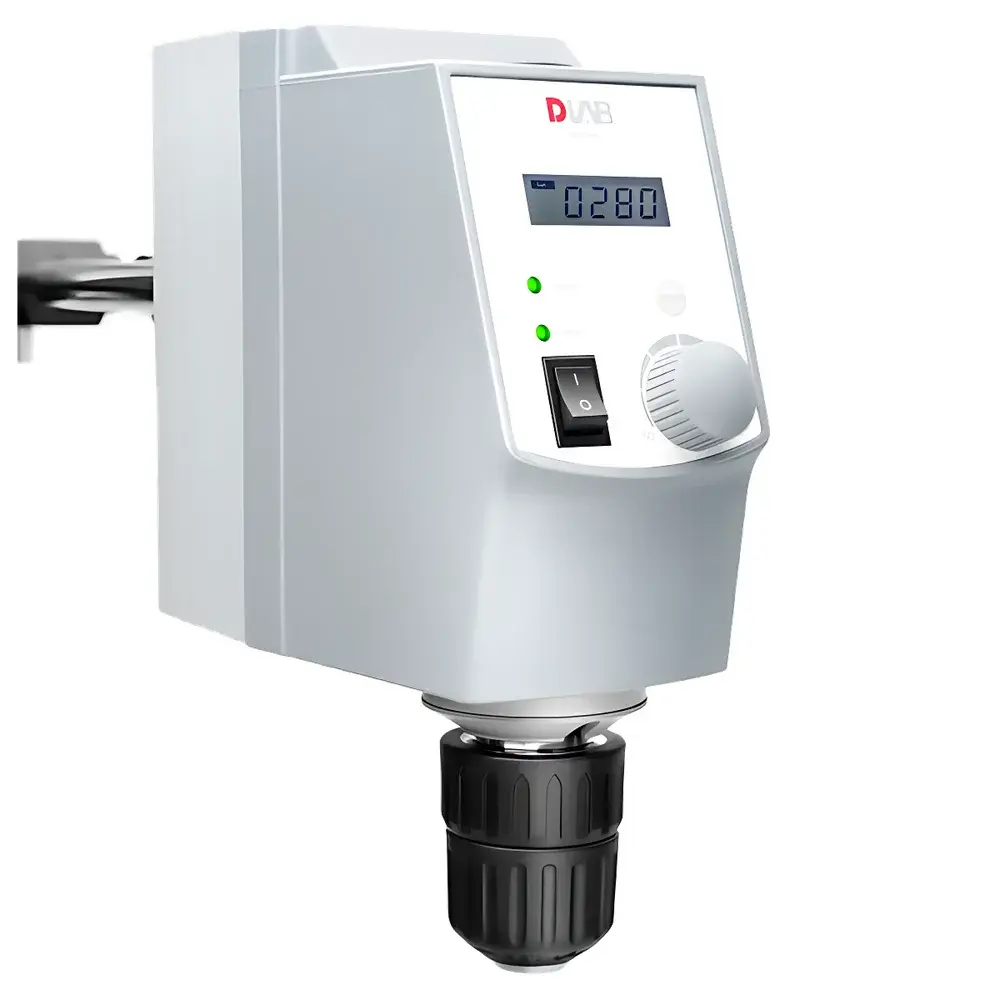
DLAB OS20-Pro LCD Overhead Electronic Stirrer
| Brand | DLAB |
|---|---|
| Origin | Beijing, China |
| Manufacturer Type | Direct Manufacturer |
| Product Category | Domestic (China-made) |
| Model | OS20-Pro |
| Instrument Type | Electric Overhead Stirrer |
| Maximum Mixing Volume | 20 L |
| Speed Range | 50–2200 rpm |
Overview
The DLAB OS20-Pro LCD Overhead Electronic Stirrer is an engineered solution for precise, reproducible, and scalable mixing in research laboratories, quality control environments, and pilot-scale process development. Designed on the principle of direct-drive torque transmission via a high-efficiency brushless DC motor, the OS20-Pro delivers consistent rotational energy transfer to impellers—minimizing mechanical backlash and enabling stable operation across wide viscosity and volume ranges. Unlike magnetic stirrers limited by heat-sensitive or sealed-vessel applications, this overhead configuration supports closed-system agitation (e.g., jacketed reactors, glass-lined vessels, and pressurized reactors), making it suitable for exothermic reactions, solvent-intensive syntheses, and temperature-controlled crystallization protocols. Its robust aluminum-alloy housing and IP21-rated enclosure ensure structural integrity and protection against incidental splashes and particulate ingress during routine lab use.
Key Features
- Large backlit LCD display with real-time speed readout (rpm), elapsed runtime, and error code diagnostics—enabling immediate operational feedback without external instrumentation.
- Microprocessor-controlled speed regulation with ±1% speed accuracy across the full 50–2200 rpm range; digital setpoint memory retains last-used parameters after power cycling.
- High-torque brushless DC motor delivering up to 85 N·cm nominal torque—capable of homogenizing viscous media (up to ~50,000 mPa·s) and suspending dense particulates in aqueous or organic phases.
- Ergonomic height-adjustable support column with dual-locking mechanism (coarse + fine) ensures repeatable positioning over vessels from 50 mL to 20 L capacity.
- Integrated thermal overload protection and automatic motor shutdown upon abnormal load detection or extended stall conditions—compliant with IEC 61000-6-2 electromagnetic immunity standards.
- Standardized 10 mm hex shaft interface compatible with DLAB’s full range of PTFE-coated, stainless-steel, and glass-coated impellers (Rushton, pitched-blade, anchor, and helical types).
Sample Compatibility & Compliance
The OS20-Pro accommodates a broad spectrum of sample formats: open beakers, round-bottom flasks (with clamping adapters), jacketed reactors (up to 200 mm diameter), and custom-engineered vessels fitted with standard ISO-KF or DIN 2817 ports. It supports operation under inert atmosphere (N₂/Ar glovebox integration), low-temperature cryoreactors (−40 °C to 80 °C with optional cooling shrouds), and moderate vacuum conditions (<100 mbar). From a regulatory standpoint, the device meets CE marking requirements per Directive 2014/30/EU (EMC) and 2014/35/EU (LVD). While not intrinsically rated for hazardous locations, its design aligns with general laboratory safety practices outlined in ANSI Z9.5–2022 (Laboratory Ventilation) and ISO/IEC 17025:2017 clause 6.4.3 (Equipment Suitability Verification). Documentation includes factory calibration certificates traceable to NIM (National Institute of Metrology, China).
Software & Data Management
The OS20-Pro operates as a standalone instrument with no mandatory software dependency. However, optional RS-232 or USB-to-serial interface (available via accessory module) enables bidirectional communication with third-party lab information management systems (LIMS) or electronic lab notebooks (ELN). When connected, users can log timestamped speed profiles, trigger event markers (e.g., “addition start”, “cooling initiated”), and export CSV-formatted runtime logs compliant with ALCOA+ data integrity principles. Audit trail functionality—including user ID tagging, parameter change history, and firmware version stamping—is supported in conjunction with validated ELN platforms adhering to FDA 21 CFR Part 11 requirements. No cloud connectivity or proprietary cloud service is embedded—ensuring full data sovereignty.
Applications
- Chemical synthesis: Controlled addition and mixing during Grignard, Friedel-Crafts, and transition-metal-catalyzed reactions where shear sensitivity and thermal uniformity are critical.
- Pharmaceutical development: Dissolution testing of immediate-release tablets (per USP ), suspension formulation homogenization, and buffer preparation for bioprocessing steps.
- Materials science: Dispersion of nanomaterials (graphene oxide, TiO₂ nanoparticles) in polymer matrices and solvent-based slurries prior to rheological or spectroscopic characterization.
- Environmental analysis: Extraction and digestion of solid samples (e.g., soil, sludge) using EPA Method 3050B-compliant acid leaching protocols requiring vigorous, prolonged agitation.
- Food & beverage R&D: Emulsion stabilization trials, enzyme kinetics studies under controlled shear, and sensory sample preparation requiring batch-to-batch consistency.
FAQ
Is the OS20-Pro compatible with glass reactor vessels equipped with standard ground-glass joints?
Yes—the unit accepts standard 10 mm hex drive shafts and integrates seamlessly with DLAB’s GGS-series joint adapters for 24/40, 29/32, and 34/45 taper fittings.
Can speed profiles be programmed for multi-stage mixing sequences?
No—the OS20-Pro does not feature built-in programmable ramping or timed stages; however, external PLC or timer relays may be interfaced via its analog 0–10 V control input (optional accessory).
What impeller types are recommended for high-viscosity polymer melts?
Anchor or helical ribbon impellers made from 316L stainless steel with PTFE coating are advised for viscosities exceeding 10,000 mPa·s; maximum recommended tip speed remains ≤2.5 m/s to avoid cavitation or degradation.
Does the device include validation documentation for GMP environments?
Factory calibration reports and IQ/OQ templates are provided upon request; final PQ must be executed by the end user per their internal SOPs and applicable Annex 15 or ASTM E2500 guidelines.
Is maintenance required beyond periodic visual inspection and shaft lubrication?
The brushless motor is sealed and maintenance-free; annual verification of torque output and speed linearity using a certified tachometer and calibrated load cell is recommended for regulated applications.



