
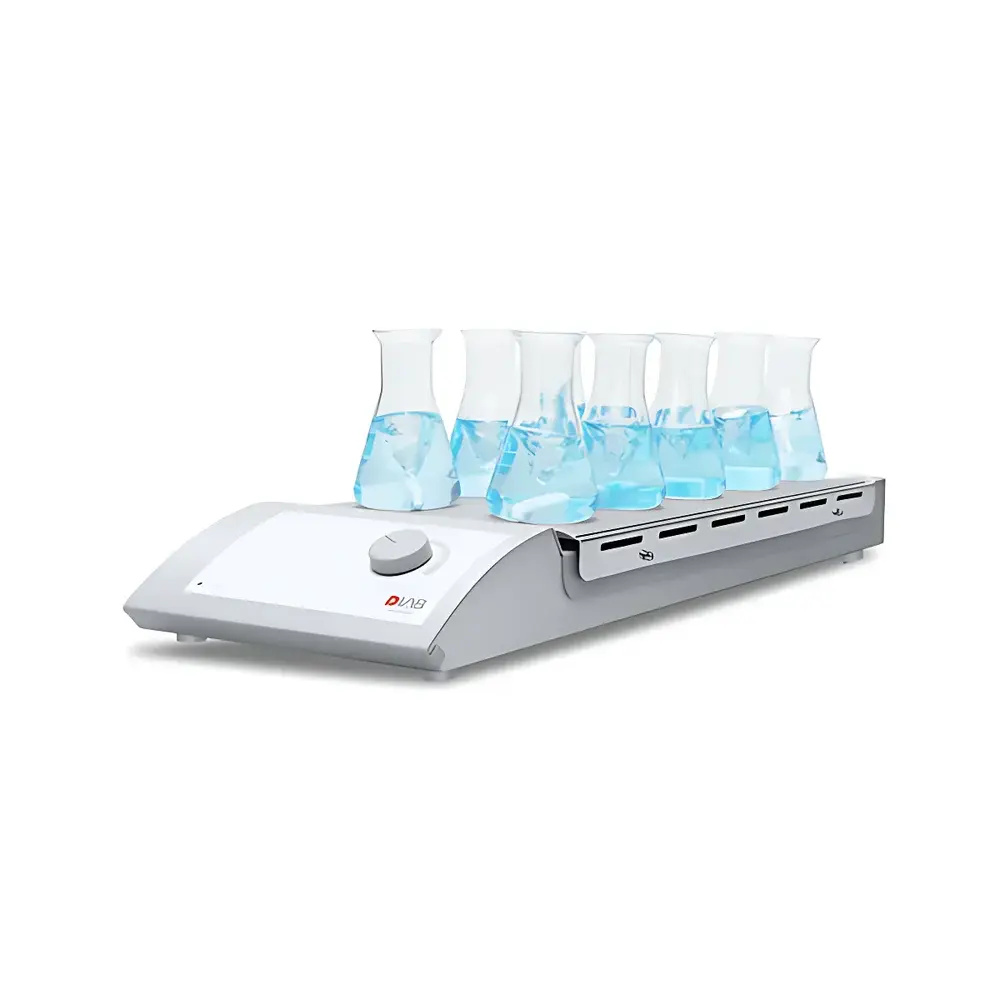
DLAB MS-M-S10 10-Position Magnetic Stirrer
| Brand | DLAB |
|---|---|
| Origin | Beijing, China |
| Manufacturer Type | Direct Manufacturer |
| Product Category | Domestic (China-made) |
| Model | MS-M-S10 |
| Instrument Type | Magnetic Stirrer |
| Max. Stirring Volume | 0.4 L × 10 positions |
| Speed Range | 0–1100 rpm |
| Temperature Control | Ambient only |
| Workplate Dimensions (L×W) | 180 × 450 mm |
| Plate Material | Stainless Steel with Silicone Resin Coating |
| Motor Type | Brushless DC Motor |
| Input Power | 12 W |
| Output Power | 4 W |
| Total Power Consumption | 20 W |
| Voltage | 100–120 V / 200–240 V, 50/60 Hz |
| Stir Bar Max. Length | 40 mm |
| Speed Display | Analog Scale |
| IP Rating | IP21 |
| Dimensions (L×W×H) | 622 × 205 × 65 mm |
| Weight | 3.2 kg |
| Operating Environment | 5–40 °C, ≤80% RH |
Overview
The DLAB MS-M-S10 is a compact, high-efficiency 10-position magnetic stirrer engineered for parallel sample handling in quality control laboratories, academic research settings, and routine analytical workflows. It operates on the principle of rotating magnetic fields generated beneath a non-magnetic work surface to drive PTFE- or glass-coated stir bars immersed in liquid samples. Unlike overhead mechanical stirrers, this device eliminates shaft seal wear, cross-contamination risk, and mechanical vibration transmission—making it ideal for low-to-medium viscosity aqueous and organic solutions requiring gentle yet consistent mixing. Designed for ambient-temperature applications only, the MS-M-S10 does not integrate heating or temperature regulation; its thermal neutrality ensures compatibility with thermally sensitive reagents, enzymatic assays, and pH-stable buffer preparations where exogenous heat input must be strictly avoided.
Key Features
- Simultaneous operation across 10 independent stirring positions, each supporting up to 400 mL of water-equivalent volume—optimized for high-throughput titration prep, dissolution testing, or multi-vial reagent homogenization.
- Brushless DC motor architecture delivering stable rotational torque across the full 0–1100 rpm range, with no carbon brush degradation or periodic maintenance requirements—ensuring long-term speed consistency and operational reliability.
- Electropolished stainless steel workplate coated with a chemically inert silicone resin film, providing superior slip resistance, corrosion resistance against acids, bases, and solvents, and easy decontamination via wipe-down protocols.
- Analog speed scale calibrated for intuitive visual reference—enabling rapid setup without digital interface dependencies or software calibration routines.
- Universal dual-voltage power supply (100–120 V / 200–240 V, 50/60 Hz) compliant with international laboratory electrical standards, eliminating need for external transformers in global deployment.
- IP21-rated enclosure offering protection against vertically falling solid objects and limited ingress of moisture—suitable for standard ISO Class 7 (10,000) clean bench environments and general-purpose lab benches.
Sample Compatibility & Compliance
The MS-M-S10 supports standard laboratory-grade magnetic stir bars up to 40 mm in length and 8 mm in diameter, compatible with common geometries including oval, cylindrical, and flea-shaped designs. It is validated for use with aqueous buffers (e.g., PBS, Tris-HCl), dilute acid/base solutions (≤1 M HCl, ≤1 M NaOH), ethanol/water mixtures, and low-viscosity organic solvents (e.g., acetone, THF). The absence of integrated heating aligns with ASTM E2912–22 guidelines for ambient-condition mixing validation and supports GLP-compliant documentation where thermal drift must be excluded as a variable. Device construction adheres to IEC 61010-1:2010 safety requirements for electrical equipment used in laboratory environments.
Software & Data Management
The MS-M-S10 is a standalone analog instrument with no embedded firmware, USB connectivity, or data logging capability. Its design intentionally omits digital control interfaces to reduce electromagnetic interference (EMI) susceptibility, enhance electromagnetic compatibility (EMC) in proximity to sensitive instrumentation (e.g., balances, spectrophotometers), and minimize validation burden under FDA 21 CFR Part 11 or EU Annex 11 frameworks. Speed settings are manually selected and visually confirmed via fixed-scale dial—supporting audit-ready procedural traceability when documented in SOPs and batch records.
Applications
- Parallel preparation of calibration standards and QC reference solutions across 10 vials or beakers.
- Homogenization of cell culture media, enzyme reaction mixtures, and immunoassay diluents prior to analysis.
- Stirring during potentiometric titrations, redox reactions, and gravimetric precipitations where uniform dispersion—without heat-induced side reactions—is critical.
- Supporting dissolution testing per USP for non-thermally activated formulations (e.g., immediate-release tablets in ambient-sink conditions).
- Use in teaching laboratories for demonstrating stoichiometric mixing kinetics, solubility equilibria, and mass transfer principles under controlled mechanical agitation.
FAQ
Does the MS-M-S10 include a heating function?
No. This model is strictly a magnetic stirrer without integrated heating elements. It is intended for ambient-temperature mixing only.
Can it operate continuously for extended periods?
Yes. The brushless DC motor and thermal management design support unattended operation for ≥72 hours at speeds ≤800 rpm under nominal load conditions.
What is the maximum recommended viscosity for reliable stirring?
Up to 500 mPa·s (e.g., 1% w/v CMC solution) at lower speeds (≤300 rpm); performance declines above 1000 mPa·s due to torque limitations.
Is the workplate resistant to hydrochloric acid or sodium hydroxide exposure?
Yes. The silicone resin coating provides verified resistance to 1 M HCl and 1 M NaOH for ≤2-hour contact durations, per ISO 2812-2 corrosion testing methodology.
Does DLAB provide calibration certificates or IQ/OQ documentation?
DLAB supplies factory verification reports confirming speed accuracy (±5% of setpoint) and electrical safety compliance; formal IQ/OQ protocols must be developed in-house per user-specific validation requirements.



