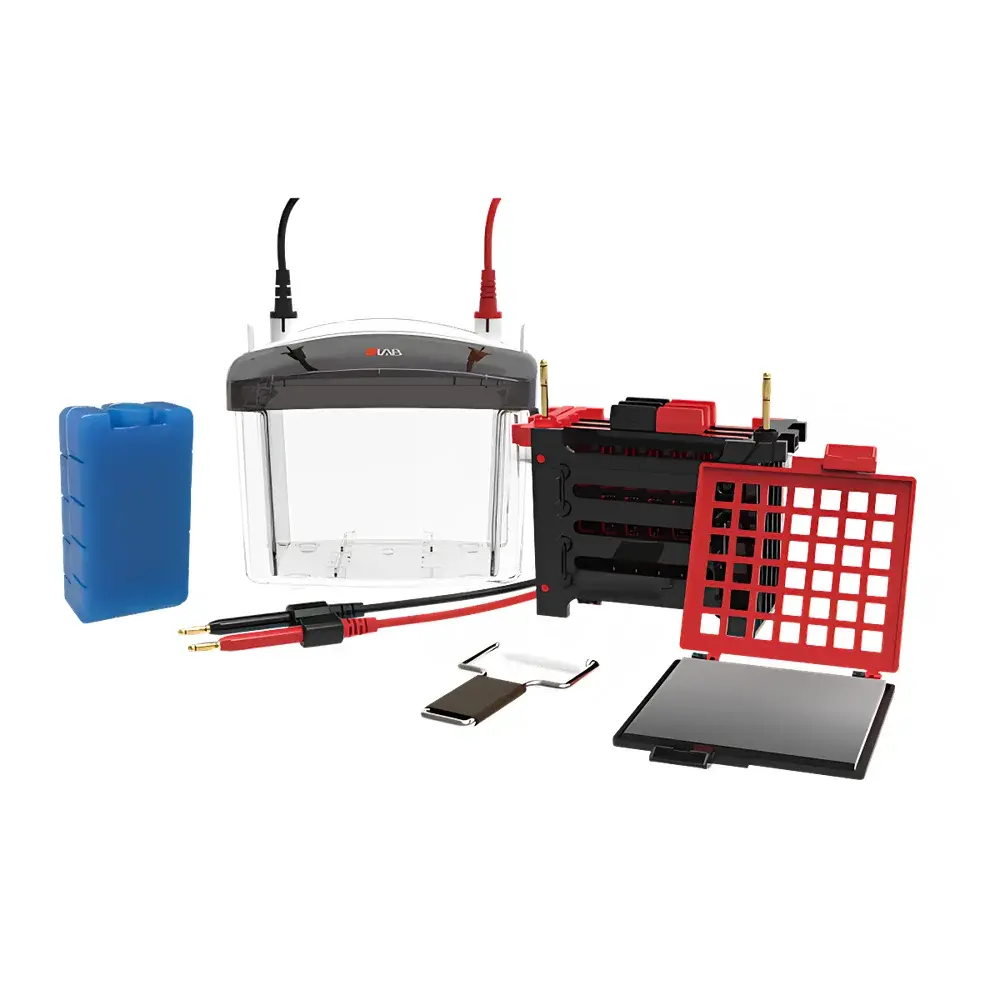
DLAB DL-ZY04 Mini Transfer Electrophoresis Cell
| Brand | DLAB |
|---|---|
| Origin | Beijing, China |
| Manufacturer Type | Direct Manufacturer |
| Country of Origin | China |
| Model | DL-ZY04 |
| Price | Upon Request |
| Gel Capacity | 4 × 83 × 73 mm gels |
| Transfer Area | 110 × 90 mm |
| Electrode Spacing | 5.5 cm |
| Electrode Material | 99.99% Pure Platinum Wire |
| Chamber Material | Optical-Grade Polycarbonate |
| Integrated Cooling | Built-in Ice Chamber |
| Accessory | Dedicated Bubble Roller |
| Gel Sandwich Clamp | Open-Design, Tool-Free Assembly |
Overview
The DLAB DL-ZY04 Mini Transfer Electrophoresis Cell is an engineered solution for semi-dry and wet electroblotting of proteins and nucleic acids from polyacrylamide or agarose gels onto nitrocellulose or PVDF membranes. Designed around the principles of uniform electric field distribution and thermal management, the system leverages a fixed 5.5 cm inter-electrode gap to generate a stable, high-intensity electric field—critical for consistent transfer efficiency across multiple small-format gels. Its compact footprint (110 × 90 mm active transfer area) targets laboratories performing routine Western blotting, validation workflows, or method development where reproducibility, ease of setup, and minimal buffer consumption are prioritized over high-throughput scalability.
Key Features
- Multi-gel capacity: Simultaneous transfer of up to four standard mini-gels (83 × 73 mm), enabling parallel processing without cross-contamination or positional bias.
- Precision electrode architecture: Parallel platinum wire electrodes (99.99% purity) ensure low-resistance current delivery, minimal polarization, and long-term corrosion resistance—even under repeated exposure to methanol-containing transfer buffers.
- Optical-grade polycarbonate chamber: Injection-molded housing provides mechanical rigidity, chemical resistance to common electrophoresis reagents (e.g., Tris-glycine, CAPS, SDS), and full visual monitoring of gel alignment and buffer level during operation.
- Integrated thermal management: A recessed, removable ice chamber sits directly beneath the gel stack, absorbing Joule heating in real time—maintaining transfer temperatures below 25 °C and preserving epitope integrity for sensitive antigen-antibody interactions.
- Ergonomic open-clamp design: The tool-free, hinged sandwich clamp allows rapid assembly of the membrane–gel–filter paper stack with tactile feedback; color-coded red (anode) and black (cathode) terminals prevent orientation errors that cause reversed or failed transfers.
- Accessory-optimized workflow: Includes a dedicated silicone bubble roller for uniform expulsion of air pockets between layers—reducing localized arcing and ensuring maximal surface contact for efficient macromolecular migration.
Sample Compatibility & Compliance
The DL-ZY04 supports standard mini-format SDS-PAGE and native PAGE gels (≤1.5 mm thickness), as well as low-percentage agarose gels for large DNA fragments. It is compatible with both standard and low-fluorescence transfer membranes (0.2 µm and 0.45 µm pore sizes) and accommodates common transfer buffers including Towbin, CAPS, and Bjerrum systems. While not certified for GMP production environments, the device meets general laboratory equipment requirements per ISO 13485 Annex C for non-sterile benchtop instrumentation and aligns with Good Laboratory Practice (GLP) documentation standards for experimental traceability when used with validated protocols.
Software & Data Management
As a standalone electrophoretic transfer cell, the DL-ZY04 operates without embedded firmware or digital controls. Power input is managed externally via standard DC power supplies (typically 10–30 V, 0.1–1.0 A). Users are advised to log transfer parameters—including voltage, current, duration, buffer composition, ambient temperature, and ice mass—manually or within LIMS-compatible electronic lab notebooks (ELNs) to satisfy audit requirements under FDA 21 CFR Part 11 for regulated research. DLAB provides a printable SOP template aligned with ISO/IEC 17025 clause 7.2.2 for method verification.
Applications
- Primary antibody validation via replicate Western blotting
- Preparative protein transfer for mass spectrometry sample preparation
- Small-scale siRNA or CRISPR guide RNA transfer verification
- Teaching laboratory modules on protein mobility, charge-to-mass ratio, and blotting kinetics
- Quality control of recombinant protein expression gels prior to purification
- Optimization of transfer conditions (voltage/time/buffer pH) for novel membrane chemistries
FAQ
What is the maximum recommended transfer duration for optimal protein recovery?
Typical semi-dry transfers range from 30 to 90 minutes at constant voltage (15–25 V); extended durations (>2 hours) may increase diffusion artifact risk without proportional yield gain.
Can the DL-ZY04 be used for nucleic acid transfer?
Yes—when paired with alkaline or neutral transfer buffers and nylon membranes, it effectively transfers DNA/RNA fragments ≥50 bp, though resolution is optimized for fragments <5 kb.
Is the ice chamber compatible with dry-ice or chilled ethanol baths?
No—the chamber is designed exclusively for crushed ice or pre-chilled deionized water; cryogenic solvents may induce polycarbonate microcracking or dimensional instability.
How often should platinum electrodes be cleaned?
Rinse thoroughly with deionized water after each use; ultrasonic cleaning in 70% ethanol for 5 minutes is recommended monthly to remove organic residue without compromising surface integrity.
Does DLAB provide protocol validation data for ISO 5725 or CLSI EP10?
DLAB supplies application notes with inter-laboratory repeatability metrics (n=6 labs, CV ≤8.3% for β-actin band density) but does not perform formal ISO/CLSI interlaboratory studies; users must conduct in-house verification per their QMS.