
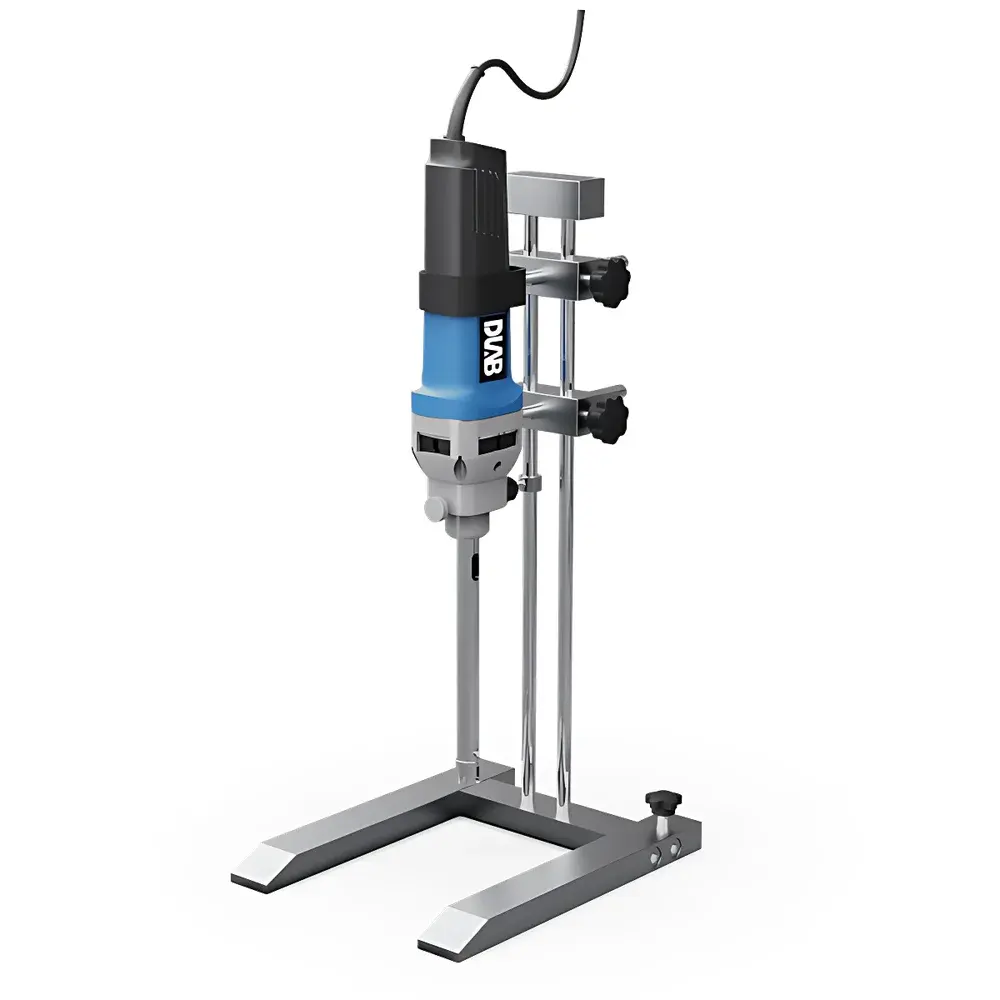
DLAB D-500 Series High-Shear Rotor-Stator Homogenizer
| Brand | DLAB |
|---|---|
| Origin | Beijing, China |
| Manufacturer Type | Direct Manufacturer |
| Model | D-500/1, D-500/2 |
| Dimensions (W×D×H) | 75 × 75 × 280 mm |
| Processing Volume Range | 10–40,000 mL |
| Rotor-Stator Material | 316L Stainless Steel |
| Max. Sample Viscosity | 10,000 mPa·s |
| Speed Control | 6-step continuous adjustment |
| Safety | Integrated overload protection & soft-start motor |
| Sterilization Compatibility | Autoclavable components (121°C, 20 min) |
Overview
The DLAB D-500 Series is a benchtop high-shear rotor-stator homogenizer engineered for reproducible, scalable sample disruption, emulsification, and dispersion in life science, pharmaceutical, and materials research laboratories. Operating on the principle of hydrodynamic shear generated between a rapidly rotating rotor and a fixed stator, the system induces intense localized turbulence, cavitation, and mechanical stress—enabling efficient cell lysis, nanoparticle deagglomeration, and uniform phase mixing across viscous and heterogeneous matrices. Its compact footprint (75 × 75 × 280 mm) supports integration into biosafety cabinets, cold rooms, or shared instrumentation suites without compromising performance. Designed for routine use under GLP-compliant workflows, the D-500 meets essential mechanical reliability and material traceability requirements for regulated environments.
Key Features
- 316L stainless steel rotor-stator assembly ensures long-term resistance to corrosion, chemical degradation, and thermal stress—validated for repeated autoclaving at 121°C for 20 minutes per ISO 17665-1.
- Modular head design allows tool-free disassembly within seconds; all wetted parts are accessible for visual inspection, ultrasonic cleaning, and validated sterilization protocols.
- Six-step continuously adjustable speed control (range calibrated to deliver consistent tip speeds across loads) enables precise optimization for sensitive biological samples (e.g., primary neurons) or high-viscosity formulations (e.g., polymer suspensions up to 10,000 mPa·s).
- Interchangeable rotors and stators share a common drive shaft interface—reducing inventory complexity and enabling rapid method transfer between applications such as tissue homogenization (D-500/1) and nanoemulsion preparation (D-500/2).
- Integrated electronic overload protection monitors current draw in real time, automatically reducing torque during stall conditions to prevent motor winding damage and extend service intervals.
- Soft-start motor control eliminates abrupt torque delivery, minimizing sample splashing, foam generation, and aerosol formation—critical for handling pathogenic or volatile substances.
Sample Compatibility & Compliance
The D-500 accommodates sample volumes from 10 mL (micro-tube processing with optional micro-probe) to 40 L (with extended shaft and large-vessel stator housing), supporting both batch and semi-continuous operation. It is routinely deployed in workflows compliant with USP , ISO 13485, and ASTM D4290 (standard test method for particle size distribution of colloidal dispersions). All contact surfaces comply with FDA 21 CFR Part 11 material eligibility criteria for non-porous metallic components. Documentation packages include material certifications (EN 10204 3.1), dimensional validation reports, and electrical safety compliance (IEC 61010-1:2010).
Software & Data Management
While the D-500 operates via analog front-panel controls for maximum operational simplicity and electromagnetic compatibility in shielded labs, optional digital retrofit modules support RS-232/USB connectivity for external logging of run duration, speed setpoint, and motor load history. Audit trails generated through third-party LIMS or ELN systems (e.g., LabWare, Benchling) satisfy 21 CFR Part 11 requirements when paired with role-based user authentication and electronic signature validation. Firmware updates are delivered via encrypted firmware image files with SHA-256 checksum verification.
Applications
- Cell and subcellular fractionation: mammalian, bacterial, and yeast lysate preparation with minimal nucleic acid shearing.
- Nanomaterial processing: carbon nanotube dispersion in aqueous surfactant systems, lipid nanoparticle (LNP) pre-formulation, and ceramic slurry homogenization.
- Food & agricultural R&D: stable emulsion development (e.g., plant-based dairy alternatives), pesticide suspension standardization, and microbial load reduction in seed treatment slurries.
- Quality control testing: viscosity-dependent dispersion validation per ISO 25577, particle size stability assessment (via inline laser diffraction coupling), and extractable/leachable screening support.
FAQ
Is the D-500 suitable for GMP manufacturing environments?
Yes—when operated with documented maintenance logs, calibrated speed verification, and validated cleaning procedures, the D-500 supports equipment qualification (IQ/OQ/PQ) per Annex 15 and WHO TRS 986 guidelines.
Can I process hazardous or explosive samples?
The base unit is not ATEX-certified; however, explosion-proof motor variants and inert gas purging kits are available upon request for Class I, Division 2 environments.
What maintenance intervals are recommended?
Rotor-stator alignment verification every 200 operating hours; full lubrication and bearing inspection every 1,000 hours or annually—whichever occurs first.
Does DLAB provide application-specific protocol support?
Yes—DLAB’s global technical support team offers method development assistance, including shear rate estimation modeling, scale-up correlation templates (from mL to L), and regulatory documentation templates for audit readiness.



