
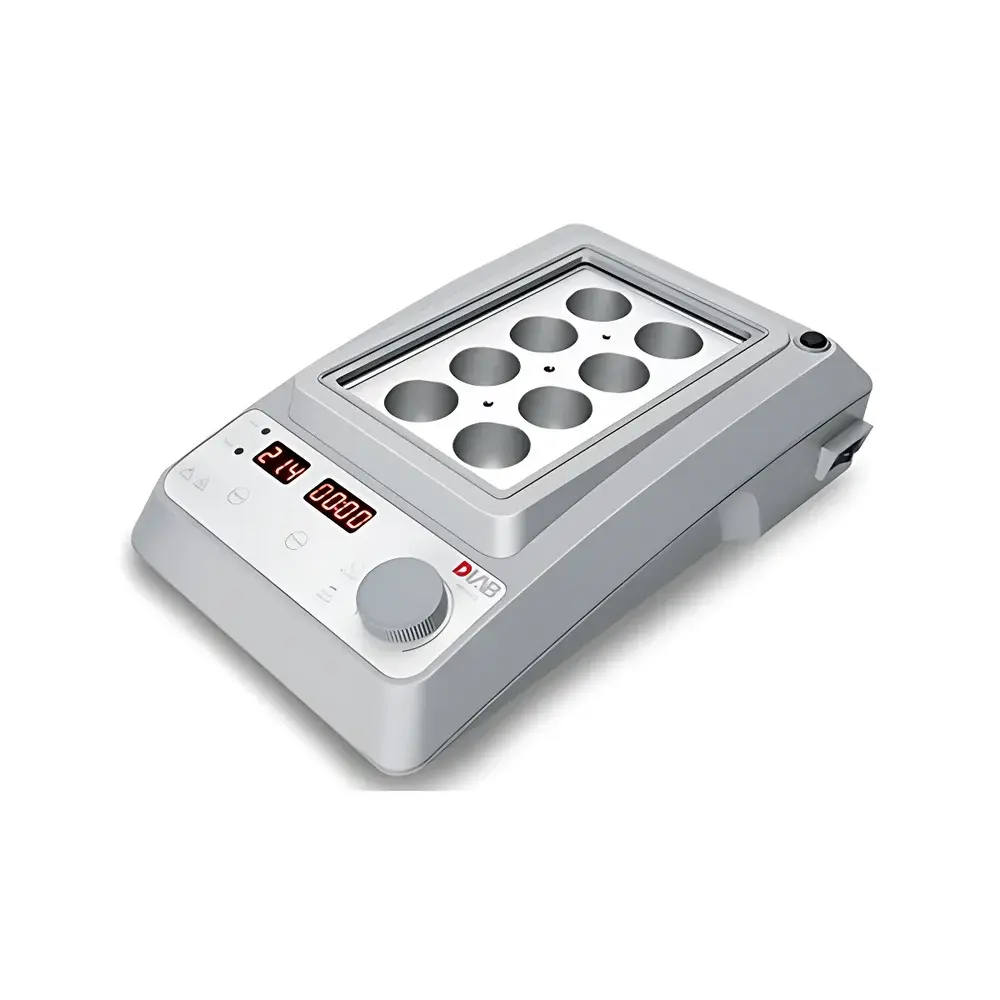
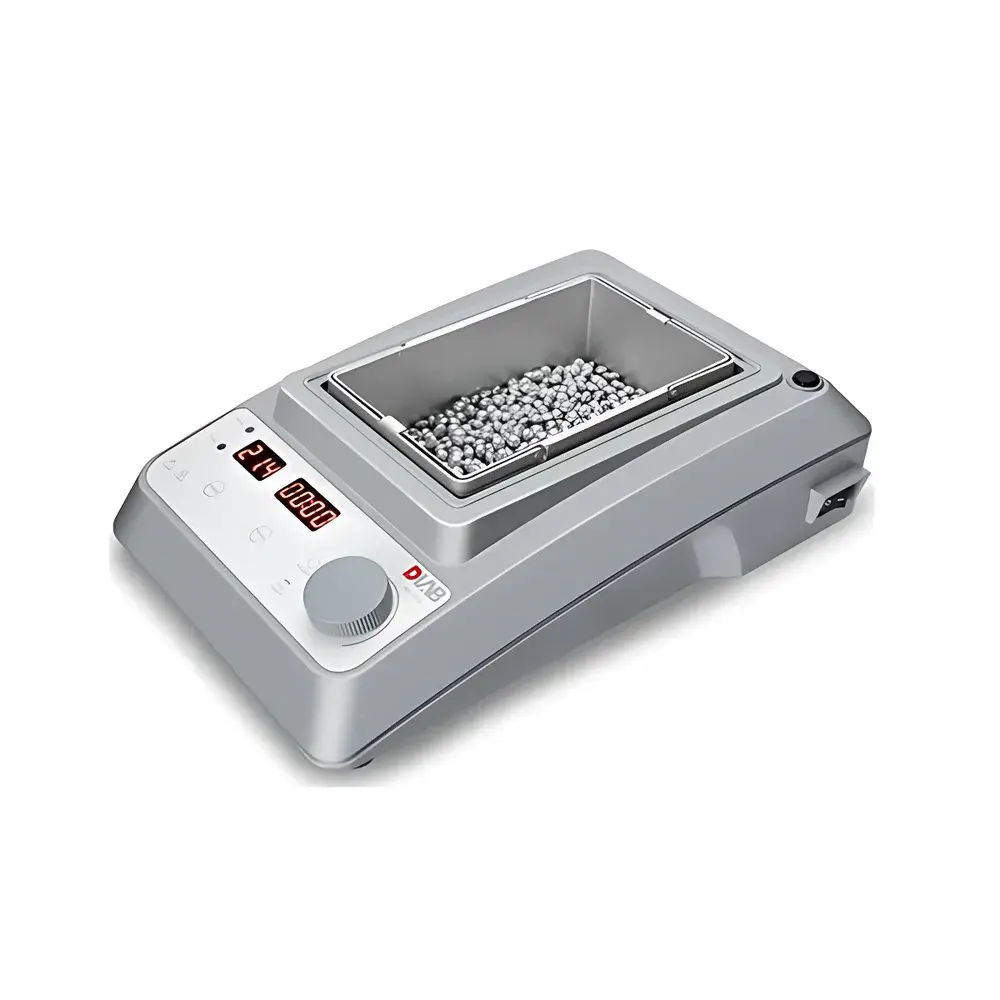
DLAB HB120-S LED Digital Display Metal Block Heater
| Brand | DLAB |
|---|---|
| Origin | Beijing, China |
| Manufacturer Type | Direct Manufacturer |
| Country of Origin | China |
| Model | HB120-S |
| Temperature Range | Ambient +5°C to 120°C |
| Temperature Accuracy | ±0.5°C at 37°C |
| Timer Range | 0–99 h 30 min |
| Dimensions (L×W×H) | 175 × 290 × 85 mm |
| Net Weight | 1.6 kg |
| Input Voltage | 110/220 VAC |
| Frequency | 50/60 Hz |
| Power Consumption | 160 W |
| Block Dimensions | 150 × 95 mm |
| Operating Environment | 10–40°C, <80% RH |
Overview
The DLAB HB120-S LED Digital Display Metal Block Heater is a compact, precision-engineered thermal platform designed for consistent and reproducible sample heating in life science, clinical diagnostics, environmental testing, and quality control laboratories. Unlike water baths or air ovens, the HB120-S employs solid-state aluminum block heating—leveraging high-thermal-conductivity metal blocks to deliver rapid, uniform heat transfer directly to sample tubes or microplates. Its operating principle relies on resistive heating elements embedded beneath a machined aluminum heating block, coupled with PID (Proportional-Integral-Derivative) feedback control to maintain setpoint stability across the full range of ambient +5°C to 120°C. This architecture eliminates liquid evaporation concerns, minimizes cross-contamination risk, and ensures mechanical robustness under routine benchtop use. The unit is engineered for continuous operation or time-limited protocols, supporting both research-grade method development and regulated QC workflows requiring documented thermal consistency.
Key Features
- Precise PID temperature control with ±0.5°C accuracy at 37°C—validated per internal calibration protocol and traceable to NIST-traceable reference standards;
- Dual LED display showing real-time temperature and remaining timer duration simultaneously, enabling unambiguous monitoring without mode switching;
- Programmable timer with adjustable range from 1 minute to 99 hours 30 minutes, supporting both single-step incubation and multi-stage thermal protocols;
- Interchangeable modular blocks (150 × 95 mm footprint) compatible with common tube formats including 0.2 mL, 0.5 mL, 1.5 mL, and 2.0 mL microcentrifuge tubes, as well as 96-well PCR plates;
- Integrated overtemperature protection circuitry that automatically cuts power if internal sensor readings exceed safe operational thresholds;
- Optional insulated lid accessory (sold separately) reduces convective heat loss and improves thermal uniformity across the block surface, especially critical for low-temperature applications near ambient;
- Low-profile design (85 mm height) and lightweight construction (1.6 kg net) facilitate integration into laminar flow hoods, biosafety cabinets, or crowded benchtop environments.
Sample Compatibility & Compliance
The HB120-S accommodates standard laboratory consumables without modification: polypropylene, polyethylene, glass, and stainless-steel vessels up to 120°C are thermally stable under sustained exposure. It complies with IEC 61010-1:2010 safety requirements for electrical equipment used in laboratory settings. While not certified for medical device manufacturing under ISO 13485, its design supports GLP and GMP-aligned practices—including audit-ready parameter logging when paired with external data acquisition systems. Temperature uniformity across the block surface is maintained within ±1.0°C (measured at nine points per ASTM E2251-22), making it suitable for applications referenced in USP , CLSI EP23-A, and ISO 15197:2013 where thermal consistency impacts assay validity.
Software & Data Management
The HB120-S operates as a standalone instrument with no built-in connectivity (e.g., USB, RS-232, or Ethernet). However, its analog-compatible timer and stable thermal output enable seamless integration with third-party data loggers (e.g., Omega OM-DAQPRO-5300 or Testo 176 T4) for time-stamped temperature recording. For regulated environments, users may implement manual calibration logs per SOPs aligned with FDA 21 CFR Part 11—requiring handwritten entries supplemented by independent thermometer verification at defined intervals (e.g., daily pre-use checks at 37°C and 95°C). DLAB provides a factory calibration certificate upon request, documenting initial accuracy verification against certified reference thermometers.
Applications
- Enzyme reaction incubation (e.g., restriction digests, ligations, kinase assays);
- Sample thawing and reconstitution of lyophilized reagents;
- Pre-heating of reagents prior to ELISA, Western blotting, or immunoassay setup;
- Controlled denaturation steps in nucleic acid extraction and PCR setup;
- Standardization of viscosity measurements in buffer equilibration protocols;
- Environmental sample conditioning for heavy metal digestion or BOD/COD preparation;
- Calibration reference point generation for secondary thermometers in metrology labs.
FAQ
What is the maximum recommended continuous operating temperature?
The HB120-S is rated for continuous operation up to 120°C; prolonged use above 105°C may accelerate thermal aging of internal components and is discouraged unless validated for specific long-duration protocols.
Can the unit be used inside a CO₂ incubator or cold room?
No—it is rated for ambient operating conditions between 10°C and 40°C. Operation outside this range compromises PID responsiveness and may trigger false overtemperature faults.
Is the aluminum block anodized or coated?
Yes—the heating block features hard-anodized aluminum surface treatment, providing enhanced corrosion resistance and improved thermal emissivity for more consistent radiative exchange.
Does DLAB provide IQ/OQ documentation templates?
DLAB supplies basic installation and operational qualification checklists upon request; full validation packages must be developed internally or with qualified third-party service providers per user-specific regulatory requirements.
How often should the unit be recalibrated?
Annual calibration is recommended for GLP/GMP environments; for non-regulated research use, verification against a calibrated reference thermometer before each critical experiment is sufficient.



