
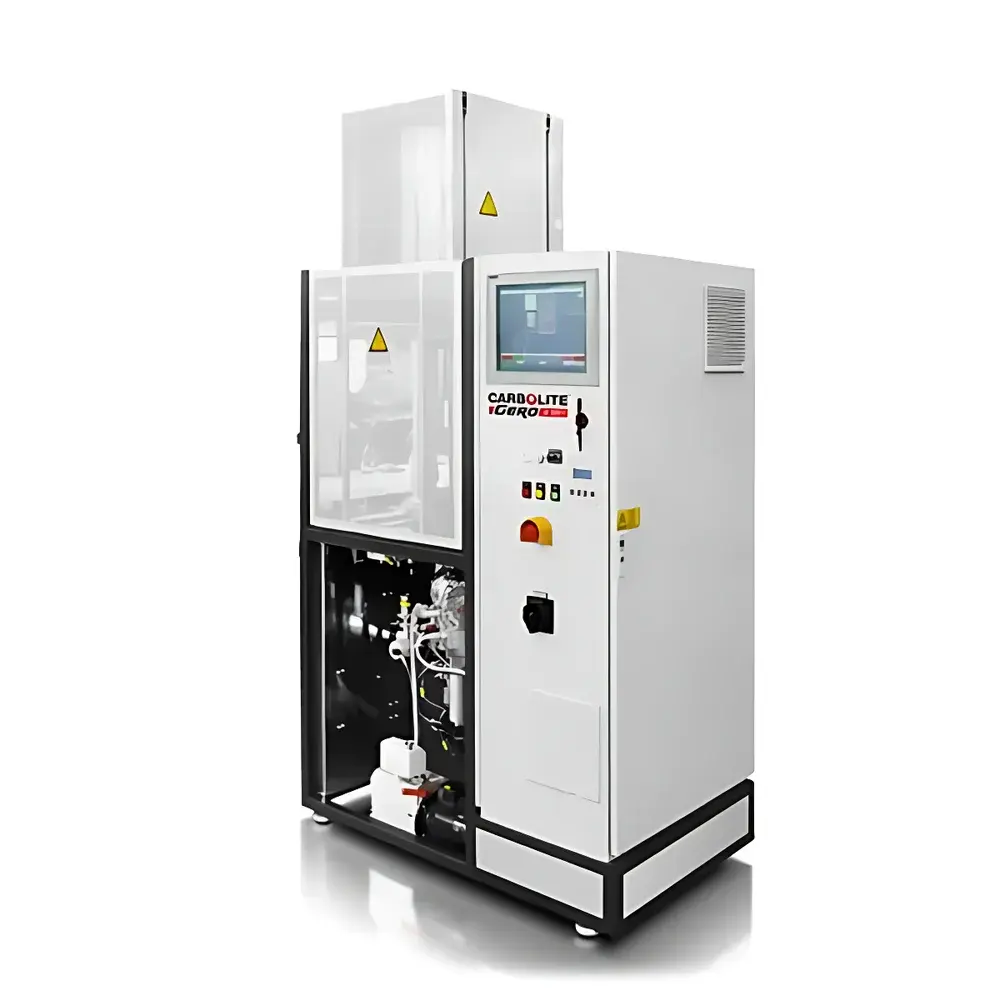
Carbolite Gero V-L Vertical Vacuum Brazing Furnace
| Brand | Carbolite Gero |
|---|---|
| Origin | Germany |
| Model | V-L |
| Type | Vertical Lift Tube Furnace |
| Max Operating Temperature | 1050 °C (under vacuum) |
| Heating Element | FeCrAl Resistance Wire |
| Insulation | High-Purity Ceramic Fiber |
| Chamber Material | Fused Quartz Tube (sealed, bottom-opening) |
| Internal Dimensions | Ø180 mm × 300 mm (H) |
| Effective Heating Volume | ~2 L |
| Ultimate Vacuum | <5×10⁻⁶ mbar |
| Atmosphere Control | Precision Mass Flow Controllers for Inert/Reducing/Reactive Gases |
| Cooling Modes | Controlled Quench in Vacuum, Inert Gas, or Ambient Air |
| Temperature Uniformity | Optimized via Triple-Zone Heating & Software-Driven Thermal Profiling |
| Safety Compliance | Integrated Over-Temperature Protection, Interlocked Vacuum/Gas Valves, Emergency Stop, CE Marked per EU Machinery Directive 2006/42/EC |
Overview
The Carbolite Gero V-L Vertical Vacuum Brazing Furnace is a precision-engineered tube furnace designed for high-purity thermal processing under ultra-high vacuum (UHV) and controlled atmosphere conditions. Based on the fundamental principle of resistive heating within a sealed fused quartz envelope, the V-L leverages vertical lift mechanics to decouple sample handling from thermal cycling—enabling rapid, contamination-free loading/unloading without compromising vacuum integrity or thermal stability. Its core architecture integrates a triple-zone ceramic fiber insulated chamber with FeCrAl resistance windings, thermally optimized for uniform axial temperature distribution across the 300 mm heated length. The furnace operates up to 1050 °C exclusively under vacuum, constrained by the softening point of high-purity quartz; this limit ensures structural integrity while permitting extended dwell times at temperatures critical for active metal brazing, MIM sintering, and high-fidelity thermal debinding. Unlike conventional horizontal tube furnaces, the V-L’s vertical motion system eliminates gas convection asymmetry during cooling and enables true process repeatability in applications demanding strict oxygen partial pressure control (<10⁻⁴ ppm equivalent).
Key Features
- Vertical lift mechanism with dual operational modes: (1) furnace body ascends while quartz tube remains stationary—enabling rapid quenching in vacuum, inert gas, or ambient air; (2) synchronized upward movement of furnace and quartz tube for safe, tool-free sample insertion and removal
- Fused quartz working tube (Ø180 mm × 300 mm H) with bottom-flanged, metal-sealed interface—achieving ultimate vacuum ≤5×10⁻⁶ mbar using compatible turbomolecular pumping stations
- Triple-zone heating system with independently controlled FeCrAl coil windings and armored Type S thermocouples—programmable via integrated PID algorithm to maintain ±1 °C thermal uniformity over central 150 mm zone
- Full safety interlock architecture: vacuum/gas valve sequencing, redundant over-temperature cutoff (primary + secondary thermocouples), emergency power-off, and CE-compliant mechanical guarding
- Touchscreen HMI with preloaded process templates (e.g., MIM debind-sinter ramp, Cu–Ag braze cycle, ceramic anneal profile) and real-time graphical trend logging
Sample Compatibility & Compliance
The V-L accommodates substrates and assemblies up to Ø170 mm × 280 mm—including metal injection molded (MIM) green parts, powder metallurgy compacts, ceramic-metal composites, and microelectronic packages requiring void-free joint formation. Its quartz chamber provides chemically inert, low-particulate exposure—critical for Ti, Al, and refractory alloy brazing where oxide inhibition is non-negotiable. The system complies with ISO 9001:2015 quality management requirements for recorded thermal profiles, and its digital audit trail (timestamped setpoints, actual temperatures, vacuum levels, gas flows) supports GLP and FDA 21 CFR Part 11 validation when paired with optional electronic signature modules. Vacuum integrity meets ASTM E595 outgassing specifications for space-grade hardware processing.
Software & Data Management
Control is executed via Carbolite Gero’s proprietary FurnaceManager™ software (Windows-based, USB/Ethernet interface), supporting ISO/IEC 17025 traceable calibration workflows. All thermal cycles are stored with metadata including operator ID, batch number, and environmental conditions. Raw data exports to CSV or XML formats for integration into LIMS or MES platforms. Optional features include remote monitoring via secure HTTPS portal, automated report generation (PDF/Excel), and deviation alerting triggered by configurable thresholds (e.g., >±2 °C drift, vacuum leak >1×10⁻⁵ mbar/s). Firmware updates preserve backward compatibility with existing process recipes.
Applications
- Vacuum brazing of aluminum, copper, stainless steel, and superalloys using active braze alloys (e.g., Cu–Si, Ag–Cu–Ti)
- Thermal debinding and sintering of MIM and CIM components with minimal carbon residue
- High-purity annealing of semiconductor substrates and optical ceramics
- Controlled-atmosphere pyrolysis of polymer-derived ceramics
- Low-oxygen stress relief of additive manufactured titanium and nickel alloys
- Rapid thermal processing (RTP) for thin-film densification and interfacial reaction studies
FAQ
What vacuum level is required for optimal brazing performance?
For oxide-free wetting of active metals (e.g., Ti, Al), base pressure ≤1×10⁻⁵ mbar is recommended prior to heating; process pressure maintained at 1×10⁻⁶ mbar during brazing ensures atomic-scale surface cleanliness.
Can the V-L be integrated into an automated production line?
Yes—the furnace supports Modbus TCP and OPC UA protocols for seamless PLC communication, enabling recipe synchronization, status polling, and fault reporting within Industry 4.0 architectures.
Is quartz tube replacement a field-serviceable procedure?
Quartz tube exchange requires recalibration of thermocouple positioning and vacuum leak verification; Carbolite Gero provides certified field service engineers trained to ISO/IEC 17025 procedures for full requalification.
Does the system support hydrogen or forming gas atmospheres?
Hydrogen-compatible configurations are available with explosion-proof actuators, catalytic recombiners, and H₂-specific mass flow controllers—certified to ATEX Zone 1 and IECEx standards.
How is temperature uniformity validated across the hot zone?
Uniformity mapping is performed per ASTM E220 using a 9-point thermocouple array; Carbolite Gero issues a factory-verified uniformity certificate (±1.5 °C over 150 mm) with each unit shipment.



