
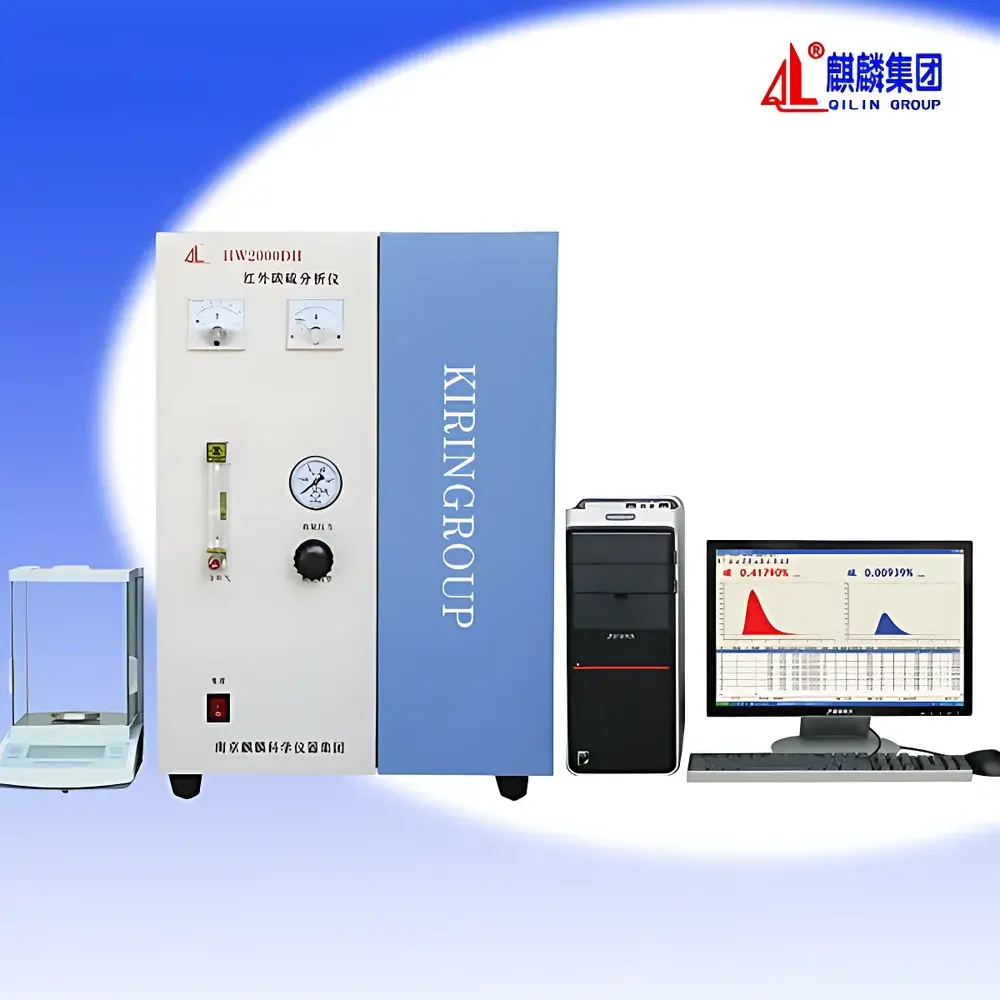
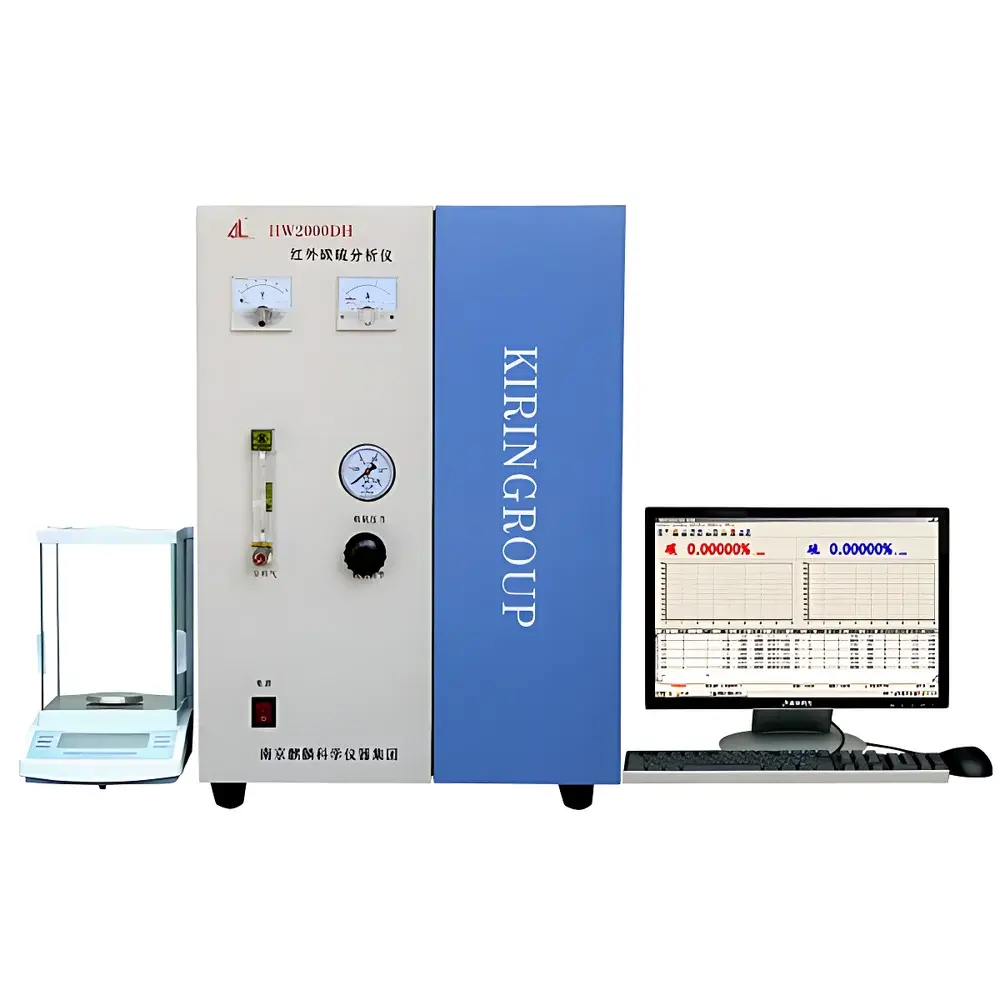
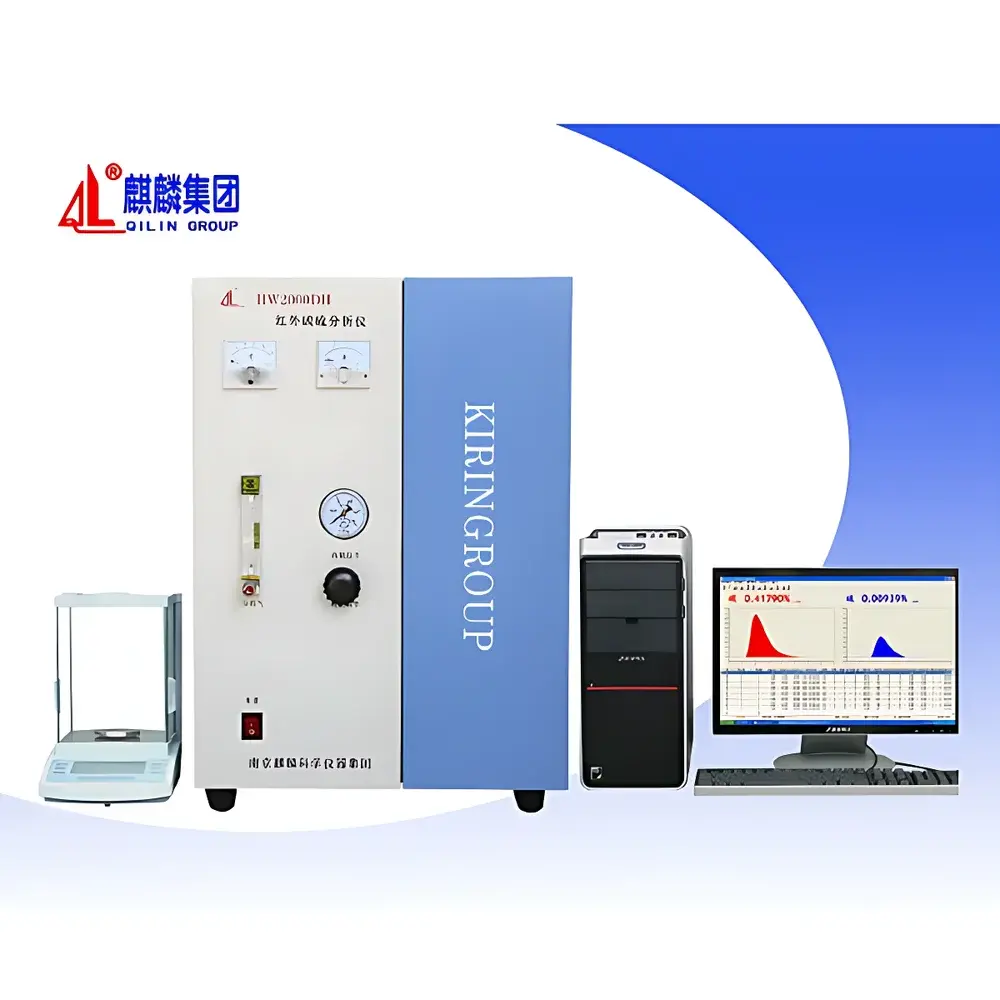
QL-HW2000DH High-Frequency Infrared Carbon-Sulfur Analyzer by Qilin
| Brand | Qilin (QL) |
|---|---|
| Origin | Jiangsu, China |
| Model | QL-HW2000DH |
| Measurement Principle | Infrared Absorption |
| Heating System | High-Frequency Induction Furnace |
| Carbon Range | ω(C) 0.0010–10.00% |
| Sulfur Range | ω(S) 0.0005–0.500% |
| Sensitivity | 0.1 ppm (reading resolution) |
| Accuracy | Compliant with GB/T 223.69–1997 (C) and GB/T 223.68–1997 (S) |
| Analysis Time | Adjustable 20–60 s (typical: 35 s) |
| Sample Weighing | Analytical Balance (0.0001 g resolution) |
| Operating Environment | 10–30 °C, RH < 75% |
Overview
The QL-HW2000DH High-Frequency Infrared Carbon-Sulfur Analyzer is a dedicated elemental analyzer engineered for precise quantification of total carbon (C) and sulfur (S) mass fractions in ferrous and non-ferrous metallic materials—including carbon steels, alloy steels, cast irons, stainless steels, and nickel- or cobalt-based superalloys. It operates on the principle of non-dispersive infrared (NDIR) absorption spectroscopy: following high-frequency induction combustion at temperatures exceeding 1700 °C, the evolved CO2 and SO2 gases are swept through dual-wavelength infrared cells. Concentrations are determined via Beer–Lambert law-based absorbance measurements at characteristic wavelengths (4.26 µm for CO2, 7.35 µm for SO2), enabling trace-level detection with high spectral specificity and minimal cross-interference. The instrument integrates a fully automated high-frequency furnace with rapid arc ignition (≤0.4 s per sample), eliminating manual electrode alignment and ensuring consistent combustion efficiency across heterogeneous matrices.
Key Features
- High-frequency induction furnace (2.5 MHz, 2.5 kW output) with graphite crucible and ceramic combustion tube—designed for complete oxidation of refractory carbides and sulfides without catalyst addition
- Dual-channel NDIR detection system with thermoelectrically cooled detectors and optical filters certified to ISO 10473:2021 calibration traceability
- Automatic sample weighing interface compatible with standard 0.1 mg resolution analytical balances (e.g., METTLER TOLEDO XP series); supports both fixed- and variable-mass protocols
- Real-time gas flow control via mass flow controllers (MFCs), maintaining stoichiometric O2 supply and carrier gas (He/Ar) purity ≥99.995%
- Rugged mechanical architecture: all-metal furnace housing, corrosion-resistant gas path components (316L SS, fused silica), and sealed optical compartment meeting IP54 environmental rating
- Embedded microprocessor with onboard diagnostics—including furnace temperature profiling, detector signal stability monitoring, and automatic baseline correction every 10 analyses
Sample Compatibility & Compliance
The QL-HW2000DH accepts solid metallic samples in chip, drill swarf, or machined pellet form (mass range: 0.2–1.0 g). It accommodates high-carbon cast iron (up to 4.5% C), low-sulfur bearing steels (<0.001% S), and titanium alloys with minimal blank contribution. Method validation aligns with ASTM E1019–22 (“Standard Test Methods for Determination of Carbon, Sulfur, Nitrogen, and Oxygen in Steel, Iron, Nickel, and Cobalt Alloys”) and ISO 4935:2020 (“Steel and Iron — Determination of Carbon and Sulfur Content — Infrared Absorption Method after Combustion”). Data integrity complies with GLP requirements: full audit trail (user ID, timestamp, method version, raw spectra, calibration history) is retained for ≥12 months. Optional firmware upgrade enables 21 CFR Part 11–compliant electronic signatures and role-based access control.
Software & Data Management
Control and analysis are executed via Qilin’s proprietary CS-Analyzer v4.2 software (Windows 10/11 64-bit), featuring intuitive workflow navigation, customizable report templates (PDF/Excel), and real-time spectral visualization. Calibration curves support multi-point linear and quadratic regression with R² ≥ 0.9999. Each analysis generates a structured data packet containing: raw absorbance values, peak area integrals, drift-corrected concentration outputs, combustion profile graphs (temperature vs. time), and pass/fail flags against user-defined specification limits. Data export adheres to ASTM E1382–95 format for seamless integration into LIMS platforms (e.g., LabWare, Thermo Fisher SampleManager). Backup and restore functions operate via encrypted USB storage or network share with AES-256 encryption.
Applications
- Quality control in primary steel production: rapid verification of melt chemistry prior to casting
- Failure analysis laboratories: correlation of C/S segregation with hot-shortness or embrittlement mechanisms
- Foundry process optimization: monitoring desulfurization efficiency during ladle treatment
- Scrap metal sorting: classification of alloy grades based on C/S fingerprinting
- Research on advanced high-entropy alloys: quantifying interstitial content affecting lattice distortion and hardness
- Third-party certification testing per ISO/IEC 17025:2017—validated uncertainty budgets provided per ISO/IEC Guide 98-3
FAQ
What combustion method does the QL-HW2000DH employ, and why is high-frequency induction preferred over tube furnaces?
It uses a 2.5 MHz high-frequency induction furnace, which delivers rapid, uniform heating (>1700 °C in <3 s) without physical contact—eliminating thermal gradients and ensuring complete oxidation of stable carbides (e.g., TiC, VC) and sulfides (e.g., MnS, CaS) that resist conventional resistance heating.
How is interference from NOx or H2O vapor mitigated in the infrared detection system?
A dual-stage chemical dryer (anhydrous Mg(ClO4)2 + Ascarite II) removes moisture and acidic gases upstream of the IR cell; spectral deconvolution algorithms further suppress residual water vapor absorption bands using reference spectra libraries.
Can the instrument be validated for ISO/IEC 17025 accreditation?
Yes—full validation documentation (IQ/OQ/PQ protocols, uncertainty calculations per GUM, and traceable calibration certificates for balance, gas standards, and IR detectors) is supplied with the system.
What maintenance intervals are recommended for routine operation?
Daily: crucible cleaning and O-ring inspection; Weekly: dust filter replacement and MFC zero calibration; Quarterly: detector sensitivity verification with certified gas standards (NIST SRM 2681a for CO2, SRM 2682a for SO2).
Related Products




