
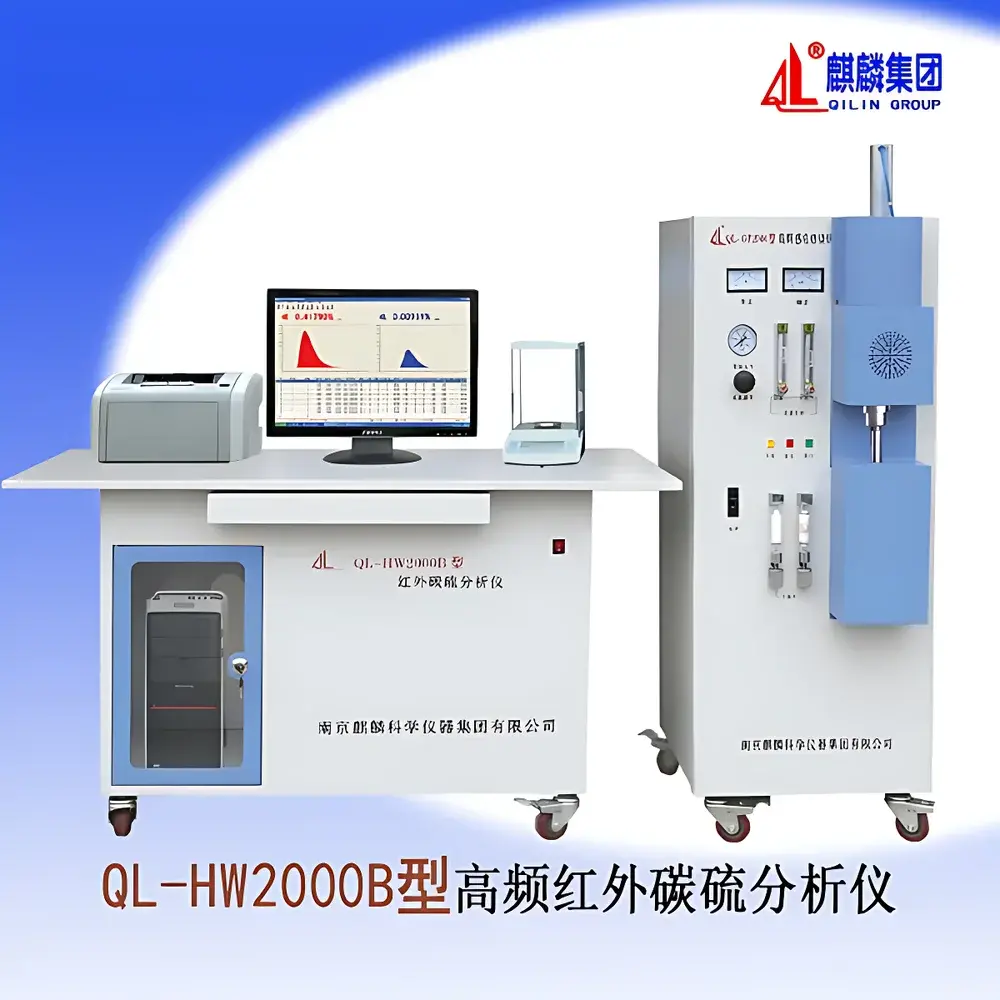
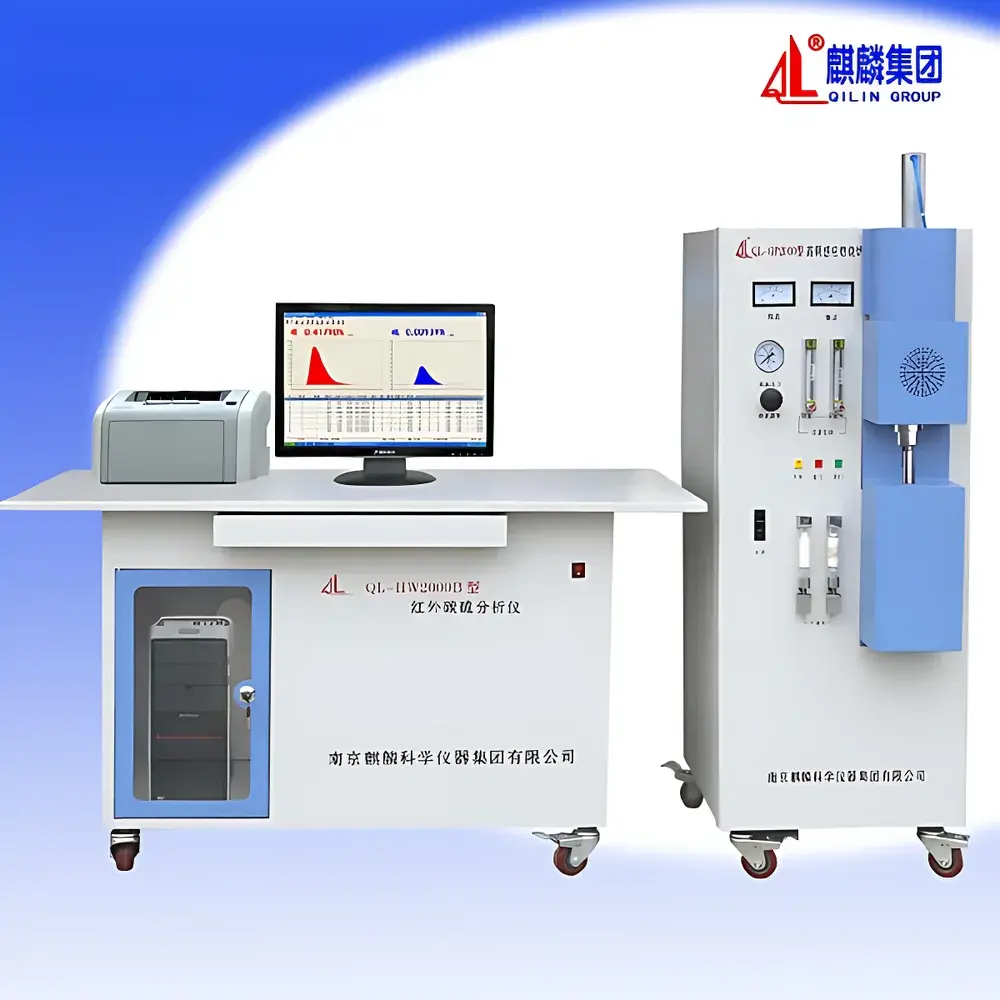
Qilin HW2000B High-Frequency Infrared Carbon-Sulfur Analyzer
| Brand | Qilin (QL) |
|---|---|
| Origin | Jiangsu, China |
| Model | QL HW2000B |
| Measurement Principle | Non-Dispersive Infrared (NDIR) Absorption |
| Heating System | 2.5 kVA High-Frequency Induction Furnace (18–20 MHz) |
| Carbon Range | 0.00001–10.0000 wt% (extendable to 99.999 wt%) |
| Sulfur Range | 0.00001–0.5000 wt% (extendable to 99.999 wt%) |
| Sensitivity | 0.1 ppm (minimum display resolution) |
| Precision | Carbon RSD ≤ 0.5% |
| Analysis Time | 25–60 s (user-adjustable) |
| Sample Weighing Accuracy | 0.0001 g |
| Compliance | GB/T 20123–2006 & ISO 15350:2000 |
| Detector Type | High-Stability Pyroelectric Infrared Detector with Narrow-Band Optical Filters |
| Gas Control | Precision Mass Flow Controllers + Airtac Solenoid Valves (rated for ≥100,000 cycles) |
| Drive Mechanism | Aerospace-Grade Synchronous Motor in IR Absorption Cell (MTBF > 100,000 h) |
Overview
The Qilin HW2000B High-Frequency Infrared Carbon-Sulfur Analyzer is a dedicated elemental combustion analyzer engineered for quantitative determination of total carbon (C) and sulfur (S) in solid inorganic and organic materials. It operates on the principle of non-dispersive infrared (NDIR) absorption spectroscopy: samples are combusted quantitatively in a high-frequency induction furnace under controlled oxygen flow, converting carbon and sulfur into CO₂ and SO₂ gases, respectively. These gaseous oxides pass sequentially through dual-channel infrared cells where their characteristic absorption bands—4.26 µm for CO₂ and 7.35 µm for SO₂—are measured by thermally stabilized pyroelectric detectors. The instrument’s optical architecture incorporates precision narrow-band interference filters to eliminate spectral overlap, particularly mitigating high-C matrix interference on SO₂ quantification—a critical design feature for accurate sulfur measurement in ferroalloys and high-carbon steels.
Key Features
- High-frequency induction furnace (2.5 kVA, 18–20 MHz) with RF-driven thermal ramping ensures reproducible, complete sample combustion across heterogeneous matrices—including refractory metals, carbides, and low-conductivity ceramics.
- Dual independent NDIR detection channels with temperature- and pressure-compensated signal processing enable simultaneous, interference-free quantification of CO₂ and SO₂ at sub-ppm sensitivity.
- Pyroelectric infrared detectors coupled with aviation-grade synchronous motors in the absorption cell deliver long-term baseline stability and operational reliability exceeding 100,000 hours MTBF.
- Modular electronic architecture with embedded flow, temperature, and pressure compensation algorithms ensures analytical consistency across ambient fluctuations and extended duty cycles.
- Industrial-grade pneumatic system featuring Airtac solenoid valves (certified for ≥100,000 actuation cycles) and precision mass flow controllers guarantees repeatable gas delivery and zero drift in carrier and auxiliary oxygen streams.
- Integrated high-resolution analytical balance interface (0.1 mg readability) supports GLP-compliant sample logging and automatic stoichiometric correction based on weighed mass.
Sample Compatibility & Compliance
The HW2000B is validated for use with ferrous and non-ferrous alloys (e.g., stainless steel, cast iron, Ni-based superalloys), ores (iron ore, manganese ore), refractories (silica, alumina), catalysts, coal and coke, cement raw materials, and organic polymers. Its combustion protocol meets the procedural requirements of GB/T 20123–2006 and ISO 15350:2000 for total carbon and total sulfur determination in metallic materials. While not pre-certified for FDA 21 CFR Part 11, the system’s hardware architecture—featuring immutable audit trails, user-access controls, and electronic signature readiness—supports validation under GMP/GLP environments when deployed with compliant LIMS integration and documented IQ/OQ/PQ protocols.
Software & Data Management
The analyzer is operated via a Windows-based control suite supporting method parameterization (combustion time, oxygen flow rate, delay timing), real-time spectral visualization, and automated calibration curve generation using certified reference materials (CRMs). All raw detector voltages, gas flow logs, furnace temperature profiles, and balance weight timestamps are stored in encrypted binary format with SHA-256 hashing. Export options include CSV, XML, and ASTM E1382-compliant report templates. Audit trail functionality records operator ID, timestamp, parameter changes, and result overrides—meeting traceability requirements for ISO/IEC 17025 accredited laboratories.
Applications
- Quality control of incoming raw materials in steelmaking: rapid verification of C/S specifications in scrap, ferromanganese, and silicomanganese.
- Process monitoring in foundries: analysis of ductile iron melts to maintain optimal nodularization and prevent graphite degeneration.
- Geochemical assay support: quantification of organic carbon and sulfide sulfur in sedimentary rock cores and mine tailings.
- Catalyst development labs: tracking sulfur poisoning thresholds in Pt/Al₂O₃ or Ni/Mo formulations during sulfidation studies.
- Coal characterization per ASTM D3176: determination of total sulfur content for compliance with EPA Clean Air Act emission standards.
- Research on advanced ceramics: measuring residual carbon in SiC sintering aids and sulfur impurities in BaTiO₃ dielectrics.
FAQ
What combustion atmosphere is required for optimal performance?
High-purity oxygen (≥99.995%) at regulated flow (1–3 L/min) is mandatory; optional helium dilution may be used for ultra-low-sulfur applications to improve SO₂ peak shape.
Can the instrument analyze liquid or powder samples directly?
No—samples must be solid and combustible. Powders require pelletization with tungsten or tin accelerants; volatile organics necessitate sealed ceramic crucibles and modified ramp profiles.
Is external calibration required between analyses?
No routine recalibration is needed. Drift correction is performed automatically using internal reference cells; full multi-point calibration is recommended after 500 analyses or following maintenance.
How is moisture or halogen interference managed?
A dual-stage reagent trap (anhydrous magnesium perchlorate + copper oxide) removes H₂O, NOₓ, and halogens upstream of the IR cells; trap replacement is indicated by color change and logged in software.
Does the system support remote diagnostics or preventive maintenance alerts?
Yes—the embedded controller transmits operational health metrics (furnace coil resistance, detector bias voltage, valve cycle count) to a secure cloud dashboard with configurable SMS/email alerts for predictive maintenance scheduling.
Related Products




