
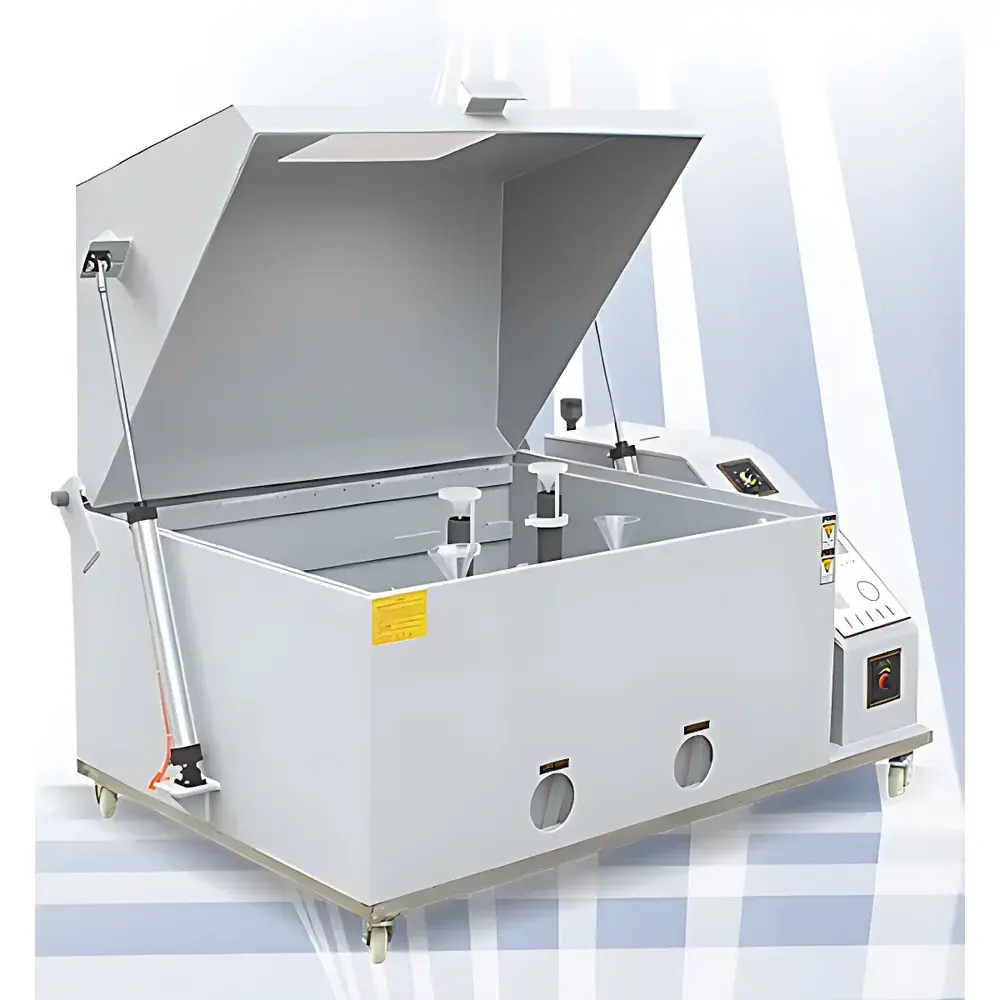
Jianhu JH-ASS Environmental Cycling Salt Spray Chamber with Automatic Temperature & Humidity Control
| Brand | Jianhu |
|---|---|
| Origin | Shanghai, China |
| Model | JH-ASS (Acetic Acid Salt Spray) |
| Spray Method | Continuous Atomization |
| Spray Rate | 1–2 mL/(80 cm²·h) |
| Nozzle Pressure | 0.7–1.0 kgf/cm² |
| Fog Removal | Pneumatic Air-Compression Exhaust |
| Salt Fog Deposition Rate | 1–2 mL/(80 cm²·h) |
| Test Chamber Temperature Range | 35 °C ±2 °C |
| Compliance | ASTM B117, ISO 9227, GB/T 2423.17, JIS Z2371 |
| Control System | Microprocessor-Based PID Controller with Touchscreen HMI |
| Chamber Construction | PVC-Coated Steel Frame with Transparent Acrylic Viewing Window |
| Internal Volume | ≥200 L (Standard Configuration) |
| Power Supply | 220 VAC ±10%, 50/60 Hz |
Overview
The Jianhu JH-ASS Environmental Cycling Salt Spray Chamber is an engineered solution for accelerated corrosion testing under controlled, multi-parameter environmental conditions. Designed around the principles of electrochemical corrosion simulation, this chamber integrates precise temperature regulation, humidity modulation, and standardized salt fog generation to replicate aggressive atmospheric exposure scenarios—particularly those involving acetic acid-acidified saline aerosols. Unlike basic static salt spray cabinets, the JH-ASS supports dynamic environmental cycling protocols, enabling sequential or overlapping exposure to defined thermal, hygrothermal, and corrosive phases per ASTM G85 Annex A2 (Acetic Acid Salt Spray – ASS) and ISO 9227. Its architecture adheres to fundamental fluid dynamics and mass-transfer constraints governing fog uniformity, droplet size distribution (<10 µm median Sauter diameter), and deposition consistency across standardized test panels. The system is validated for use in materials qualification, coating performance evaluation, and comparative corrosion resistance benchmarking across metallic substrates, galvanized steels, aluminum alloys, and protective polymer coatings.
Key Features
- Microprocessor-driven PID control system with 7-inch capacitive touchscreen HMI for intuitive parameter setup, real-time monitoring, and alarm logging
- Dual-stage air-saturated preheating and pressurized nozzle atomization ensure stable fog generation at 1–2 mL/(80 cm²·h) within ±5% volumetric repeatability over 24-hour continuous operation
- Independent temperature regulation (35 °C ±2 °C operational setpoint) via stainless-steel sheathed heating elements and forced-air circulation, verified per IEC 60068-3-5
- Pneumatically actuated fog exhaust mechanism prevents chamber over-pressurization and eliminates residual condensate accumulation between cycles
- Corrosion-resistant chamber interior: 6 mm PVC-coated steel walls with seamless welded joints; transparent acrylic observation window compliant with EN 61000-4-2 ESD safety requirements
- Integrated safety interlocks including over-temperature cutoff (±5 °C deviation threshold), low-level brine reservoir detection, and door-open emergency shutdown
- Modular design accommodates optional upgrades: humidity control module (20–98% RH), programmable cycling controller, and external data interface (RS-485/Modbus RTU)
Sample Compatibility & Compliance
The JH-ASS chamber accepts standard test specimens up to 600 mm × 450 mm × 400 mm (W × D × H), supporting flat panels, fasteners, electronic enclosures, and coated component assemblies. Specimen racks are constructed from inert PVC-coated stainless steel to prevent galvanic interference. All operational parameters conform to internationally recognized corrosion test standards, including but not limited to: ASTM B117 (Neutral Salt Spray), ASTM G85 Annex A2 (Acetic Acid Salt Spray), ISO 9227 (Corrosion tests — Salt spray tests), GB/T 2423.17 (Chinese national standard equivalent to IEC 60068-2-11), and JIS Z2371. The chamber’s fog deposition uniformity is certified through quarterly verification using six calibrated funnels distributed per ASTM B117 Figure 1 layout. It supports GLP-compliant test execution when paired with optional audit-trail-enabled software (see Software & Data Management section).
Software & Data Management
The embedded controller logs timestamped records of chamber temperature, nozzle pressure, elapsed test time, and fault events into non-volatile memory (retention ≥10 years). Optional Jianhu DataLink™ software (v3.2+) provides USB and Ethernet connectivity for remote parameter configuration, live telemetry streaming, and CSV-formatted report export. When configured with the Audit Trail Module, the system complies with FDA 21 CFR Part 11 requirements for electronic records and signatures—including user authentication, immutable event logging, and change history tracking. Data integrity is preserved via SHA-256 hash verification on exported datasets. Integration with laboratory information management systems (LIMS) is supported via HL7 or custom API endpoints upon request. All firmware updates undergo ISO/IEC 17025-accredited validation prior to release.
Applications
- Evaluation of corrosion inhibition efficacy in automotive OEM coatings and aerospace primer systems
- Accelerated aging studies for marine-grade stainless steels and cathodically protected offshore structures
- Comparative assessment of zinc-nickel, trivalent chromium, and electrophoretic paint systems per ISO 1456 and ASTM B633
- Teaching laboratories: Undergraduate metallurgy courses demonstrating electrochemical degradation mechanisms and passivation breakdown kinetics
- Graduate research: Multi-stress corrosion fatigue modeling under cyclic thermal-hygrometric loading combined with chloride ingress
- Quality assurance workflows in electronics manufacturing for printed circuit board (PCB) conformal coating validation per IPC-CC-830B
FAQ
Does the JH-ASS support humidity control beyond salt spray mode?
Standard configuration operates at ambient humidity during ASS testing. Optional RH control module (JH-HUMID-PRO) extends capability to 20–98% RH at ±3% RH accuracy, enabling combined salt fog/humidity cycling per ISO 6270-2.
What calibration documentation is provided with shipment?
Each unit ships with a factory calibration certificate traceable to NIM (National Institute of Metrology, China), covering temperature sensor linearity (±0.5 °C full scale), pressure transducer accuracy (±1.0% FS), and volumetric fog deposition verification.
Is the chamber suitable for testing lithium-ion battery enclosures?
Yes—chamber materials and airflow design eliminate halogen-based contaminants. For UN 38.3-compliant battery testing, optional inert gas purge integration (N₂ or dry air) is available to suppress oxidation pathways during extended exposure.
Can test cycles be programmed to alternate between salt spray and dry storage phases?
Yes. With the optional CycleMaster™ controller, users define up to 99-step sequences combining spray duration, rest periods, temperature ramps, and purge intervals—all stored in EEPROM with power-fail recovery.
What maintenance intervals are recommended for sustained compliance?
Brine tank cleaning every 72 operating hours; nozzle inspection weekly; full system verification (temperature uniformity, deposition rate, pressure stability) quarterly per ASTM E2209. Preventive maintenance kits include calibrated reference sensors and replacement nozzles with NIST-traceable certification.



