
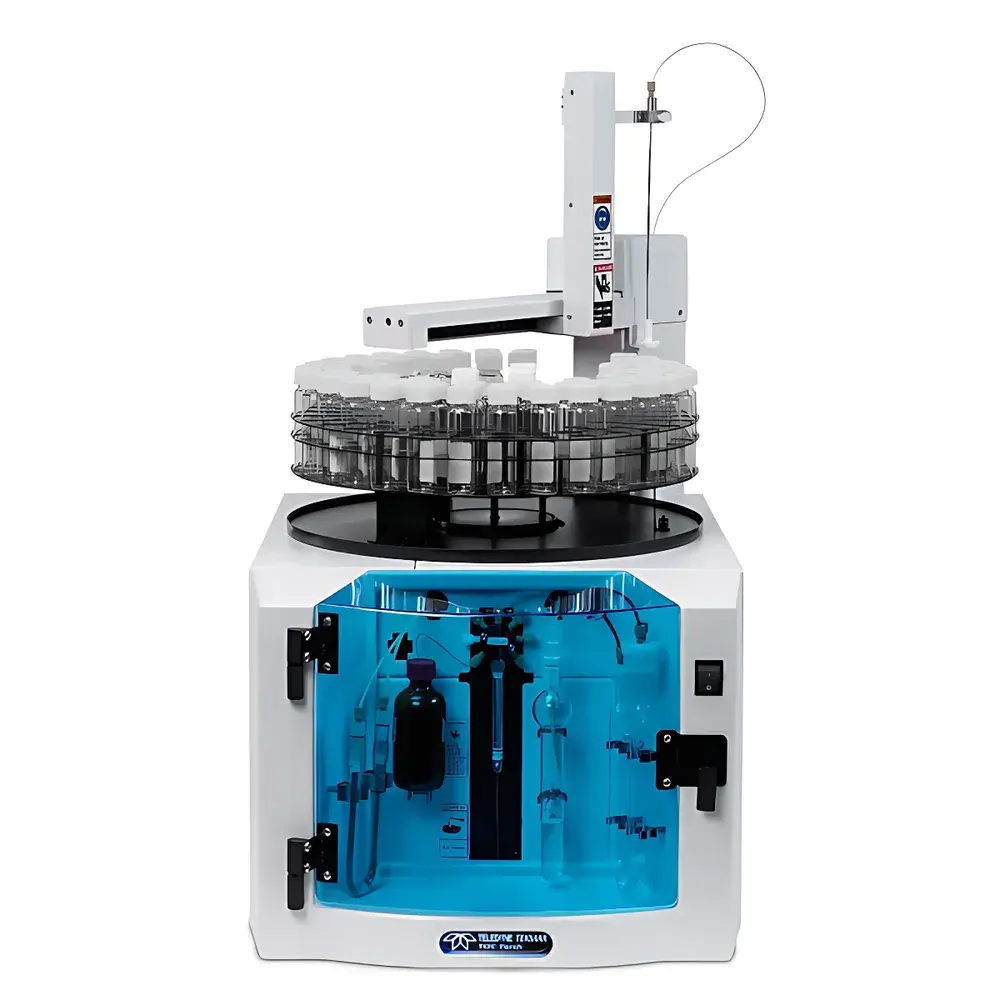
Tekmar Torch Total Organic Carbon Analyzer
| Brand | Tekmar |
|---|---|
| Origin | Imported |
| Manufacturer Type | Authorized Distributor |
| Instrument Type | Laboratory TOC Analyzer |
| Detection Principle | Non-Dispersive Infrared (NDIR) Absorption |
| Oxidation Method | High-Temperature Catalytic Combustion |
| Detection Limit | 500 ppb |
| Quantification Range | 50 ppb – 30,000 ppm |
| Compliance | HJ 501–2009, GB/T 32116–2015, EPA Methods 415.1, 415.3, and 9060A, Standard Methods 5310B, ISO 8245, EN 1484, USP <643>, ASTM D2579, AOAC 973.47 |
Overview
The Tekmar Torch Total Organic Carbon (TOC) Analyzer is a high-performance laboratory instrument engineered for precise quantification of organic carbon in aqueous matrices using high-temperature catalytic combustion coupled with non-dispersive infrared (NDIR) detection. Designed to meet stringent regulatory requirements across environmental monitoring, pharmaceutical manufacturing, semiconductor process water control, and nuclear facility effluent management, the Torch delivers robust, reproducible results from 50 ppb to 30,000 ppm TOC. Its core measurement architecture relies on complete oxidation of organic carbon to CO2 at 680 °C in a proprietary catalytic furnace, followed by highly selective NDIR detection—ensuring minimal interference from inorganic carbon species or matrix-derived gases. The system employs static headspace concentration technology to enhance sensitivity and stability, particularly for ultra-trace analysis in low-conductivity ultrapure water or high-salinity industrial effluents.
Key Features
- High-temperature catalytic combustion at 680 °C with optimized catalyst formulation for complete oxidation of refractory organics, including humic substances and chlorinated compounds
- Static headspace concentration module integrated with dual-stage NDIR detector for enhanced signal-to-noise ratio and long-term baseline stability
- Automated leak-check diagnostics and real-time pressure monitoring to ensure system integrity prior to each analysis cycle
- Programmable furnace temperature profiles—up to six user-defined methods stored internally—to accommodate diverse sample types (e.g., seawater, pharmaceutical rinse water, steam condensate)
- Intelligent auto-dilution capability: detects out-of-range samples via preliminary conductivity or TOC screening and performs on-the-fly serial dilution using calibrated peristaltic pumps
- Self-calibrating operation with automatic standard delivery and multi-point calibration verification; eliminates manual standard preparation and reduces operator error
- Integrated 64-position autosampler with optional vial mixing function to ensure homogeneity of suspended or viscous samples prior to injection
- Precision mass flow controllers (MFCs) for carrier gas (ultra-high-purity air or oxygen) and purge gas, maintaining ±0.5% flow accuracy across full operational range
- Modular combustion tube design enabling rapid field replacement without tooling—typical maintenance time < 10 minutes
Sample Compatibility & Compliance
The Torch analyzer supports direct analysis of liquid samples with conductivity ranging from 0.055 µS/cm (Type I ultrapure water) to 150 mS/cm (brine solutions), without pre-treatment. It accommodates filtered and unfiltered samples (with optional particulate handling protocol per ASTM D2579), as well as preserved and unpreserved field-collected waters. Regulatory compliance is embedded in firmware and software workflows—including audit-trail-enabled method execution, electronic signature support per FDA 21 CFR Part 11, and GLP/GMP-ready reporting templates aligned with ISO/IEC 17025 laboratory accreditation requirements. All reported data are traceable to NIST-traceable TOC standards and validated against primary reference materials per USP and EP 2.2.44 protocols.
Software & Data Management
Controlled via TorchLink™ PC software (Windows 10/11 compatible), the system provides intuitive method setup, real-time chromatogram visualization, and automated report generation compliant with LIMS integration standards (ASTM E1467, HL7). Raw data files include full metadata: instrument configuration, calibration history, diagnostic logs, gas flow parameters, and timestamped sequence records. Software supports secure user role management (administrator, analyst, reviewer), configurable electronic signatures, and encrypted database storage. Audit trails capture all critical events—including method edits, calibration overrides, and result reprocessing—with immutable timestamps and operator IDs. Export formats include CSV, PDF, XML, and direct SQL database push for enterprise-level data aggregation.
Applications
- Regulatory compliance testing for drinking water, wastewater, and surface water per EPA 415.3 and HJ 501–2009
- Pharmaceutical water system validation (PW, WFI, SW) in accordance with USP , EP 2.2.44, and Annex 1 requirements
- Ultrapure water monitoring in semiconductor fab utilities, including UPW distribution loops and point-of-use verification
- Process stream analysis in petrochemical refining, where hydrocarbon carryover must be quantified below 100 ppb
- Nuclear power plant secondary coolant and condensate monitoring to detect organic degradation products indicative of resin breakdown or lubricant ingress
- Research applications in biogeochemistry, where dissolved organic carbon (DOC) speciation requires high-precision baseline resolution
FAQ
What is the minimum detection limit under routine operating conditions?
The validated method detection limit (MDL) is 500 ppb TOC, determined per EPA 40 CFR Part 136 guidelines using seven replicate analyses of a 5-ppb standard in reagent water.
Does the Torch support solid-phase extraction (SPE) or acid-purge protocols for POC/POC fractionation?
No—the Torch is configured exclusively for dissolved organic carbon (DOC) analysis. For particulate or purgable organic carbon, complementary instrumentation (e.g., filtration modules or sparging systems) must be deployed upstream.
Can the system be integrated into a centralized laboratory network with remote monitoring?
Yes—TorchLink™ supports OPC UA server functionality and TLS-encrypted HTTP API endpoints for secure integration with SCADA, MES, or centralized analytics platforms.
Is the combustion catalyst replaceable by the end user?
Yes—catalyst cartridges are field-serviceable consumables with documented lifetime (≥12 months at typical throughput) and included in the annual preventive maintenance kit.
Related Products







