
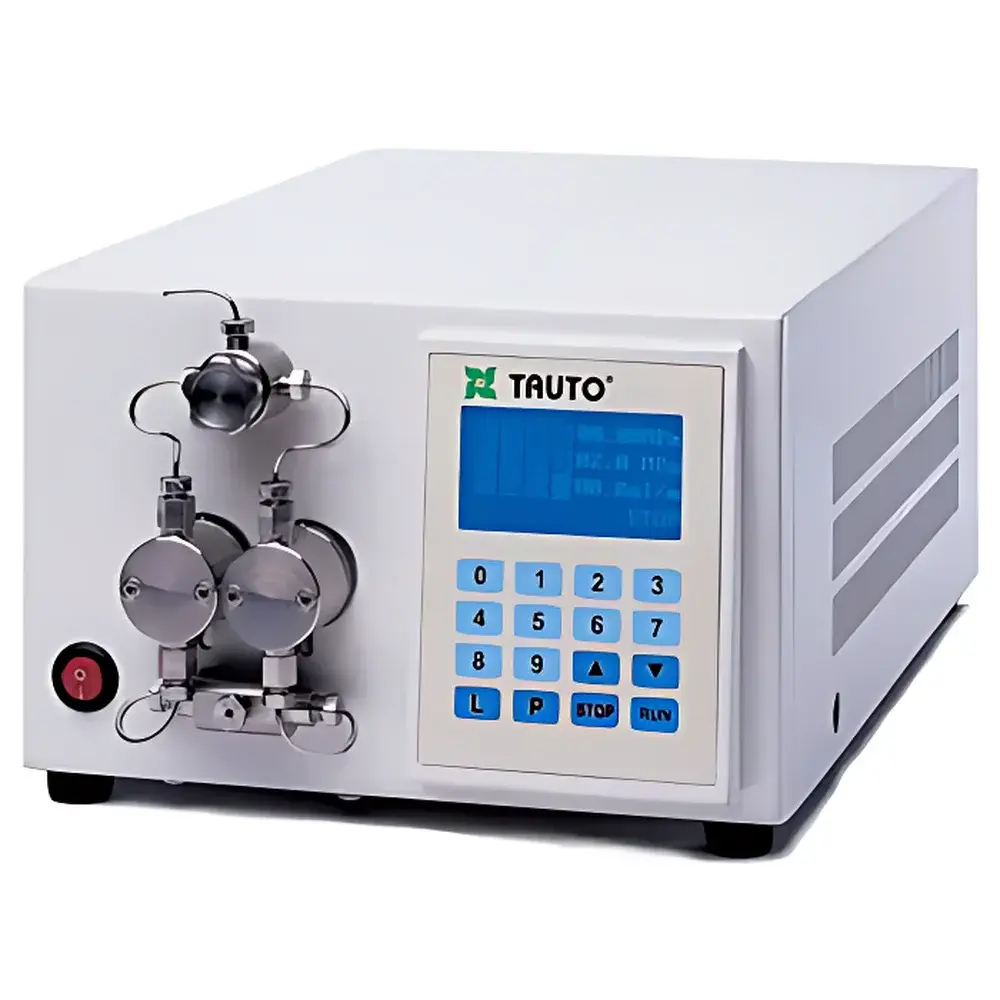
Tongtian Grad50 Dual-Plunger Medium-Pressure Binary Gradient Pump
| Brand | Tongtian |
|---|---|
| Origin | Shanghai, China |
| Model | Grad50 |
| Pressure Range | 0–5.0 MPa |
| Flow Rate Range | 0.1–50.0 mL/min |
| Gradient Accuracy | ±1% |
| Flow Increment Resolution | 0.1 mL/min |
| Mixing Ratio Range | 0.0–100% |
| Pressure Pulsation | ≤0.10 MPa |
| Pressure Accuracy | ≤±0.05 MPa |
| Flow Rate Accuracy | ≤±1% (0.1–10 mL/min), ≤±2% (10–50 mL/min) |
| Flow Precision (RSD) | ≤1% |
| Wetted Materials | Sapphire, 316L Stainless Steel, Zirconia Ceramic |
| Power Supply | 220 V ±10%, 50/60 Hz |
| Power Consumption | 75 W |
| Dimensions | 360 × 255 × 160 mm |
| Weight | 12 kg |
Overview
The Tongtian Grad50 is a dual-plunger, medium-pressure binary gradient pump engineered for precise, stable, and chemically resistant liquid delivery in analytical and preparative chromatographic applications. Unlike low-pressure gradient systems—where mixing occurs upstream of the pump and introduces dead volume, bubble formation, and system-wide failure upon single-pump malfunction—the Grad50 implements high-fidelity gradient generation at the pump outlet via two independently controllable plunger units. This medium-pressure gradient architecture eliminates mixing-induced degassing, reduces dwell volume to <150 µL, and ensures superior gradient reproducibility (RSD ≤1%) across repeated runs. The pump operates on positive displacement principles using sapphire ball-and-seat check valves and precision-machined ceramic plungers, delivering consistent flow profiles under variable backpressure up to 5.0 MPa. Its microprocessor-based control system enables real-time pressure monitoring, dynamic flow compensation, and integrated overpressure protection—critical for safeguarding columns and detectors in HPLC, flash chromatography, and method development workflows.
Key Features
- Dual independent plunger modules with full individual addressability—ensures operational continuity if one unit requires maintenance or calibration
- Chemically inert fluidic path constructed from sapphire, 316L stainless steel, and zirconia ceramic—compatible with aggressive solvents including concentrated acids, bases, THF, DMSO, and chlorinated organics
- Low-pressure pulsation design (≤0.10 MPa) achieved through synchronized dual-piston actuation and optimized valve timing—minimizes baseline noise in UV and conductivity detection
- Onboard flow calibration routine with user-accessible correction factors—maintains long-term volumetric accuracy per ISO 5725-2 traceability principles
- Integrated air-removal mechanism featuring vacuum-assisted priming and pulse-dampened venting—prevents bubble entrapment without manual syringe purging
- Large backlit LCD interface with intuitive menu navigation, parameter memory retention, and timestamped event logging
- RS-232 and optional USB communication protocols—enables remote operation, script-driven method sequencing, and integration into LIMS or ELN environments
Sample Compatibility & Compliance
The Grad50 supports continuous delivery of aqueous, organic, and mixed-phase mobile phases across pH 0–14 and viscosity ranges up to 15 cP. Its wetted materials meet USP Class VI biocompatibility requirements and comply with ASTM F899-22 for metallic implant-grade stainless steel. When configured with PEEK or titanium pump heads (available as TBP-K and TBP-T variants), the system extends compatibility to highly corrosive media such as hydrofluoric acid, molten salts, and oxidizing halogen solutions. The instrument adheres to IEC 61010-1:2010 safety standards for laboratory equipment and incorporates hardware-enforced pressure cutoffs aligned with EN 61800-5-2 functional safety guidelines. For regulated environments, firmware supports audit trail generation, electronic signature capture, and 21 CFR Part 11-compliant data integrity controls when paired with validated PC software.
Software & Data Management
The Grad50’s embedded firmware provides real-time visualization of pressure trends, flow rate deviations, and gradient composition profiles via graphical waveform display. Users may define multi-step methods—including timed flow ramps, pressure-limited hold segments, and solvent ratio transitions—with up to 99 programmable steps stored in non-volatile memory. All operational parameters—including current pressure, setpoint values, elapsed runtime, and error codes—are timestamped and exportable as CSV files via serial interface. Optional Tongtian ChromoControl Suite (v3.2+) adds GLP/GMP functionality: role-based access control, change history tracking, digital signature workflows, and automated report generation compliant with ISO/IEC 17025 documentation requirements. Data encryption (AES-128) and secure firmware update signing ensure regulatory readiness for pharmaceutical QC labs operating under Annex 11 and FDA guidance.
Applications
- Binary gradient elution in analytical-scale reversed-phase, ion-exchange, and size-exclusion HPLC
- Method scouting and robustness testing requiring rapid solvent composition sweeps (e.g., %B gradients from 5% to 95% in ≤5 min)
- Flash chromatography purification of natural products, synthetic intermediates, and peptide fragments
- Continuous feeding in coupled techniques such as LC-MS, LC-ICP-MS, and preparative SFC
- Calibration standard delivery in automated environmental testing systems (EPA Method 8081, ISO 10302)
- Long-duration stability studies involving pH-sensitive biomolecules or oxidation-prone small molecules
FAQ
What distinguishes medium-pressure gradient formation from low-pressure gradient systems?
Medium-pressure gradients are generated post-pump, minimizing dwell volume and eliminating pre-column bubble nucleation—resulting in faster gradient response, improved retention time reproducibility, and higher method transfer fidelity.
Can the Grad50 be integrated into an existing HPLC stack with third-party detectors?
Yes—its RS-232 interface supports ASCII command protocols compatible with Agilent, Waters, and Shimadzu controllers; analog voltage outputs (0–5 V) enable direct pressure/flow feedback to external DAQ systems.
Is flow accuracy verified across the entire 0.1–50 mL/min range?
Calibration is performed at five points (0.1, 1, 5, 20, and 50 mL/min) per ISO 8502-3 using gravimetric measurement against NIST-traceable balances; RSD remains ≤1% within specification limits.
How does the pump handle viscous or particulate-containing mobile phases?
The sapphire check valves and hardened ceramic plungers resist abrasion and galling; however, filtration through 0.22 µm membranes is recommended prior to introduction—especially for >5 cP solvents or suspensions.
Does the Grad50 support gradient delay volume compensation?
Yes—dwell volume can be entered manually or auto-measured via step-gradient profiling; firmware applies real-time offset correction to retention time calculations during method transfer.



