
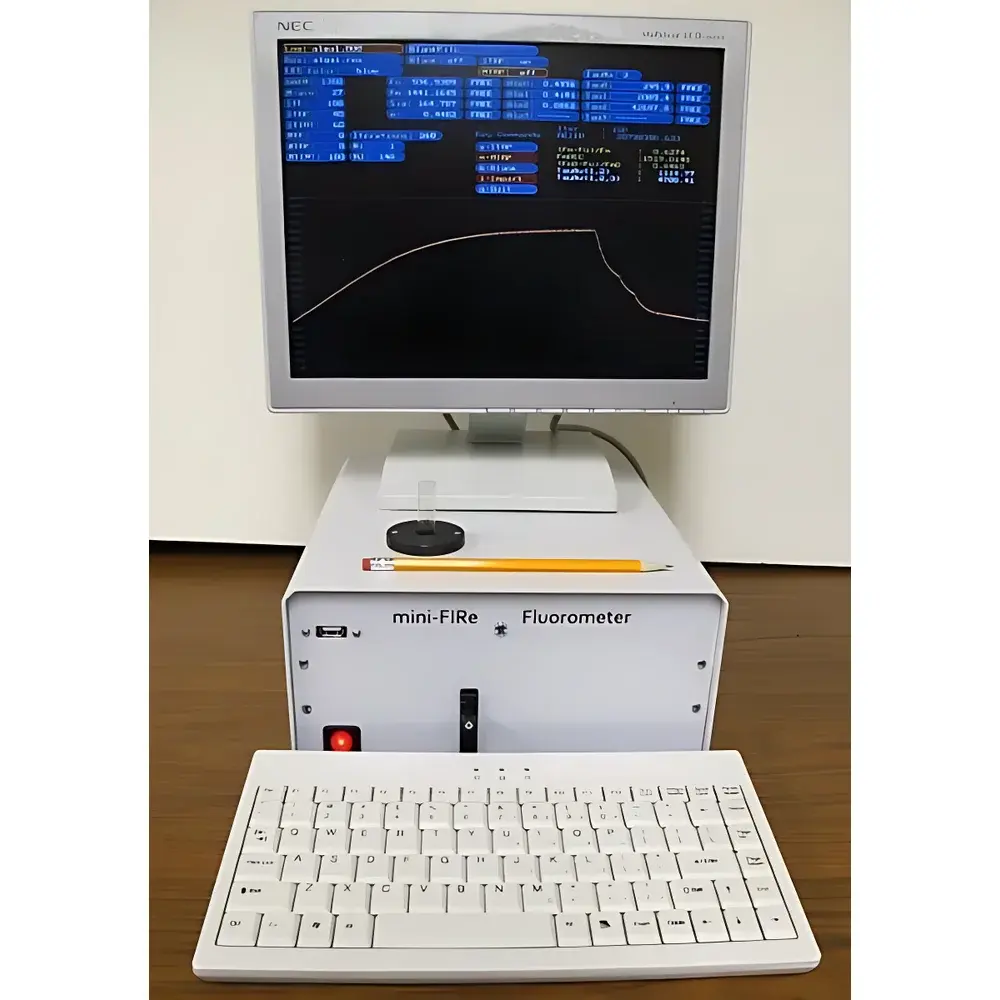
Rutgers mini-FIRe Fluorescence Induction and Relaxation System
| Origin | Imported |
|---|---|
| Manufacturer Type | Authorized Distributor |
| Model | mini-FIRe |
| Detection Limit | 0.005–100 mg/m³ chlorophyll *a* |
| Excitation Wavelengths | 450 nm (blue), 530 nm (green), 590 nm (orange) |
| Emission Detection | 680 nm (Chl *a*), 880 nm (bacteriochlorophyll *a*) |
| Sample Modes | Discrete cuvette + flow-through configuration |
| Sensitivity Enhancement | ~10× vs. prior FIRe systems |
Overview
The Rutgers mini-FIRe Fluorescence Induction and Relaxation System is a benchtop, high-sensitivity fluorometer engineered for quantitative, non-invasive assessment of photosynthetic physiology in phytoplankton and other phototrophic organisms. It implements the patented Fluorescence Induction and Relaxation (FIRe) methodology—developed over two decades by the Rutgers University biophysics group—to resolve ultrafast (microsecond-to-second) fluorescence transients induced by precisely controlled actinic and saturating light pulses. Unlike conventional PAM fluorometers, mini-FIRe employs multi-phase excitation protocols—including Single-Turnover Flashes (STF, ~100 µs) and Multi-Turnover Flashes (MTF, 50 ms)—to decouple photochemical and non-photochemical processes across Photosystem II (PSII) and the intersystem electron transport chain. Its core measurement principle relies on the biophysical relationship between variable chlorophyll *a* fluorescence yield and the redox state of PSII reaction centers (QA/QB) and the plastoquinone (PQ) pool. This enables derivation of quantum efficiencies, functional absorption cross-sections (σPSII), electron transfer time constants (τQA, τPSII–PSI), and kinetic parameters governing energy redistribution and photoprotection. Designed for both discrete sample analysis (e.g., Niskin bottle filtrates) and continuous in situ deployment via flow-through cell integration, mini-FIRe delivers laboratory-grade precision under field-relevant conditions—including open-ocean sampling where chlorophyll *a* concentrations fall below 0.01 mg/m³.
Key Features
- Ultra-high sensitivity detection limit of 0.005 mg/m³ chlorophyll a, enabling reliable measurements in oligotrophic marine environments.
- Triple-wavelength excitation (450 nm, 530 nm, 590 nm) for selective activation of functional phytoplankton groups (e.g., cyanobacteria, diatoms, prasinophytes) based on pigment composition.
- Dual-channel emission detection at 680 nm (Chl a) and 880 nm (bacteriochlorophyll a), with interchangeable emission filters for extended spectral flexibility.
- Microsecond-resolution transient recording (≥1 MHz sampling) across four defined kinetic phases: STF-induced induction, QA− reoxidation relaxation, MTF-induced PQ pool saturation, and PQ pool reoxidation kinetics.
- Integrated, computer-controlled Actinic Light Source (ALS) for automated generation of rapid light curves (RLCs), supporting calculation of photosynthetic electron transport rate (ETR), maximum quantum yield (Fv/Fm), effective quantum yield (ΔF’/Fm‘), and non-photochemical quenching (NPQ).
- Compact footprint (25.4 × 12.7 × 30.5 cm) and modular design compatible with shipboard labs, autonomous platforms, or shore-based analytical facilities.
Sample Compatibility & Compliance
mini-FIRe accommodates standard 1-cm pathlength quartz cuvettes for discrete sample analysis and integrates seamlessly with custom flow-through cells (e.g., 1–5 mL volume, stainless-steel or quartz construction) for continuous seawater profiling. It is validated for use with natural seawater, filtered and unfiltered plankton suspensions, cultured isolates, and benthic microalgal biofilms. All optical components comply with ISO 17025 calibration traceability requirements for photometric instrumentation. The system supports GLP-compliant data acquisition through timestamped, audit-trail-enabled software logging—fully compliant with FDA 21 CFR Part 11 for electronic records and signatures when deployed in regulated environmental monitoring programs. Measurement protocols align with ASTM D7980–15 (Standard Guide for Chlorophyll Fluorescence-Based Assessment of Phytoplankton Physiology) and are referenced in peer-reviewed literature spanning marine biogeochemistry, climate change impact studies, and harmful algal bloom forecasting.
Software & Data Management
The proprietary FIRe Analysis Suite provides real-time visualization, automated transient fitting, and parameter extraction using constrained multi-exponential decay models (3-component for QA reoxidation; 2-component for PQ pool kinetics). Raw fluorescence traces are stored in HDF5 format with embedded metadata (excitation intensity, temperature, salinity, sample ID, operator). Batch processing supports parallel analysis of RLC datasets to derive Pmax, Ek, and α (initial slope), all exportable to CSV, MATLAB (.mat), or netCDF for integration with ecosystem modeling frameworks (e.g., ERSEM, MEDUSA). Software includes built-in QA/QC flags for signal-to-noise ratio, pulse saturation fidelity, and dark-adaptation compliance. Audit logs record all user actions, parameter edits, and calibration events—ensuring full reproducibility and regulatory readiness.
Applications
- Quantifying physiological stress responses to nutrient limitation (N, Fe, Si), UV exposure, thermal anomalies, and anthropogenic pollutants in coastal and pelagic ecosystems.
- Resolving diel and vertical variability in PSII efficiency and electron transport capacity during oceanographic cruises and moored observatory deployments.
- Validating satellite-derived primary productivity algorithms by ground-truthing in vivo Fv/Fm and ETR profiles across light gradients.
- Characterizing photophysiological diversity within phytoplankton communities via wavelength-selective excitation and σPSII heterogeneity mapping.
- Supporting biogeochemical model parameterization through direct measurement of light-saturated electron transport rates and photoinhibition thresholds.
FAQ
What distinguishes mini-FIRe from conventional PAM fluorometers?
mini-FIRe resolves fluorescence transients at microsecond resolution using multi-phase flash sequences, enabling independent quantification of PSII charge separation, QA reoxidation, and intersystem electron transport—parameters inaccessible to standard pulse-amplitude modulation systems.
Can mini-FIRe be deployed on autonomous platforms?
Yes. Its low power consumption (<12 W), compact form factor, and RS-232/Ethernet interface support integration with AUVs, gliders, and moored profilers equipped with flow-through seawater intake systems.
Is calibration required before each measurement series?
A daily dark-adapted Fo/Fm check using a reference standard (e.g., lyophilized Synechococcus) is recommended; factory-calibrated excitation intensities and detector gains remain stable for ≥6 months under controlled lab conditions.
Does the system support simultaneous multi-wavelength excitation?
No—excitation wavelengths are selected sequentially via motorized filter wheel to avoid spectral crosstalk; however, rapid switching (<100 ms) enables quasi-simultaneous multi-pigment interrogation within a single measurement cycle.
How is data integrity ensured during long-term field deployments?
All raw transients are written to non-volatile memory with cyclic redundancy checking (CRC-32); the software enforces write-verify protocols and generates SHA-256 checksums for every dataset archive.





