
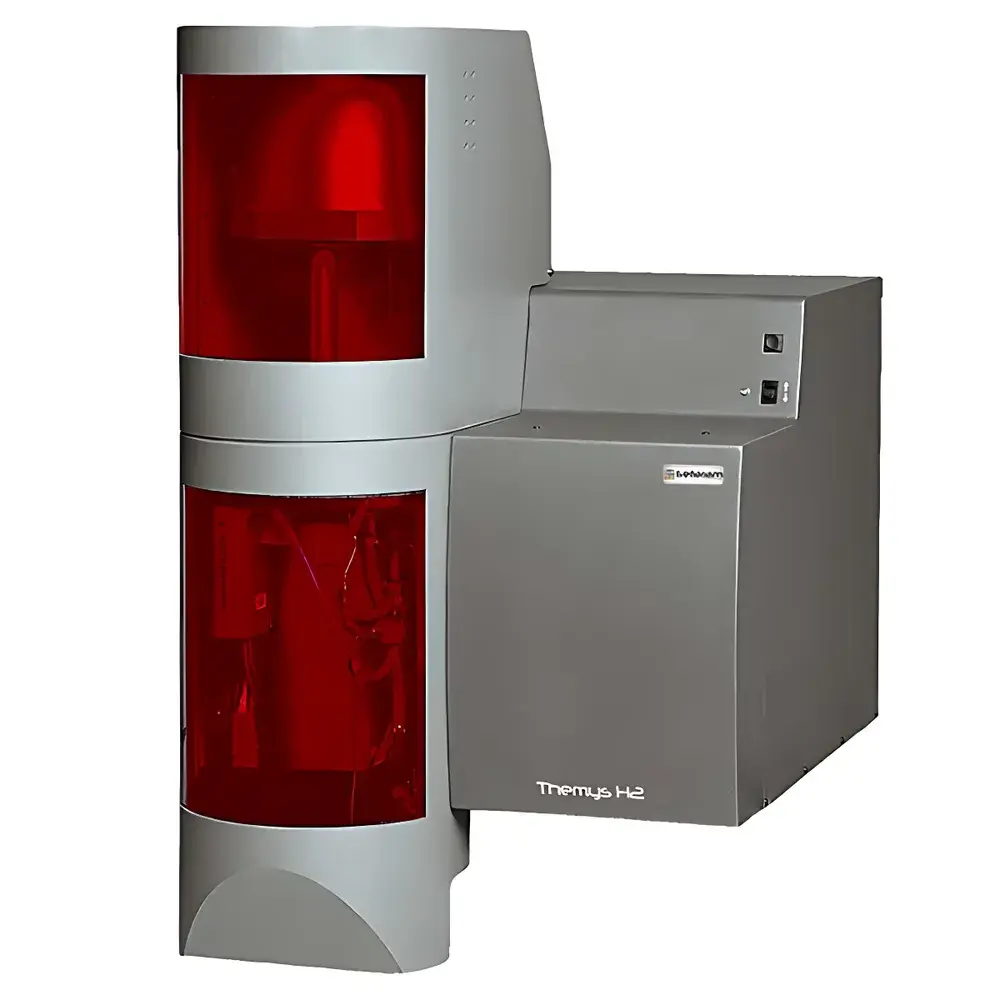
SETARAM THEMYS H2 Hydrogen-Compatible Simultaneous Thermal Analyzer
| Brand | SETARAM |
|---|---|
| Origin | France |
| Model | THEMYS H2 |
| Temperature Range | Ambient to 1000/1600/1750 °C |
| Heating Rate | 0.01–100 °C/min |
| Max Sample Mass | 35 g |
| Atmosphere | 3 Gas Lines (including dedicated H₂ line) |
| Safety | Dual H₂/O₂ Sensors, Interlocked Furnace & Balance, Emergency H₂ Shutoff, Vacuum- and High-Temp-Interlocked Access |
| Vacuum Level | < 5×10⁻² mbar |
| Resolution | 0.4 μW (DTA), 1 μW (DSC), 0.002 μg (TGA), 0.02 μg (microbalance), 0.2 nm (TMA) |
| Quantitative Accuracy | ±1.4% (DTA), ±0.9% (DSC), ±0.06% (TGA), ±0.08×10⁻⁶/°C (TMA expansion) |
Overview
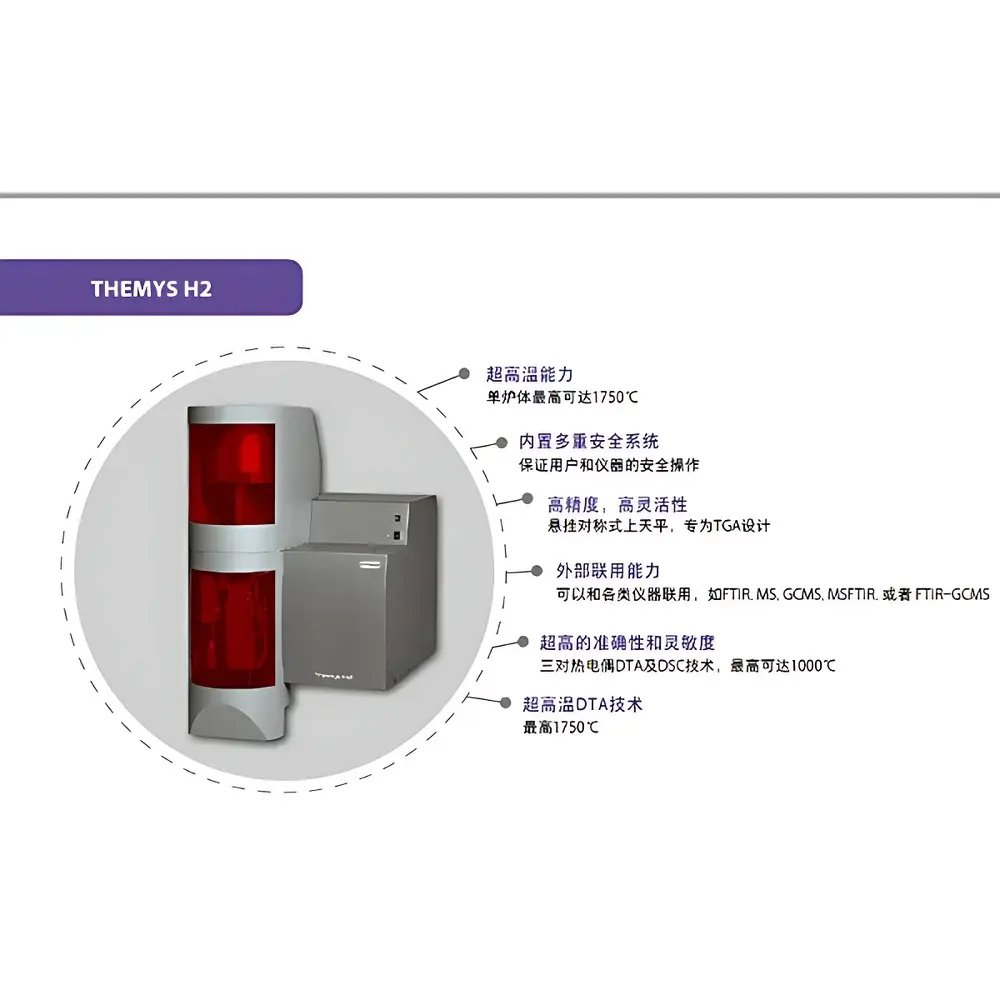
The SETARAM THEMYS H₂ is a purpose-engineered simultaneous thermal analyzer designed for rigorous, reproducible material characterization under controlled hydrogen atmospheres—up to 1750 °C. Unlike conventional STA systems, the THEMYS H₂ integrates intrinsic safety architecture with high-temperature thermal analysis capabilities, enabling direct measurement of mass change (TGA), heat flow (DTA/DSC), dimensional response (TMA), and thermal stability in reducing, inert, or reactive H₂ environments. Its core measurement principle relies on differential thermal analysis coupled with high-resolution microgravimetry, where sample and reference crucibles are suspended symmetrically from an upper-mounted balance—minimizing buoyancy artifacts and ensuring exceptional baseline stability across wide temperature ramps. The furnace employs optimized resistive heating elements and multi-zone thermal shielding to achieve uniform temperature distribution and precise control up to 1750 °C, validated per ASTM E1142 and ISO 11357 standards. This platform supports both standalone operation and hyphenated analysis via external coupling to mass spectrometry (MS) or Fourier-transform infrared (FTIR) gas analyzers—enabling real-time identification of evolved gases during hydrogenation, dehydrogenation, oxide reduction, or metal powder sintering.
Key Features
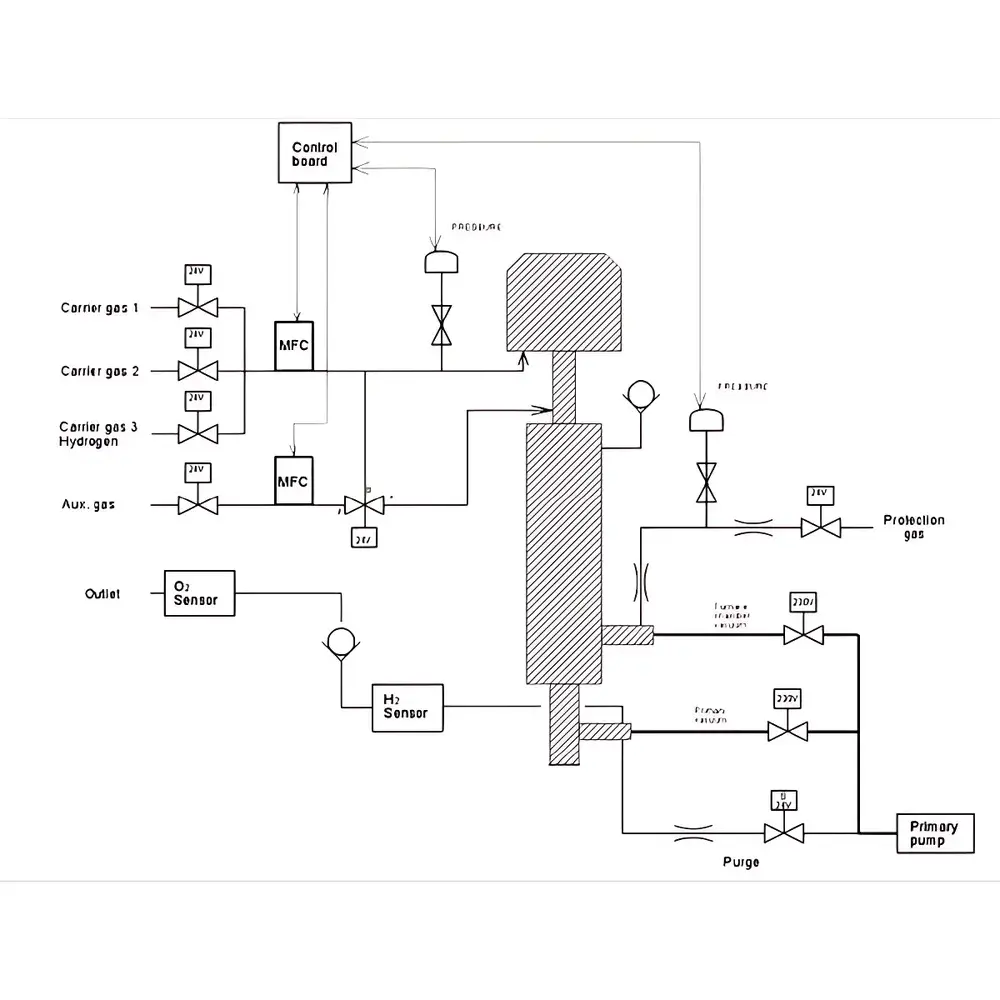
- Triple-gas manifold with independent mass flow controllers (MFCs), including a dedicated, leak-tight hydrogen line certified for Class II, Division 1 hazardous area compatibility
- Dual electrochemical H₂ and O₂ concentration sensors installed at exhaust outlet—continuously monitoring for cross-contamination risk and triggering automated interlocks
- Furnace and balance access physically disabled when H₂ is detected or when internal O₂ exceeds 0.5 vol%, per IEC 60079-26 functional safety requirements
- High-temperature vacuum system (< 5×10⁻² mbar) with hydrogen-compatible pumping stage, eliminating oxidation artifacts during in-situ reduction studies
- Symmetrical top-loading microbalance with 0.002 μg resolution and 35 g maximum capacity—optimized for long-duration TGA under dynamic H₂ flow
- Modular sensor head supporting interchangeable DTA, DSC, TMA, and TGA configurations without hardware reconfiguration
- Thermal expansion calibration traceable to NIST SRM 736 (sapphire) and certified per ISO 11359-2
Sample Compatibility & Compliance
The THEMYS H₂ accommodates diverse sample geometries—including powders (e.g., MgH₂, NaAlH₄), sintered ceramics, metallic alloys, and injection-molded feedstocks—within crucibles ranging from 30 μL (DSC) to 2500 μL (TGA), with maximum dimensions of Ø14 mm × 20 mm. All wetted materials—including furnace linings, gas lines, and sensor housings—are selected for hydrogen embrittlement resistance (per ASTM G142) and high-temperature oxidation stability. The system complies with GLP and GMP data integrity requirements: audit trails record all parameter changes, user actions, and alarm events; raw data files are cryptographically hashed and timestamped in accordance with FDA 21 CFR Part 11 Annex 11. It meets CE marking directives for electromagnetic compatibility (2014/30/EU) and low-voltage safety (2014/35/EU), and its hydrogen safety architecture aligns with NFPA 55 and EN 13445-3 pressure equipment guidelines.
Software & Data Management
SETARAM’s CALISTO software provides full instrument control, real-time visualization, and post-acquisition analysis using ISO-standardized algorithms. Multi-step temperature programs support conditional logic (e.g., hold until H₂ concentration stabilizes below threshold), while kinetic modeling modules implement Friedman, Ozawa-Flynn-Wall, and ASTM E698 methodologies for activation energy determination. All datasets export in ASTM E1970-compliant ASCII format, with embedded metadata including calibration history, gas composition logs, and sensor health diagnostics. Remote monitoring is enabled via TLS-secured HTTP API, allowing integration into centralized laboratory information management systems (LIMS) without compromising data sovereignty.
Applications
- Quantification of hydrogen absorption/desorption kinetics in metal hydrides and complex hydrides
- In-situ reduction of transition metal oxides (e.g., Fe₂O₃ → Fe, NiO → Ni) under programmable H₂ partial pressures
- Thermal stability assessment of polymer electrolyte membranes (PEMs) and catalyst supports under fuel-cell-relevant conditions
- Debinding and sintering behavior of metal injection molding (MIM) feedstocks in H₂/N₂ mixtures
- Decomposition thermodynamics of ammonia borane and other chemical hydrogen carriers
- Thermal expansion and softening point determination of refractory ceramics under reducing atmospheres
FAQ
What hydrogen purity levels are supported?
The THEMYS H₂ accepts ≥99.999% H₂ (5.0 grade); optional gas purifiers reduce O₂/H₂O content to < 100 ppb.
Can the system operate under vacuum while introducing hydrogen?
No—vacuum and hydrogen introduction are mutually exclusive per safety interlock; H₂ is introduced only after atmospheric or inert purge completion.
Is calibration traceable to national standards?
Yes: temperature calibration uses NIST-traceable In, Sn, Zn, Ag, and Au standards; mass calibration employs certified weights per ISO/IEC 17025.
How is data integrity ensured during long-term experiments?
Raw data streams are written continuously to redundant SSDs with SHA-256 checksum validation; power-fail recovery preserves unsaved buffers.
Does the system support custom crucible materials?
Yes—graphite, alumina, tungsten, and molybdenum crucibles are qualified for use up to their respective service limits; compatibility matrices are provided in the technical manual.



