
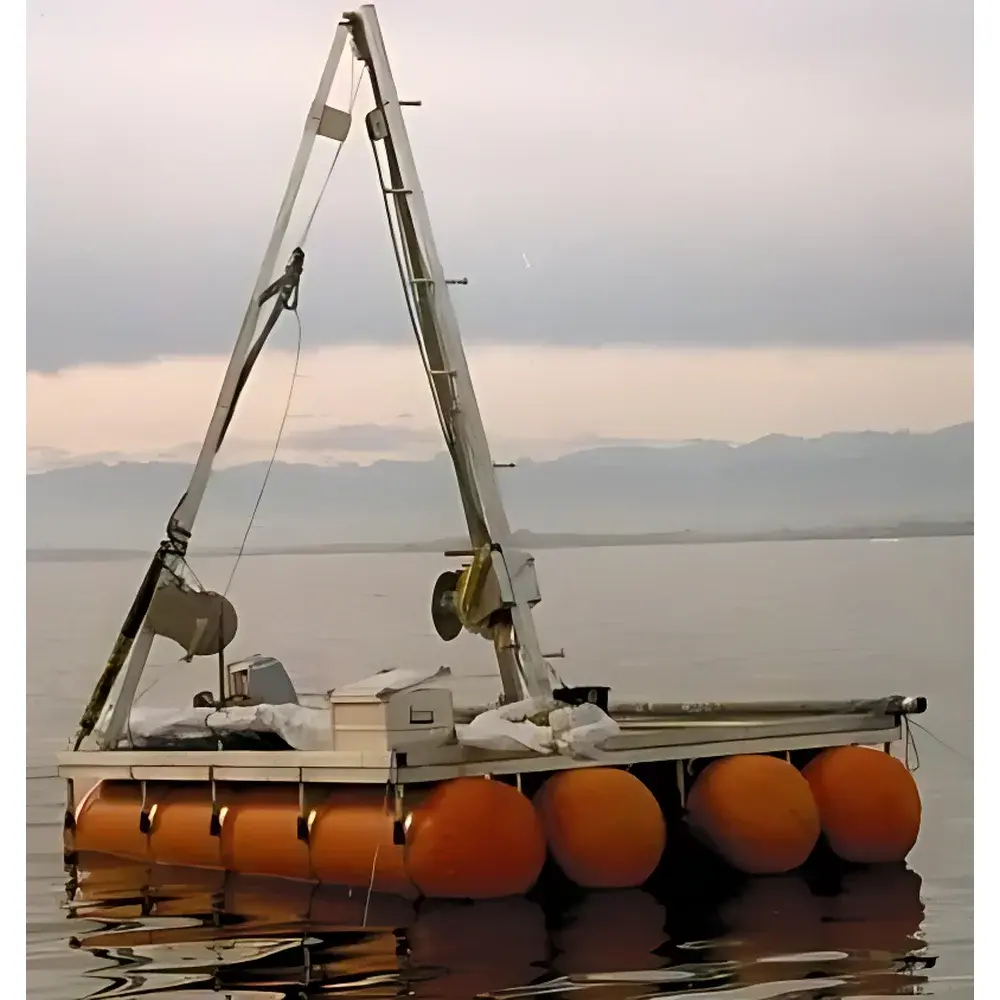
UWITEC PC 60 Piston Coring System for Deep-Water Sediment Sampling
| Origin | Austria |
|---|---|
| Supplier Type | Authorized Distributor |
| Origin Category | Imported |
| Model | PC 60 |
| Pricing | Available Upon Request |
Overview
The UWITEC PC 60 Piston Coring System is a field-deployable, gravity-assisted deep-sediment sampling platform engineered for high-fidelity retrieval of undisturbed sediment cores from freshwater and marine environments. Operating on the principle of free-fall piston coring—where a weighted coring assembly descends under gravity while a stationary piston maintains vacuum-induced suction within the core barrel—the system minimizes sediment compression and flow disturbance during penetration. Designed for operational depths up to 140 m, it delivers continuous, stratigraphically intact cores up to 20 m in length, supporting paleolimnological, geochemical, geotechnical, and environmental monitoring workflows requiring centimeter-scale vertical resolution. Its modular architecture integrates seamlessly with vessel-based or ice-based deployment setups, enabling rapid mobilization in remote or logistically constrained locations.
Key Features
- Modular piston corer with interchangeable core barrel diameters (36 mm, 60 mm, and 86 mm) to accommodate varying sediment rheology and analytical requirements.
- Dual capture mechanisms: mechanical clamp-type core catcher for consolidated or gravel-rich sediments; hydraulic core catcher for soft, unconsolidated, or gel-like deposits.
- Corrosion-resistant, precision-machined stainless steel construction across all load-bearing components—including extension rods (2–5 m), steel drive tubes (1.2–5 m), and piston assemblies—ensuring long-term structural integrity in saline or acidic environments.
- Lightweight, self-assembling sampling platform (4.2 × 2.8 × 0.76 m, total weight 270 kg) featuring four polyester-fiber buoyancy modules with Hypalon-coated exteriors and integrated quick-release buckles.
- Adjustable tripod mast (2.7 × 4 m footprint, 60 kg mass) with telescoping legs, onboard hand-crank winches, and triple-pulley rope guidance—providing 2× mechanical advantage and enhanced operator safety during cable deployment.
- Optional motorized propulsion integration via pre-installed mounting brackets, enabling autonomous or semi-autonomous platform positioning on lacustrine or coastal surfaces.
Sample Compatibility & Compliance
The PC 60 system is validated for use across a broad spectrum of depositional settings, including oligotrophic lakes, estuarine mudflats, glacial lake basins, and continental shelf sediments. Core recovery efficiency exceeds 95% in cohesive clays and silts (ASTM D1586-22), and remains >85% in moderately stratified sandy-clay mixtures when deployed with appropriate piston velocity control. All structural materials comply with ISO 9001-certified manufacturing protocols, and corrosion resistance meets ASTM A240/A240M standards for austenitic stainless steels. The platform’s flotation configuration satisfies IMO Resolution A.761(18) stability criteria for unmanned surface sampling platforms operating in sheltered waters.
Software & Data Management
While the PC 60 is primarily a mechanically operated system, its winch subsystem supports optional digital instrumentation upgrades—including rotary encoders (IP67-rated) mounted on pulley shafts for real-time depth logging and rope payout monitoring. Encoded data streams are compatible with standard NMEA 0183 and ASCII serial output formats, allowing direct ingestion into GIS-enabled sediment logging software (e.g., CoreWall, SedLog, or QGIS-based custom pipelines). All electronic add-ons adhere to IEC 61000-4-2/4-3 EMC standards and support audit-trail functionality required under GLP-compliant sediment archive protocols.
Applications
- Paleoenvironmental reconstruction using varve counting, microfossil analysis, and radiometric dating (e.g., 210Pb, 137Cs).
- Contaminant profiling of legacy pollutants (PCBs, PAHs, heavy metals) across sediment–water interfaces.
- In situ geotechnical characterization for offshore infrastructure planning, including shear strength and consolidation behavior assessment.
- Baseline monitoring for regulatory compliance under EU Water Framework Directive (WFD) Annex V and US EPA Method 1668C.
- Calibration and ground-truthing of acoustic sub-bottom profiler (SBP) and CHIRP sonar datasets.
FAQ
What maximum water depth can the PC 60 system operate in?
The system is rated for reliable operation at depths up to 140 meters, provided appropriate rope length, buoyancy margin, and winch capacity are maintained.
Can the PC 60 collect cores from ice-covered lakes?
Yes—its tripod mount allows secure anchoring to ice surfaces, and the modular design permits rapid disassembly for over-ice transport and reassembly.
Is the system compatible with third-party core splitting or XRF scanning workflows?
All core barrels conform to standard DIN 18123-1 dimensions and accept industry-standard core liners (PVC, polycarbonate), ensuring seamless integration with downstream subsampling and elemental analysis systems.
Does UWITEC provide calibration documentation or traceable metrology reports?
Each delivery includes material certification (EN 10204 3.1), dimensional verification reports, and winch torque calibration certificates issued by an ISO/IEC 17025-accredited laboratory.
What training and technical support options are available?
UWITEC-certified field engineers offer on-site commissioning, multi-day operator training (including safety protocols, core handling, and troubleshooting), and remote diagnostics via encrypted VNC sessions.
Related Products







