
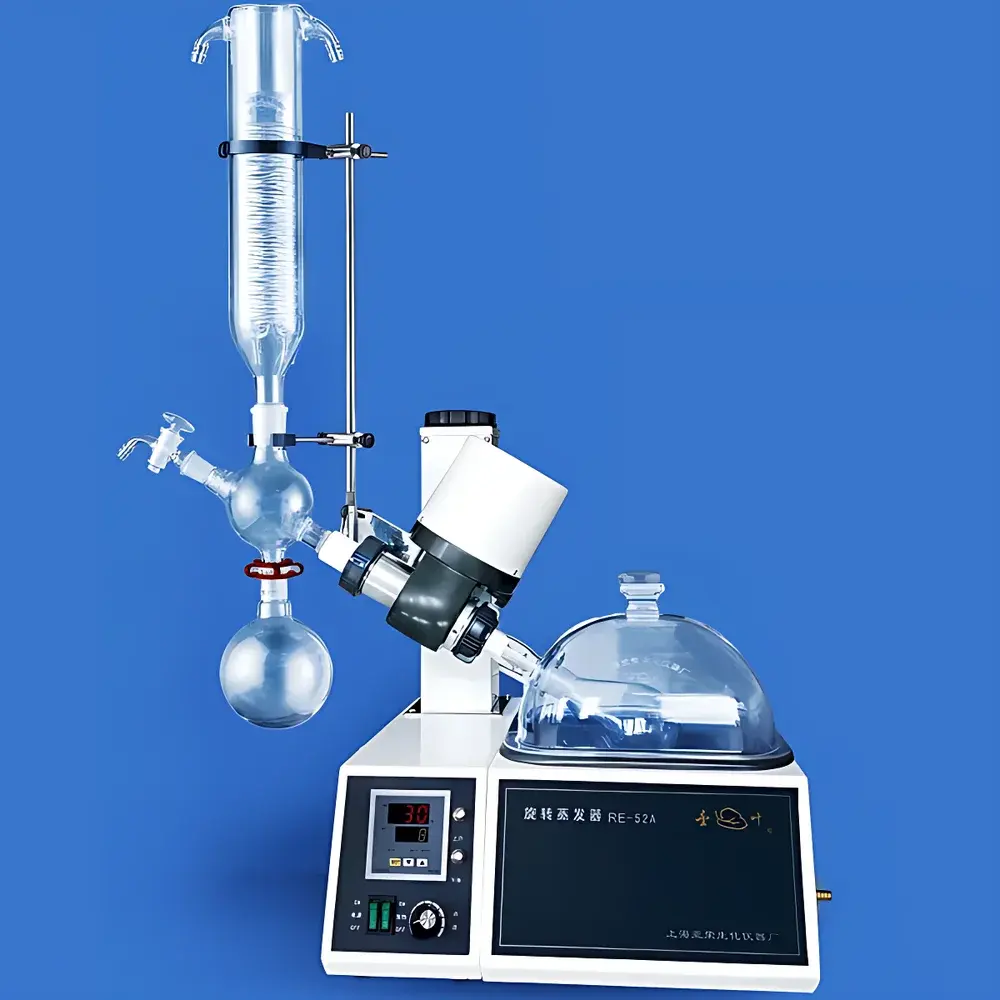
Shanghai Yarong RE-52A Rotary Evaporator
| Brand | Jinye |
|---|---|
| Origin | Shanghai, China |
| Manufacturer Type | Direct Manufacturer |
| Region of Origin | Domestic (China) |
| Model | RE-52A |
| Capacity Range | 50–2000 mL |
| Rotational Speed | 0–150 rpm |
| Temperature Control Range | Ambient to 99 °C |
| Temperature Control Accuracy | ±1 °C |
| Condensing Surface Area | 0.08 m² (coiled cold finger condenser) + dry ice cooling interface |
| Display | Digital temperature display |
| Drive | Electronic speed control |
| Lift Mechanism | Motorized vertical lift |
Overview
The Shanghai Yarong RE-52A Rotary Evaporator is a benchtop vacuum distillation system engineered for reliable solvent removal, concentration, and gentle sample recovery under reduced pressure. Based on the principle of rotary evaporation—where reduced pressure lowers the boiling point of solvents while controlled heating and uniform rotation increase surface area and mass transfer—the RE-52A enables efficient, reproducible processing of heat-sensitive compounds across pharmaceutical, chemical, and academic laboratories. Its modular design integrates a motorized lift, digital temperature monitoring, and electronic speed regulation to support method consistency and operator safety. The system operates within standard laboratory environments and complies with foundational mechanical and electrical safety requirements for Class I laboratory equipment (IEC 61010-1).
Key Features
- Motorized Vertical Lift: Enables precise, hands-free adjustment of the evaporation flask relative to the heating bath—critical for optimizing vapor path length and preventing bumping or splashing during volatile solvent removal.
- Digital Temperature Display & PID-Controlled Heating Bath: Provides real-time feedback and stable thermal regulation from ambient temperature up to 99 °C, with an accuracy of ±1 °C—sufficient for ethanol, acetone, ethyl acetate, and other common low-boiling solvents.
- Electronic Speed Control (0–150 rpm): Delivers smooth, stepless rotational adjustment to maintain film uniformity across varying viscosities and volumes (50–2000 mL), minimizing foaming and maximizing evaporation efficiency.
- Cold Finger Condenser with Dual-Cooling Interface: Features a 0.08 m² coiled condensing surface optimized for high-efficiency vapor capture; includes dedicated dry ice cooling capability for low-boiling solvents (e.g., diethyl ether, dichloromethane) where water-cooled condensers may be insufficient.
- Robust Construction & Chemical Compatibility: Mainframe fabricated from corrosion-resistant stainless steel and aluminum alloy; all wetted parts (condenser, vapor duct, collection flasks) constructed from borosilicate glass (GG-17 or equivalent), ensuring compatibility with organic solvents, mild acids, and bases.
Sample Compatibility & Compliance
The RE-52A accommodates a broad range of sample types—including aqueous extracts, organic reaction mixtures, polymer solutions, and natural product fractions—within its 50–2000 mL capacity envelope. It supports Good Laboratory Practice (GLP) workflows through repeatable parameter control and manual documentation of operating conditions (temperature, rotation speed, vacuum level). While not certified to ISO/IEC 17025 or FDA 21 CFR Part 11 out-of-the-box, the instrument’s operational transparency and mechanical stability make it suitable for non-GMP research, process development, and teaching applications. Users are advised to validate method parameters per internal SOPs when used in regulated environments.
Software & Data Management
The RE-52A operates as a stand-alone analog-digital hybrid instrument with no embedded microprocessor or data logging capability. All operational parameters—including bath temperature, rotation speed, and lift position—are set manually and monitored via front-panel LED displays. Data recording must be performed externally (e.g., lab notebook, LIMS entry, or third-party vacuum/temperature loggers). This architecture prioritizes reliability, serviceability, and minimal failure points—ideal for environments where firmware updates, cybersecurity concerns, or software validation overhead are impractical.
Applications
- Solvent removal from synthetic reaction mixtures prior to chromatographic analysis or crystallization
- Concentration of thermolabile biomolecules (e.g., peptides, plant extracts, enzyme preparations) under mild vacuum and controlled temperature
- Recovery and recycling of expensive or hazardous solvents in fine chemical synthesis
- Preparative-scale dehydration of hygroscopic materials in material science labs
- Teaching core principles of phase equilibria, vapor pressure depression, and interfacial mass transfer in undergraduate chemistry and chemical engineering curricula
FAQ
What vacuum level is recommended for optimal operation?
Typical operating vacuum ranges from 10–100 mbar (7.5–75 Torr), depending on solvent boiling point and desired evaporation rate. A two-stage vacuum pump with oil mist filter is recommended for long-term stability.
Can the RE-52A be used with aggressive solvents like chloroform or THF?
Yes—provided appropriate PTFE seals and borosilicate glass components are used and ventilation meets local fume hood safety standards (e.g., ASHRAE 110 or EN 14175).
Is the heating bath compatible with silicone oil or water-only operation?
The bath accepts both water and silicone oil media; maximum safe oil temperature is limited by bath sensor calibration (≤99 °C), and viscosity changes at elevated temperatures should be considered for uniform heat transfer.
Does the unit include a vacuum controller or pressure sensor?
No—the RE-52A requires external vacuum regulation via a manual or electronic vacuum controller; integration with digital vacuum gauges is possible using standard NPT or KF fittings.
What maintenance is required for long-term reliability?
Routine inspection of PTFE seals, cleaning of condenser surfaces with appropriate solvents, periodic lubrication of lift mechanism gears, and verification of temperature sensor calibration every 6–12 months are recommended practices.



