
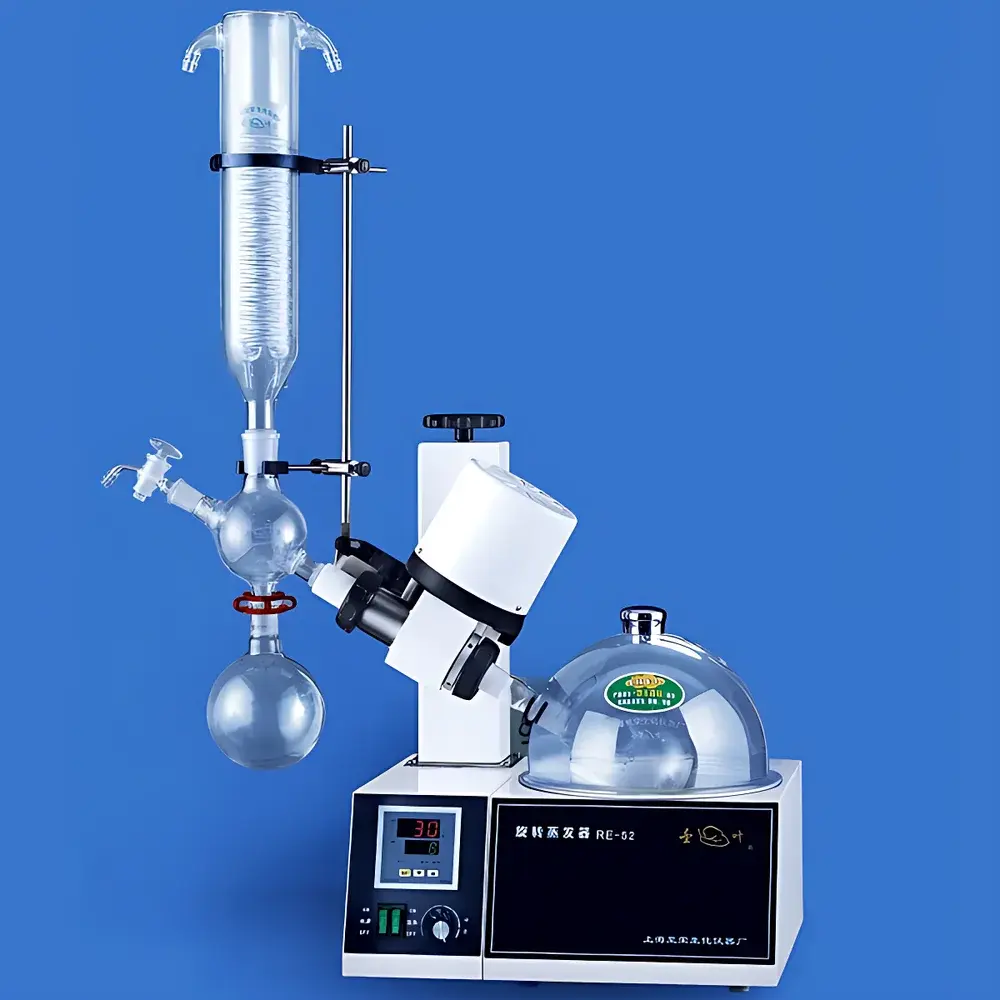
Jinye RE-52 Rotary Evaporator
| Brand | Jinye |
|---|---|
| Origin | Shanghai, China |
| Manufacturer Type | Direct Manufacturer |
| Country of Origin | China |
| Model | RE-52 |
| Rotating Flask Capacity | 50–2000 mL |
| Rotation Speed Range | 0–150 rpm |
| Temperature Control Range | Ambient to 99 °C |
| Temperature Control Accuracy | ±1 °C |
| Condensing Surface Area | 0.08 m² (coiled cold finger condenser) + optional dry ice cooling interface |
Overview
The Jinye RE-52 Rotary Evaporator is an engineered vacuum distillation system designed for efficient solvent removal, concentration, and gentle sample recovery under reduced pressure. Based on the principle of rotary evaporation—where simultaneous rotation, heating, and vacuum lower the boiling point of solvents—the RE-52 enables reproducible, scalable purification across research and pilot-scale laboratory workflows. Its robust mechanical architecture integrates a precision-controlled rotating flask drive, digitally regulated bath heating, and a high-efficiency coiled cold-finger condenser optimized for rapid vapor condensation. The system operates within standard laboratory ambient conditions and supports routine use in synthetic chemistry, natural product isolation, pharmaceutical process development, and quality control laboratories requiring reliable, operator-safe solvent recovery.
Key Features
- Digital temperature display and PID-based heating control with ±1 °C accuracy across a 0–99 °C range, ensuring thermal stability during extended evaporation cycles.
- Stepless electronic speed regulation (0–150 rpm) with real-time rpm readout, enabling precise optimization of film formation and evaporation rate for viscous or heat-sensitive samples.
- Manual handwheel-driven vertical lift mechanism for controlled flask positioning—designed for ergonomic operation and repeatable alignment between rotating flask and condenser.
- Cold-finger-type condenser with 0.08 m² effective surface area, constructed from borosilicate glass for chemical resistance and thermal shock resilience; compatible with supplementary dry ice/acetone cooling for low-boiling solvents (e.g., diethyl ether, dichloromethane).
- All-glass vapor pathway (including rotary joint, condenser, and receiving flask) minimizes adsorption and cross-contamination, supporting compliance with GLP-aligned sample integrity requirements.
- Integrated vacuum seal design with PTFE-coated ground glass joints and reinforced silicone gaskets ensures long-term vacuum integrity at ≤10 mbar operating pressure.
Sample Compatibility & Compliance
The RE-52 accommodates rotating flasks from 50 mL to 2000 mL, facilitating batch processing across analytical, preparative, and small-batch production scales. It is routinely deployed for aqueous and organic solvent systems—including ethanol, methanol, ethyl acetate, hexane, and toluene—as well as thermally labile compounds where moderate heating and rapid condensation are critical. While not certified to specific ISO or ASTM standards as a standalone unit, its construction and operational parameters align with general laboratory safety practices outlined in ISO 15190:2020 (laboratory safety management) and support adherence to USP guidelines for analytical instrument qualification when integrated into validated workflows. The all-glass fluid path and absence of metallic contact surfaces render it suitable for applications governed by ICH Q5C (stability testing) and FDA-recommended good manufacturing practice (GMP) environments where extractables and leachables must be minimized.
Software & Data Management
The RE-52 operates as a stand-alone analog-digital hybrid instrument without embedded firmware or network connectivity. Temperature setpoint and rotation speed are configured via front-panel controls with direct digital readouts; no software installation, data logging, or remote interface is provided. This design prioritizes operational simplicity, mechanical reliability, and compatibility with external vacuum controllers, temperature recorders, or programmable chillers (e.g., Huber, Julabo) via standard analog I/O or relay triggers. For laboratories requiring audit-trail capability per 21 CFR Part 11, integration with third-party environmental monitoring systems (e.g., DeltaTrak, Testo) is supported through external sensor inputs and time-stamped manual log entry protocols.
Applications
- Solvent removal from reaction mixtures post-synthesis in medicinal chemistry and process R&D.
- Concentration of crude natural extracts (e.g., plant alkaloids, essential oils) prior to chromatographic fractionation.
- Removal of volatile excipients during formulation development of liposomal or nanoparticle suspensions.
- Recovery and recycling of high-purity solvents in QC labs to reduce consumables cost and environmental footprint.
- Dehydration of hygroscopic intermediates under mild thermal conditions to prevent decomposition.
- Preparative-scale crystallization initiation via controlled supersaturation through gradual solvent volume reduction.
FAQ
What vacuum level is recommended for optimal performance with the RE-52?
A stable vacuum between 5–25 mbar is typically sufficient for most common solvents; lower pressures may be required for high-boiling-point or azeotropic systems—always verify compatibility with your vacuum pump’s ultimate pressure and chemical resistance.
Can the RE-52 be used with corrosive solvents such as concentrated HCl or HF?
No. The standard borosilicate glass and PTFE-sealed joints are incompatible with hydrofluoric acid, fuming nitric acid, or strong alkalis above pH 12; alternative corrosion-resistant evaporators with Hastelloy or quartz components are required.
Is the dry ice cooling interface factory-installed or user-assembled?
The dry ice cooling port is an integrated feature of the cold-finger condenser housing; users add dry ice/acetone slurry directly into the outer jacket—no modification or accessory kit is needed.
Does the RE-52 include a vacuum controller or pressure regulation module?
No. Vacuum control must be managed externally using a separate vacuum regulator, two-stage pump, or solenoid-valve-based pressure controller.
What maintenance intervals are recommended for long-term reliability?
Inspect PTFE seals and ground glass joints monthly; clean condenser surfaces after each use with appropriate solvent rinse; calibrate temperature display annually against a traceable NIST-certified thermometer.
Related Products



