
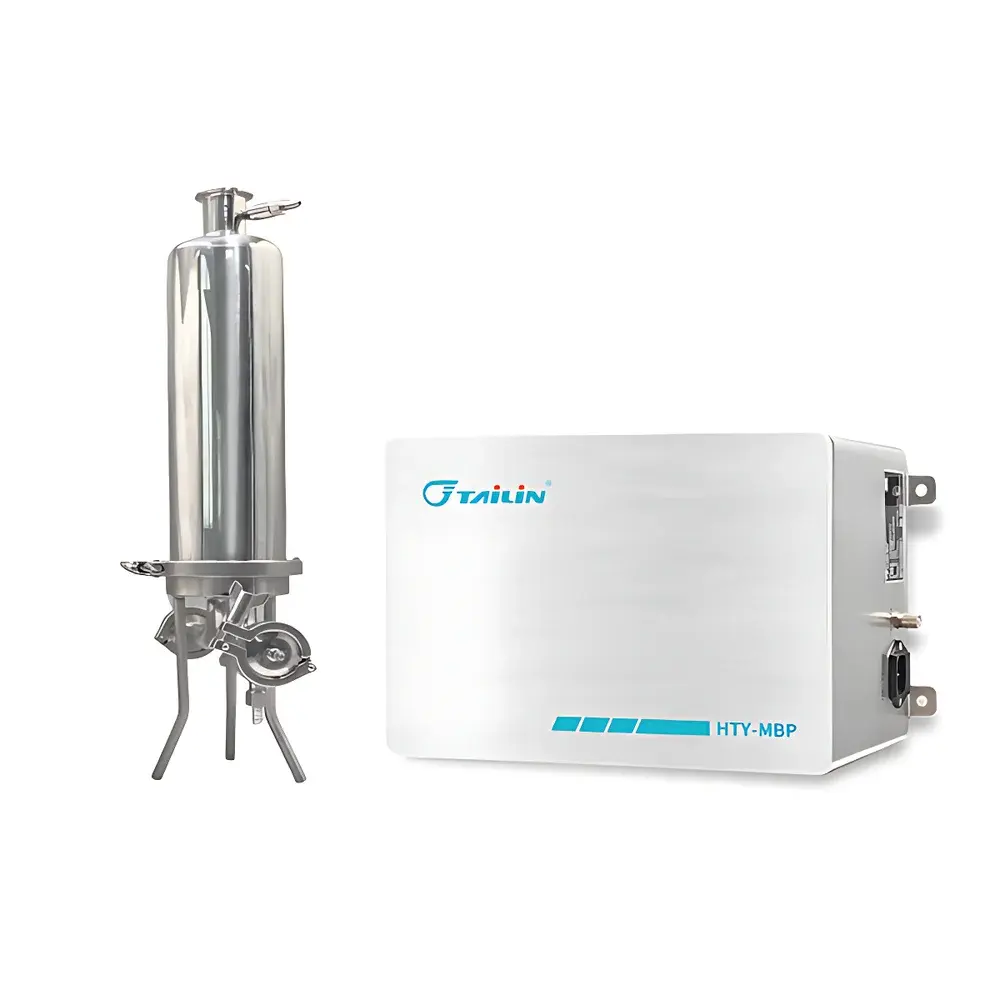
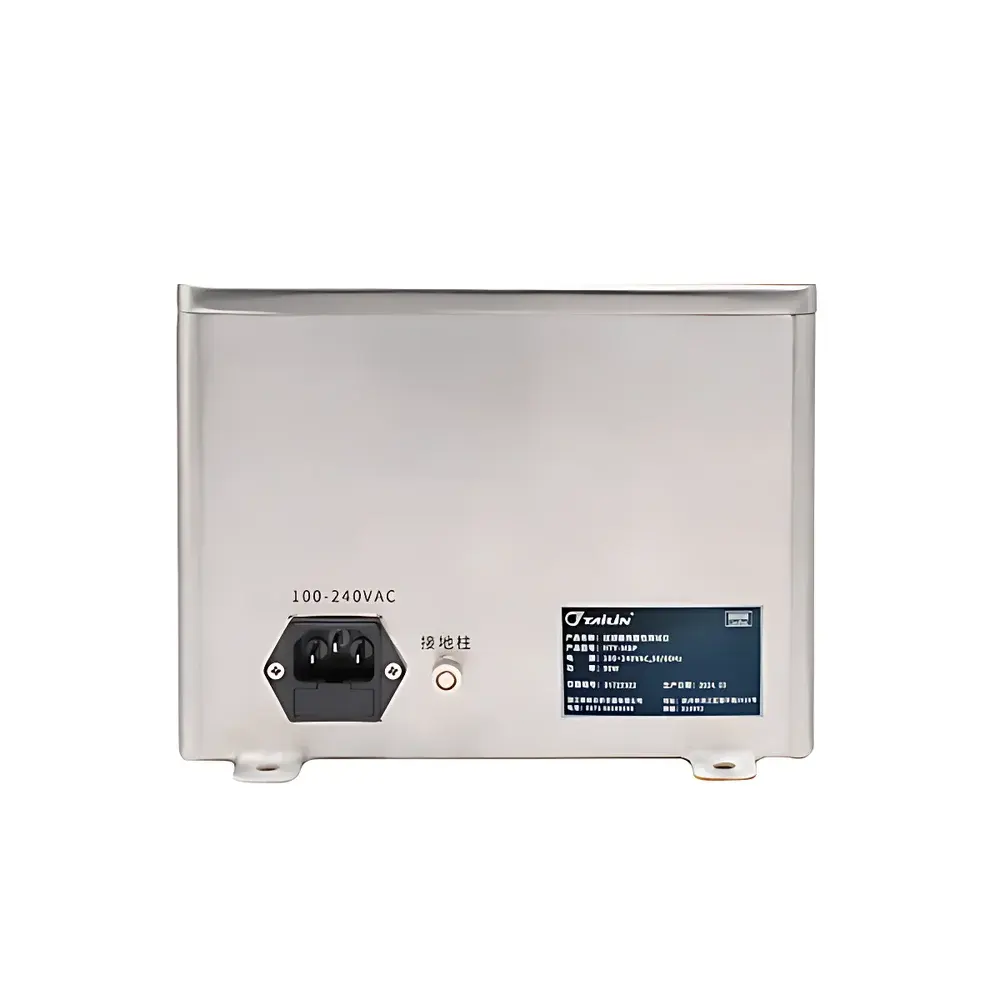
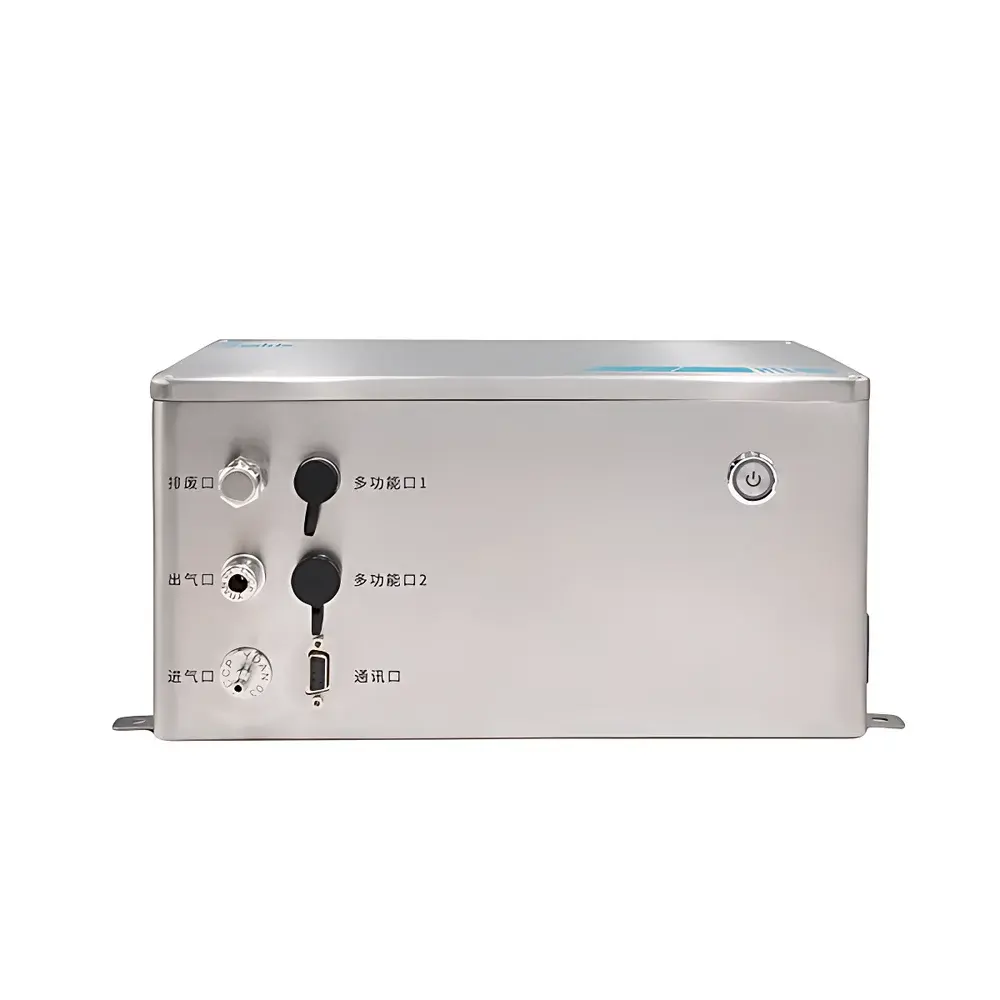
Tailin HTY-MBP Online Filter Integrity Tester
| Brand | Tailin |
|---|---|
| Origin | Zhejiang, China |
| Manufacturer Type | Manufacturer |
| Region of Origin | Domestic (China) |
| Model | HTY-MBP |
| Pricing | Upon Request |
| Bubble Point Range | 400–8000 mbar |
| Pressure Hold Range | 100–8000 mbar |
| Bubble Point Sensitivity | 50 mbar |
| Pressure Hold Sensitivity | 1 mbar |
| Bubble Point Accuracy | ±50 mbar |
| Pressure Hold Accuracy | ±10 mbar |
| Dimensions | 300 mm × 200 mm × 160 mm |
| Communication Interface | Fieldbus (e.g., Profibus, Modbus RTU/TCP), PLC-integrated I/O (Start/Stop/Status/Result), SCADA-ready |
Overview
The Tailin HTY-MBP Online Filter Integrity Tester is an engineered solution for real-time, in-line integrity verification of hydrophobic and hydrophilic membrane filters used in aseptic pharmaceutical manufacturing. Designed specifically to support Pre-Use Post-Sterilization Integrity Testing (PUPSIT), the system operates under fully closed, non-invasive conditions—ensuring sterility maintenance throughout the test cycle without compromising process containment or introducing microbial risk. It employs deterministic, pressure-based test methods—including Bubble Point, Diffusion Flow, Water Intrusion, and Pressure Hold—each aligned with regulatory expectations outlined in ASTM F838, ISO 13408-2, and EU Annex 1. Unlike offline testers requiring filter disconnection and reinstallation, the HTY-MBP integrates directly into fluid train architecture, enabling automated execution immediately after sterilization and prior to product contact.
Key Features
- Native PUPSIT compliance: Built-in logic sequences enforce strict timing, pressure ramping, and pass/fail criteria per USP , EP 2.6.27, and FDA guidance on sterile filtration validation.
- True online operation: Maintains Class A/B environmental integrity during testing via sealed, zero-leakage pneumatic coupling; eliminates manual intervention and associated contamination vectors.
- Multi-method flexibility: Configurable test protocols allow selection of Bubble Point (for hydrophobic membranes), Diffusion Flow (for hydrophilic membranes), Water Intrusion (for super-hydrophobic PTFE), or Pressure Hold (for low-diffusion scenarios).
- Fieldbus-native architecture: Standard Modbus TCP/RTU and Profibus DP interfaces enable bidirectional communication with PLCs, DCS, and MES systems—supporting full audit trail synchronization and event-driven test initiation.
- DI-compliant data handling: All test parameters, raw pressure/time datasets, operator actions, and result metadata are timestamped, digitally signed, and stored with immutable revision history—fully compatible with 21 CFR Part 11 requirements when deployed with validated software environments.
- Modular mechanical integration: Supports multiple mounting configurations—including benchtop, clamp-on pipe mount, and sanitary tri-clamp adapter—facilitating retrofit into existing bioprocess skids without piping modification.
Sample Compatibility & Compliance
The HTY-MBP accommodates standard 0.1 µm to 0.45 µm rated sterilizing-grade membranes across all common housing formats (cartridge, capsule, disk). It validates filters used in critical applications including bulk drug substance filtration, final fill sterilization, buffer preparation, and cell culture media sterilization. The instrument meets mechanical and electrical safety standards per IEC 61010-1 and electromagnetic compatibility per IEC 61326-1. Its test algorithms adhere to the scientific rationale defined in PDA Technical Report No. 40 and WHO TRS 961 Annex 2, ensuring alignment with global regulatory review expectations during inspections.
Software & Data Management
The embedded firmware provides deterministic real-time control over pressure generation, stabilization, measurement acquisition, and pass/fail evaluation—without reliance on external PCs. All test records include complete metadata: test method, nominal pore size, filter area, gas type (air/N₂), temperature, ambient humidity, operator ID, and electronic signature. Data export is supported via CSV and PDF formats, with optional OPC UA gateway integration for enterprise-level LIMS or QMS ingestion. When paired with validated third-party SCADA platforms (e.g., Siemens WinCC, Rockwell FactoryTalk), the HTY-MBP delivers full GMP-aligned electronic batch record (EBR) support—including alarm logging, deviation flagging, and automatic report generation upon test completion.
Applications
- Pre-use post-sterilization integrity testing (PUPSIT) of sterilizing-grade filters in bioreactor harvest lines
- In-process verification of vent filter integrity during tank pressurization cycles
- Final filter release testing in aseptic filling isolators with integrated glove-port interface
- Automated integrity verification in single-use bioprocessing systems with disposable sensor manifolds
- Validation support for filter qualification studies per ISO 13408-2 Annex B
FAQ
Does the HTY-MBP support both hydrophilic and hydrophobic filter testing?
Yes—it natively executes Diffusion Flow for hydrophilic membranes (e.g., PVDF, PES) and Bubble Point/Water Intrusion for hydrophobic membranes (e.g., PTFE, PP), with automatic method selection based on user-defined filter properties.
Can test results be exported to a central LIMS without manual intervention?
Yes—via Modbus TCP or OPC UA, raw datasets and structured reports are transmitted in real time to LIMS or MES platforms compliant with ASTM E1578 and ISO/IEC 17025 data exchange protocols.
Is the system qualified for use in Grade A environments?
The HTY-MBP itself is rated IP54 and intended for installation outside Grade A zones (e.g., utility corridors, equipment rooms); however, its remote operation and sealed pneumatic interface ensure no impact on classified environment integrity during test execution.
What calibration traceability does the pressure transducer provide?
The dual-range pressure sensors are factory-calibrated against NIST-traceable deadweight testers, with calibration certificates provided per unit; annual recalibration is recommended per ISO/IEC 17025 and internal SOP requirements.
How is user access controlled to meet 21 CFR Part 11 requirements?
Role-based electronic signatures, password complexity enforcement, session timeout, and audit trail encryption are implemented at firmware level—though full Part 11 compliance requires deployment within a validated IT infrastructure and documented procedural controls.





