
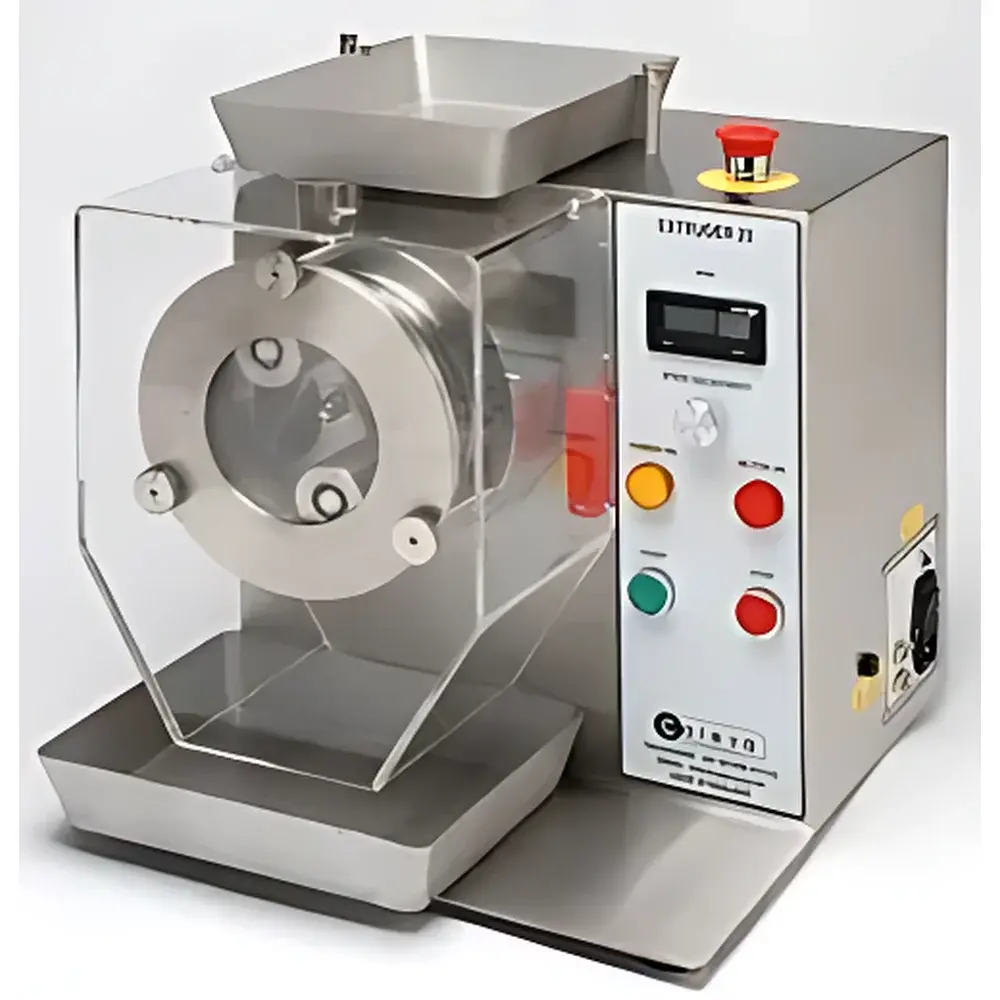
Caleva Extruder-20 Desktop Screen Extruder
| Brand | Caleva |
|---|---|
| Origin | United Kingdom |
| Model | Extruder-20 |
| Throughput | 10 g/hr to 20 kg/hr |
| Screen Options | Full-height and half-height screens (0.8 mm, 1.0 mm, 1.2 mm aperture) |
| Compliance | Designed for pharmaceutical development and scale-up validation per ICH Q5A/Q5C, FDA 21 CFR Part 11–ready configuration available |
Overview
The Caleva Extruder-20 is a benchtop screen extruder engineered for precise, reproducible extrusion of wet mass in pharmaceutical solid dosage form development—particularly for spheronization feedstock preparation. Unlike screw or gear extruders, it operates on the principle of positive displacement through calibrated stainless-steel screens under controlled mechanical compression. This screen-based architecture eliminates shear-induced thermal degradation, avoids localized hot spots, and ensures consistent extrudate geometry critical for downstream rolling and spheronization. Its design directly supports Quality-by-Design (QbD) initiatives by enabling systematic parameter mapping (e.g., screen type, aperture size, feed rate, moisture content) with minimal material consumption—making it indispensable for early-phase formulation screening, excipient compatibility studies, and regulatory documentation generation.
Key Features
- Benchtop footprint (W × D × H: 360 × 420 × 310 mm) optimized for fume hood or laminar flow cabinet integration
- Dual-screen configuration system: interchangeable full-height and half-height screens for scalable throughput—from 10 g/batch (ideal for high-value APIs) to 20 kg/hr (pilot-scale feasibility)
- Stainless-steel construction (316L contact surfaces) compliant with ISO 14644-1 Class 5 cleanroom handling requirements
- Integrated safety interlocks: automatic motor cutoff upon door opening or screen misalignment detection
- Motor-driven roller assembly with adjustable pressure control (0–12 N/cm² range) to accommodate varying paste rheology
- Modular design supporting phased upgrades—including DataStor™ data acquisition, optional cooling jacket, and custom screen fabrication
Sample Compatibility & Compliance
The Extruder-20 processes wet granules, moist pastes, and thermolabile formulations containing APIs, polymers (e.g., HPMC, MCC), binders, and plasticizers. It accommodates viscosities ranging from 10–500 Pa·s (measured via rotational rheometry) without requiring pre-conditioning. All wet-contact components meet USP polymer classification standards; surface finish Ra ≤ 0.4 µm. The system supports GMP-aligned documentation packages—including IQ/OQ protocols, traceable calibration certificates, and raw material compliance statements per ICH Q7. When configured with DataStor™, audit trails comply with FDA 21 CFR Part 11 requirements for electronic records and signatures.
Software & Data Management
The optional DataStor™ software provides real-time logging of operational parameters—including roller speed (rpm), torque (N·m), extrusion time (s), batch weight (g), and screen identification. Data exports automatically to CSV or PDF formats with timestamped metadata and user authentication logs. Each file is write-protected upon generation to prevent post-acquisition modification—ensuring ALCOA+ (Attributable, Legible, Contemporaneous, Original, Accurate, Complete, Consistent, Enduring, Available) data integrity. Integration with LIMS platforms is supported via OPC UA protocol.
Applications
- Pre-formulation screening of extrusion-spheronization candidates (e.g., extended-release pellets, mini-tablets)
- Process characterization for regulatory submissions (ICH Q5A, Q5C): establishing design space boundaries for screen aperture, feed rate, and moisture content
- Comparative evaluation of binder efficacy across viscosity grades and concentrations
- Development of pediatric or oncology formulations where API conservation is critical (half-height screen achieves ≥70% recovery at 10 g batch size)
- Technology transfer support: identical extrudate morphology between lab-scale (Extruder-20) and production-scale (Caleva Extruder-100/200) systems enables direct scale-up correlation
- Validation of cleaning procedures per PDA Technical Report No. 29 (Points to Consider for Cleaning Validation)
FAQ
What distinguishes screen extrusion from screw or gear extrusion in pharmaceutical applications?
Screen extrusion applies uniform compressive force without internal shear heating, minimizing API degradation—unlike screw extruders that generate localized thermal stress (>10°C rise) or gear extruders with fixed orifice geometry limiting flexibility.
Can the Extruder-20 be used for non-pharmaceutical materials such as food or ceramics?
Yes—its modular screen system and corrosion-resistant construction support R&D in nutraceuticals, catalyst pellets, and ceramic green bodies, provided material rheology falls within the validated torque range (0.5–8.0 N·m).
How does the half-height screen improve recovery for low-mass batches?
By reducing dead volume in the extrusion chamber and optimizing paste-to-screen contact area, the half-height configuration decreases residual hold-up—demonstrated recovery of 7.0 g ± 0.3 g from 10 g input batches.
Is third-party qualification support available for GMP environments?
Caleva provides vendor-supplied IQ/OQ templates aligned with ASTM E2500-13 and Annex 15; qualified engineers can perform on-site commissioning and risk-based validation planning.
What maintenance intervals are recommended for routine operation?
Daily visual inspection of screen integrity and roller alignment; monthly lubrication of drive train (ISO VG 68 synthetic oil); annual torque sensor recalibration using NIST-traceable load cells.






