
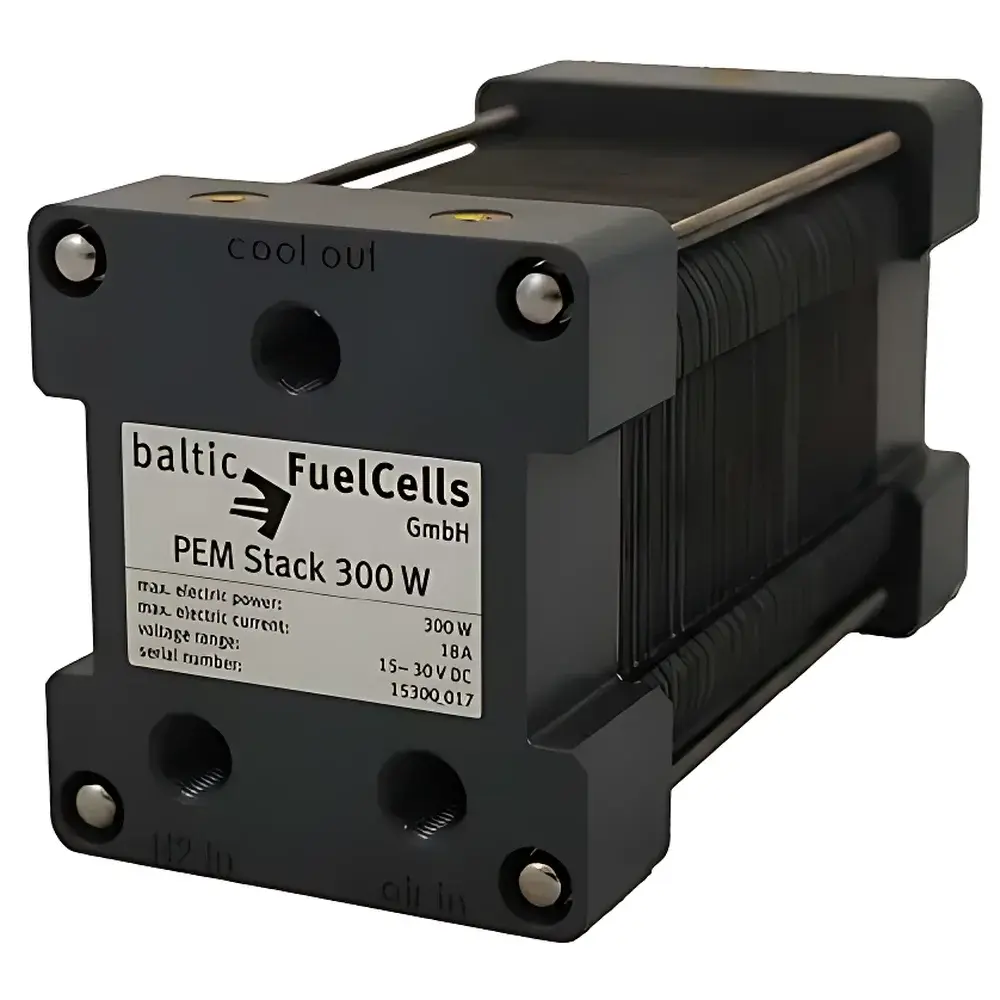
Baltic FuelCells 300W Proton Exchange Membrane (PEM) Fuel Cell Stack
| Brand | Baltic FuelCells |
|---|---|
| Origin | Germany |
| Model | 300W PEM Fuel Cell Stack |
| Rated Power | 300 W (DC) |
| Output Voltage Range | 15–30 V DC |
| Nominal Current | 18 A |
| Operating Temperature | 5–55 °C |
| Electrical Efficiency | 45% @ 300 W |
| Fuel | 99.9% H₂ and ambient air |
| H₂ Consumption | 4.5 L/min (STP) |
| H₂ Inlet Pressure | 250–350 mbar(g) |
| Number of Cells | 30 |
| Cooling | Liquid-cooled |
| Interface | 1/4" internal thread (ISO 7/1) |
| Dimensions | 175 × 85 × 95 mm |
| Weight | 1.7 kg |
Overview
The Baltic FuelCells 300W Proton Exchange Membrane (PEM) Fuel Cell Stack is a compact, liquid-cooled electrochemical power generation module engineered for integration into distributed energy systems, portable backup power solutions, and low-emission mobility platforms. Based on mature PEM technology, the stack operates via electrochemical oxidation of high-purity hydrogen (≥99.9%) at the anode and reduction of oxygen from ambient air at the cathode, producing direct current electricity, heat, and pure water as the sole byproducts. Its design emphasizes operational robustness across variable environmental conditions — functional within ambient temperatures ranging from 5 °C to 55 °C without external humidification or pressurized gas supply — making it suitable for both indoor and outdoor deployment in non-controlled environments. With a nominal output of 300 W DC across a 15–30 V voltage window and a rated current of 18 A, the stack delivers stable power under steady-state load while maintaining 45% electrical efficiency at full rated power. The integrated liquid cooling circuit enables thermal management with recoverable waste heat, supporting combined heat and power (CHP) configurations where low-grade thermal energy (typically 60–80 °C coolant outlet) can be repurposed for auxiliary heating or desiccant regeneration.
Key Features
- Compact monolithic architecture: 175 × 85 × 95 mm footprint and 1.7 kg mass facilitate seamless integration into space-constrained systems including unmanned ground vehicles (UGVs), mobile environmental sensor stations, and uninterruptible power supply (UPS) cabinets.
- Liquid-cooled thermal management system with standardized 1/4″ BSP internal thread ports enables direct connection to external recirculating chillers or passive heat exchangers.
- 30-cell bipolar plate stack configuration optimized for balanced current distribution, low interfacial resistance, and long-term voltage stability under cyclic loading.
- Operational flexibility: functions reliably in dry-air mode without external humidification; compatible with regulated H₂ supply at low overpressure (250–350 mbar gauge), eliminating need for compressors or high-pressure storage.
- Robust mechanical housing and corrosion-resistant stainless-steel end plates ensure durability under vibration, thermal cycling, and intermittent operation typical in field-deployed applications.
Sample Compatibility & Compliance
The 300W PEM stack is designed for use with certified 99.9% purity hydrogen fuel and ambient air — no noble-metal catalyst poisoning occurs under specified operating conditions. It complies with IEC 62282-2 (Fuel cell technologies – Part 2: Fuel cell modules) for safety, performance, and labeling requirements. While not certified as a standalone end-product, the stack meets essential requirements of Directive 2014/33/EU (PED) for pressure equipment and EN 60079-0 for general explosion protection principles when installed within appropriately rated enclosures. System integrators are responsible for full conformity assessment per applicable regional directives (e.g., UL 1741-SA, CSA C22.2 No. 107.1) upon final assembly. All materials contacting H₂ or coolant are selected per ASTM G133 and ISO 15156 standards for hydrogen service compatibility.
Software & Data Management
As a hardware-only stack module, the 300W unit does not include embedded firmware or onboard data logging. It interfaces exclusively via analog voltage/current outputs and discrete status signals (e.g., fault, ready, thermal limit). Integration with supervisory control systems requires external power electronics (DC–DC converter, battery buffer, or inverter) and a programmable logic controller (PLC) or industrial microcontroller. Recommended communication protocols include Modbus RTU over RS-485 for remote monitoring of stack voltage, coolant temperature, and H₂ flow rate (when paired with external sensors). For GLP/GMP-aligned validation workflows, users may implement audit-trail-capable SCADA systems compliant with FDA 21 CFR Part 11 for electronic record retention during qualification testing.
Applications
- Off-grid auxiliary power units (APUs) for electric and hybrid-electric light-duty vehicles, marine auxiliary systems, and telecom base station backup.
- Mobile environmental monitoring platforms requiring silent, zero-emission, multi-day operation — especially where grid access or generator noise is prohibitive.
- Modular UPS subsystems for critical infrastructure (e.g., data edge nodes, remote telemetry hubs) demanding >99.9% uptime and rapid start-up (<5 s from cold standby).
- Educational and R&D testbeds for PEM system modeling, thermal integration studies, and hydrogen safety protocol development in university and national laboratory settings.
- Hybrid microgrids combining photovoltaic input, battery storage, and fuel cell dispatchable generation for resilience-critical facilities.
FAQ
Is the stack pre-conditioned and tested before shipment?
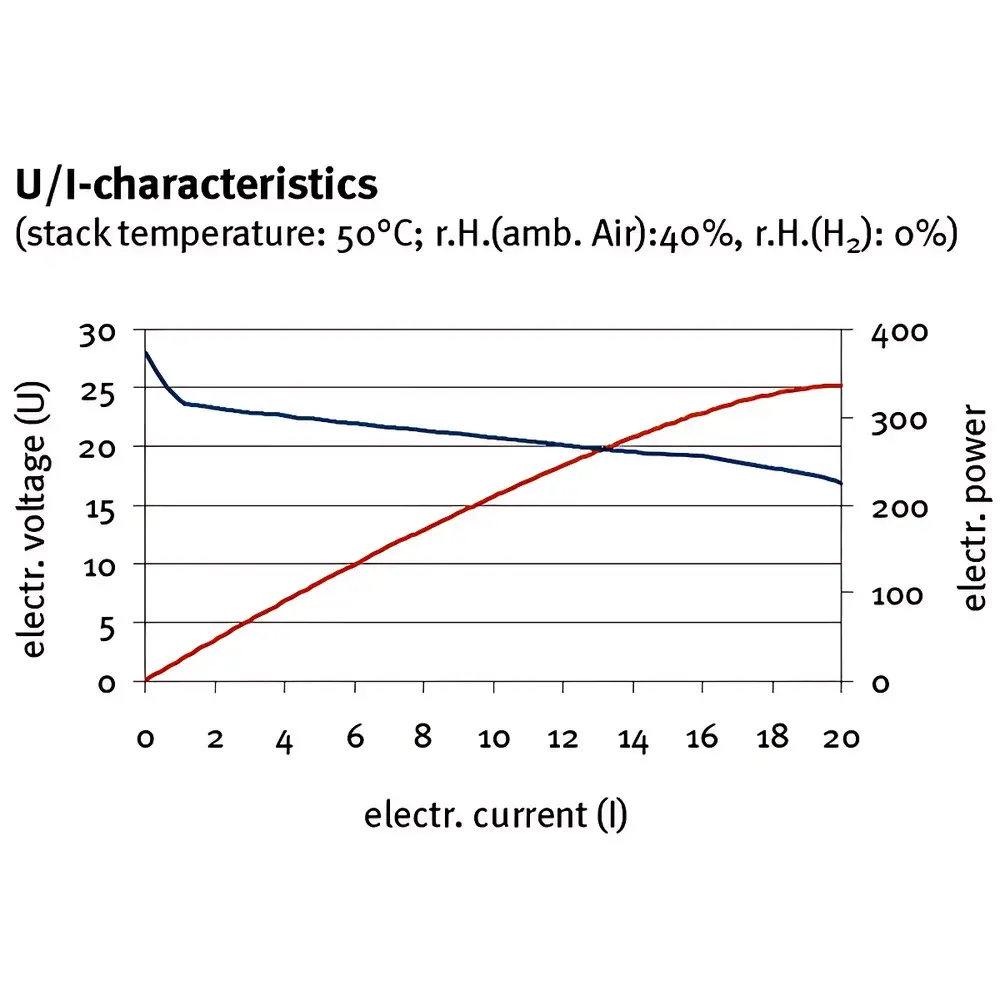
Yes — each unit undergoes factory acceptance testing (FAT) including open-circuit voltage verification, polarization curve measurement at 300 W, and thermal soak validation across the full 5–55 °C range.
Can the stack operate continuously at 300 W?
Yes — rated for continuous duty at nominal load when maintained within specified coolant inlet temperature (10–35 °C) and flow rate (>1.2 L/min) limits.
What hydrogen quality standards must be met?
Hydrogen must conform to ISO 8573-7:2014 Class 1 (total hydrocarbons ≤0.05 ppm, CO ≤0.1 ppm, H₂S ≤1 ppb) to prevent irreversible catalyst degradation.
Does the stack require external humidification?
No — the membrane electrode assembly (MEA) is designed for self-humidifying operation using product water; no external humidifier or water recirculation loop is needed.
What is the expected lifetime under typical cycling conditions?
Based on accelerated stress testing, median time to 10% voltage degradation is ≥10,000 hours at constant 300 W operation, or ≥5,000 cycles (0–100% load) with 1-hour dwell between cycles.




