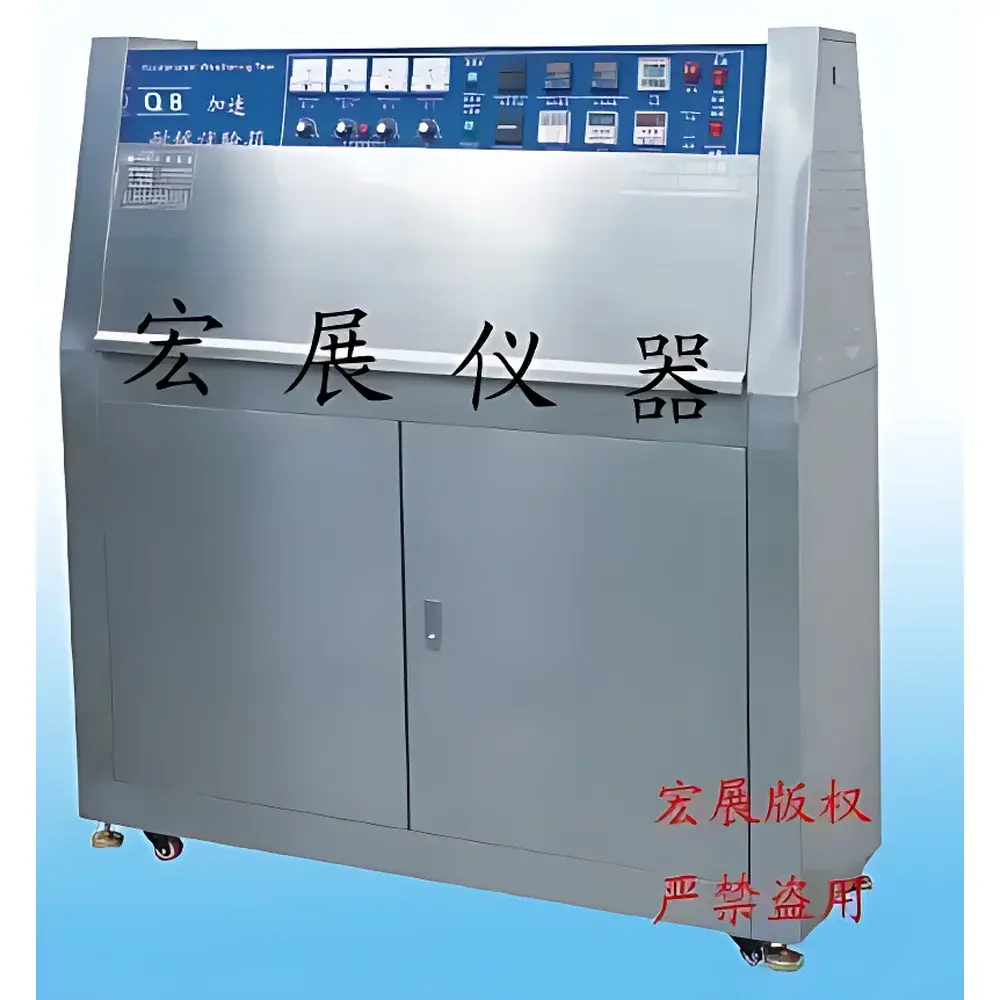
LabCompanion Q8/UV Advanced Fluorescent UV Accelerated Weathering Tester
| [Brand | LabCompanion |
|---|---|
| Origin | Guangdong, China |
| Manufacturer Type | Direct Manufacturer |
| Model | Q8/UV Series |
| UV Lamps | UVA-340 / UVB-313 / UVA-351 |
| Irradiance Control | Optional (1.0 W/m² @ 340 nm, 1.1 W/m² @ 313 nm) |
| UV Temperature Range | 50–75 °C |
| Condensation Temperature Range | 40–60 °C |
| Test Capacity | Up to 48 specimens (75 × 150 mm) |
| Water Consumption | 8 L/day (distilled water) |
| Dimensions (W×D×H) | 137 × 53 × 136 cm |
| Weight | 136 kg |
| Power Supply | 1φ, 120 V/60 Hz (16 A) or 230 V/50 Hz (9 A), max. 1800 W |
| Compliance | ASTM G153, ASTM G154, ASTM D4329, ASTM D4587, ASTM D4799, SAE J2020, ISO 4892] |
Overview
The LabCompanion Q8/UV Advanced Fluorescent UV Accelerated Weathering Tester is an engineered solution for simulating the photochemical degradation effects of solar ultraviolet radiation, moisture, and thermal cycling on polymeric, coating, and composite materials. Unlike broad-spectrum xenon arc or carbon arc testers, the Q8/UV employs fluorescent UV lamps—specifically UVA-340, UVB-313, and UVA-351—to replicate the short-wavelength UV component (295–365 nm) most responsible for polymer chain scission, pigment fading, and surface embrittlement. Its core measurement principle relies on controlled spectral irradiance delivery, coupled with precisely regulated condensation humidity and optional water spray-induced thermal shock. This tripartite exposure paradigm—UV irradiation, 100% RH condensation, and cyclic thermal stress—enables accelerated yet scientifically defensible correlation to real-world outdoor service life, particularly for indoor- or glass-filtered applications.
Key Features
- Multi-lamp spectral flexibility: Interchangeable lamp configurations support UVA-340 (sunlight-simulating, 295–365 nm), UVB-313 (high-intensity, accelerated screening), and UVA-351 (window-glass filtered UV) — enabling application-specific test protocols per ASTM D4587 and ISO 4892-3.
- Condensation-driven moisture simulation: Heated water reservoir generates saturated vapor to maintain 100% relative humidity at elevated temperatures (40–60 °C), inducing continuous dew formation on specimen surfaces—mimicking natural nocturnal condensation mechanisms validated in ASTM G154 Annex A1.
- Programmable thermal cycling: Independent control of UV irradiation temperature (50–75 °C) and condensation phase temperature ensures reproducible thermal gradients across specimen substrates, critical for evaluating thermal expansion mismatch and interfacial delamination.
- Optional water spray system: Twelve calibrated nozzles deliver brief, uniform distilled water pulses to induce rapid surface cooling (thermal shock) and mechanical erosion—relevant for automotive clearcoats, architectural sealants, and roofing membranes exposed to diurnal rain events (per ASTM D4799).
- Irradiance feedback control (optional): Integrated radiometric monitoring with Q8-CR calibration-capable sensor enables closed-loop regulation of UV intensity at 340 nm or 313 nm, ensuring test repeatability across lamp aging cycles and multi-unit labs.
- Self-diagnostic firmware: Real-time fault detection for lamp output decay, heater performance, water level, and chamber integrity supports GLP-compliant audit trails and preventive maintenance scheduling.
Sample Compatibility & Compliance
The Q8/UV accommodates up to 48 flat-panel specimens (75 × 150 mm), mounted vertically on non-reflective aluminum racks to ensure uniform irradiance distribution and unobstructed condensate runoff. Specimen holders are compatible with standard ISO 18894 and ASTM D6675 mounting fixtures. All operational modes—including UV-only, UV/condensation, and UV/condensation/spray—conform to internationally recognized weathering standards: ASTM G153 (enclosed carbon-arc), ASTM G154 (fluorescent UV), ASTM D4329 (plastics), ASTM D4587 (coatings), ASTM D4799 (roofing), SAE J2020 (automotive), and ISO 4892-3 (plastics—fluorescent UV). The system’s architecture supports traceable calibration via NIST-traceable radiometers and meets foundational requirements for FDA 21 CFR Part 11–compliant data integrity when paired with validated software.
Software & Data Management
LabCompanion Q8/UV controllers feature embedded real-time logging of irradiance (W/m²), chamber temperature, condensation duration, and spray cycle timing. Optional recorder modules provide analog/digital output for integration into centralized LIMS or MES platforms. While the base unit operates via intuitive membrane keypad and LCD interface, optional PC-based software enables protocol scheduling, remote monitoring, automated report generation (PDF/CSV), and audit-log export compliant with GLP/GMP documentation frameworks. All time-stamped event logs include operator ID, parameter setpoints, and deviation alerts—supporting full traceability for regulatory submissions and interlaboratory round-robin studies.
Applications
- Automotive OEMs evaluating UV resistance of interior trims, dashboard polymers, and exterior clearcoats under SAE J2020 protocols.
- Paint & coatings manufacturers validating gloss retention, chalking, and color shift per ASTM D4587 and ISO 2811.
- Plastics producers assessing yellowing, tensile loss, and impact strength degradation in PVC, ABS, and polycarbonate formulations.
- Architectural product developers testing durability of window films, laminated glass interlayers, and façade sealants exposed to filtered solar UV (UVA-351 mode).
- Adhesives & sealant suppliers qualifying bond line stability under cyclic UV/humidity stress per ASTM C719 and ISO 11600.
- Academic and government research labs conducting mechanistic studies on photodegradation kinetics using calibrated irradiance and controlled condensation onset.
FAQ
What UV lamp types are supported, and how do they differ in application?
The Q8/UV accepts UVA-340 (closest match to terrestrial solar UV), UVB-313 (accelerated screening for robust materials), and UVA-351 (simulates UV transmitted through window glass). Selection depends on end-use environment and standard requirements.
Is distilled water mandatory for operation?
Yes—distilled or deionized water is required to prevent mineral deposition on lamps, sensors, and condensation surfaces, which would compromise irradiance uniformity and calibration stability.
Can the Q8/UV meet FDA 21 CFR Part 11 requirements?
The base hardware supports audit-trail-capable logging; full Part 11 compliance requires validated third-party software with electronic signatures, role-based access control, and secure data archiving.
How often must UV lamps be replaced?
Lamp replacement intervals depend on accumulated irradiance dose—not calendar time. Typical service life is 1,500–2,000 hours for UVA-340 and 5,000+ hours for UVB-313, monitored via integrated radiometer or scheduled by cumulative timer.
Does the system include calibration certification?
Factory calibration certificates are provided for temperature and humidity sensors. Radiometric calibration requires optional Q8-CR radiometer and annual NIST-traceable recalibration per ASTM E2653.