
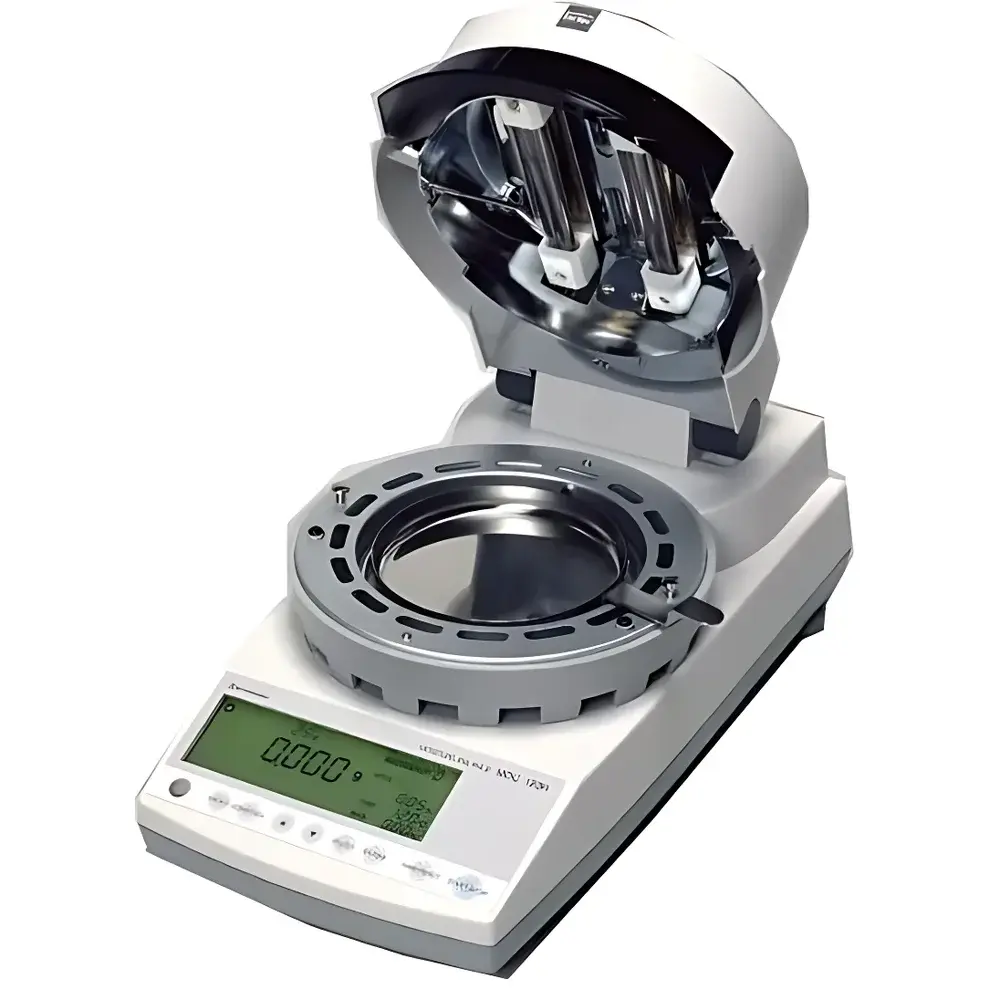
Shimadzu MOC120H Infrared Moisture Analyzer
| Brand | Shimadzu |
|---|---|
| Origin | Japan |
| Model | MOC120H |
| Measurement Principle | Gravimetric Loss-on-Drying (Infrared Heating) |
| Sample Capacity | 0.5–120 g |
| Moisture Resolution | 0.01% or 0.1% (selectable) |
| Mass Resolution | 0.001 g |
| Moisture Range | 0–100% (w/w), 0–500% (dry basis) |
| Repeatability | ±0.02% (≥10 g sample) |
| Temperature Range | 30–180 °C (1 °C increments) |
| Heating Source | Medium-Wave Infrared Lamp (625 W max) |
| Power Supply | AC 100–240 V, 50/60 Hz |
| Dimensions | 220 × 415 × 190 mm (W×D×H) |
| Weight | 4.5 kg |
| Data Storage | 100 measurement records |
| Method Storage | 10 user-defined protocols |
| Interface | RS-232C, Windows Direct Pass-through |
| Operating Environment | 5–40 °C, ≤85% RH |
| Sample Pan | Stainless Steel (Ø130 mm × 13 mm depth) |
| Compliance | Designed for GLP/GMP-aligned workflows |
Overview
The Shimadzu MOC120H Infrared Moisture Analyzer is a precision gravimetric instrument engineered for rapid, reliable quantification of moisture content in solid and semi-solid materials using the loss-on-drying (LOD) principle. It combines high-stability electromagnetic force restoration weighing technology with medium-wave infrared heating to achieve uniform thermal energy delivery—minimizing surface charring and promoting consistent internal water evaporation. Unlike convection ovens or halogen-based systems, the MOC120H’s optimized infrared source emits energy within a spectral range that maximizes absorption by water molecules while reducing non-selective heating of the sample matrix. This results in improved reproducibility, especially for thermally sensitive or heterogeneous samples such as pharmaceutical granules, food powders, polymers, and agricultural commodities. The analyzer operates under ISO 13751:2021 and ASTM D4442-22 guidelines for moisture determination and is routinely deployed in QC laboratories where regulatory traceability, method validation, and routine compliance reporting are required.
Key Features
- Integrated Single-Module Sensor Architecture: Combines load cell and temperature compensation circuitry into one monolithic unit, eliminating mechanical drift caused by thermal expansion mismatch between separate components.
- Auto-Zero Drift Compensation: Dynamically corrects for micro-scale zero-point shifts induced by infrared radiation exposure during heating—ensuring mass stability throughout extended drying cycles without manual recalibration.
- Five-Stage Programmable Ramp Drying: Enables precise control over heating profiles (e.g., low-temperature pre-drying followed by accelerated final dehydration), critical for preserving volatile actives or preventing crust formation in hygroscopic matrices.
- Dual-Mode Termination Logic: Supports both automatic endpoint detection (based on mass change rate threshold) and time-controlled termination (1–240 min, or continuous up to 12 h), allowing method flexibility across diverse material classes.
- GLP-Ready Data Integrity Framework: All measurements include timestamped metadata (operator ID, method name, ambient T/RH, pan ID), stored locally with checksum verification and exportable via RS-232 to LIMS or validated PC software supporting 21 CFR Part 11 audit trails.
Sample Compatibility & Compliance
The MOC120H accommodates samples ranging from 0.5 g to 120 g in standard stainless-steel pans (Ø130 mm × 13 mm depth), enabling analysis of bulk powders, tablets, pellets, pastes, and filter cakes. Its wide temperature range (30–180 °C, adjustable in 1 °C steps) permits method development for low-volatility solvents (e.g., glycerin, ethylene glycol) as well as high-boiling-point residual moisture in APIs. The system complies with international standards including ISO 5477 (moisture analyzers), USP <921> (Loss on Drying), and JP 2021 General Tests 2.05. When used with Shimadzu’s LabSolutions DA software, it satisfies GMP documentation requirements for instrument qualification (IQ/OQ/PQ), electronic signature enforcement, and secure data archiving.
Software & Data Management
Data acquisition and reporting are managed through Shimadzu’s dedicated LabSolutions DA platform (Windows-compatible), which provides real-time graphing of mass vs. time curves, derivative analysis for endpoint validation, and automated report generation in PDF or Excel formats. Up to 100 measurement results—including raw mass values, calculated moisture %, dry basis %, solids %, and statistical summaries (mean, SD, RSD)—are retained onboard. RS-232 communication enables bidirectional control: users can download methods, upload calibration logs, and trigger remote start/stop commands. For enterprise integration, the analyzer supports OPC UA-compliant middleware for seamless connectivity with MES or ERP systems in regulated manufacturing environments.
Applications
- Pharmaceutical: Quantifying residual solvents in lyophilized products, monitoring moisture in excipients (lactose, microcrystalline cellulose), and verifying packaging integrity via headspace moisture analysis.
- Food & Beverage: Determining water activity proxies in flour, coffee beans, spices, and pet food—supporting shelf-life modeling and HACCP compliance.
- Chemicals & Polymers: Assessing hydrolytic stability of polyesters, evaluating drying efficiency of catalyst supports, and certifying anhydrous reagents per ACS specifications.
- Agriculture & Feed: Measuring grain moisture content pre-storage to prevent mycotoxin proliferation and ensuring pellet durability in animal feed production.
- Research & Academia: Supporting method development studies comparing LOD performance against Karl Fischer titration or near-infrared spectroscopy.
FAQ
What calibration standards are recommended for routine verification?
NIST-traceable sodium tartrate dihydrate (15.66% w/w moisture) and anhydrous calcium sulfate are recommended for two-point verification at low and high moisture levels, respectively.
Can the MOC120H be used for volatile organic solvent determination?
Yes—when paired with appropriate drying temperature profiles and endpoint criteria, it reliably quantifies volatiles such as ethanol, acetone, or methanol, provided they do not decompose or react with the sample matrix below 180 °C.
Is external ventilation required during operation?
No fume hood is necessary for standard operation; however, a local exhaust system is advised when analyzing samples releasing hazardous vapors (e.g., chlorinated solvents) or high-volume organic volatiles.
How does the auto-zero correction function technically operate?
The system periodically interrupts heating for <100 ms, measures instantaneous load cell offset, and applies real-time digital compensation—without interrupting the drying sequence or requiring user intervention.
Does the instrument support multi-language UI or customizable report templates?
The embedded LCD interface is English-only, but LabSolutions DA software offers localized language packs (Japanese, Chinese, German, French) and fully configurable report layouts with company branding and regulatory headers.



