
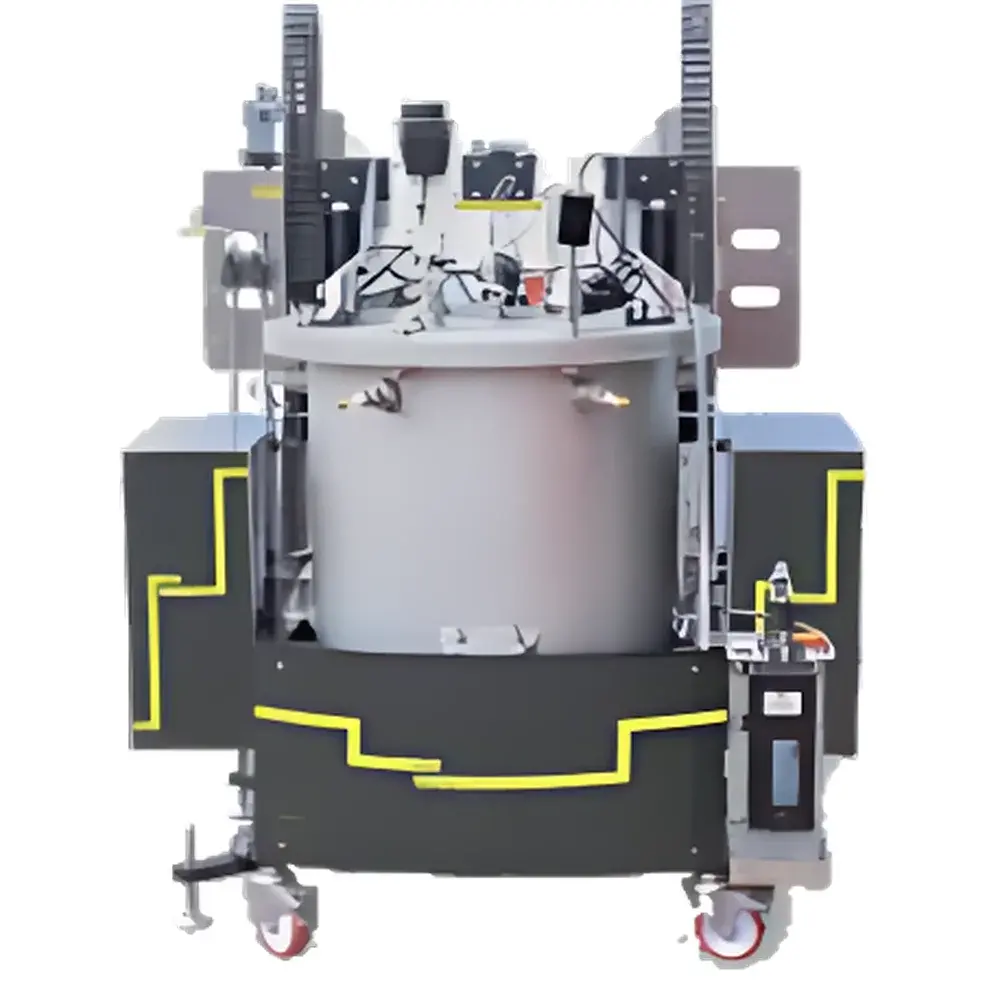
HEL BTC-500 Large-Battery Adiabatic Calorimeter
| Brand | H.E.L |
|---|---|
| Origin | United Kingdom |
| Model | BTC-500 |
| Measurement Mode | Adiabatic Calorimetry |
| Temperature Range | −40 °C to 500 °C |
| Temperature Resolution | 1 K |
| Precision | ±0.1% |
| Single-Sample Test Duration | ~30 min |
| Heat Capacity | 10,500 J/K |
| Outer Bath Volume | ~20 L |
| Inner Bath Volume | 250 mL |
| Operating Modes | Adiabatic & Isothermal Calorimetry |
| Chamber Dimensions (Standard) | Φ35 × 35 cm or Φ50 × 50 cm |
Overview
The HEL BTC-500 Large-Battery Adiabatic Calorimeter is an engineered thermal safety assessment platform designed specifically for the rigorous evaluation of electrochemical energy storage systems—from individual electrode materials and cylindrical cells (e.g., 18650, 26650) to large-format prismatic, pouch, and module-level battery assemblies. It operates on the fundamental principle of adiabatic calorimetry: by actively controlling the surrounding furnace temperature to precisely match the sample temperature in real time, the system eliminates conductive and convective heat exchange between the sample and its environment. This dynamic thermal equilibrium ensures that all measured temperature rise is attributable solely to exothermic internal reactions—enabling quantitative determination of onset temperature (Tonset), self-heating rate (dT/dt), pressure evolution, and time-to-thermal-runaway under near-adiabatic conditions. As a direct evolution of H.E.L’s PhiTEC™ ARC platform, the BTC-500 integrates enhanced mechanical stability, expanded chamber geometry, and optimized thermal inertia to meet the escalating safety validation requirements of modern high-energy-density battery development programs.
Key Features
- True dual-mode operation: switch seamlessly between adiabatic and isothermal calorimetry within a single instrument—enabling both runaway hazard screening and controlled-cycle thermal management performance testing.
- Dual-chamber compatibility: standard large-volume adiabatic chamber (Φ35 × 35 cm or Φ50 × 50 cm) accommodates full-size EV battery modules; optional smaller chamber available for rapid screening of materials, coin cells, and 18650/26650 cells without cross-contamination or reconfiguration delay.
- High-fidelity thermal control: proprietary feedback-regulated furnace system maintains ΔT ≤ 0.05 K between sample and environment during adiabatic hold—critical for accurate q = Cp·dT/dt calculation and kinetic parameter derivation.
- Integrated pressure monitoring: calibrated pressure transducer (0–15 MPa range) synchronized with thermal data acquisition enables correlation of gas evolution kinetics with exothermic events.
- Robust mechanical architecture: reinforced stainless-steel chamber and vibration-damped base minimize thermal drift and ensure measurement repeatability across extended test durations (>72 h).
- Compliance-ready design: hardware and firmware support audit trails, user access levels, and electronic signature workflows aligned with GLP, GMP, and FDA 21 CFR Part 11 requirements.
Sample Compatibility & Compliance
The BTC-500 supports heterogeneous sample geometries and chemistries—including NMC, LFP, LCO, solid-state, sodium-ion, and lithium-metal systems—without modification to core hardware. Its 250 mL inner bath and 20 L outer thermal reservoir provide stable thermal mass for high-precision enthalpy quantification (±0.1% precision at full scale). The system conforms to ASTM E1981 (Standard Guide for Evaluating Thermal Stability of Battery Materials), UN Manual of Tests and Criteria Part III, subsection 38.3, and ISO 12219-1 for automotive component thermal safety. All calibration procedures follow traceable NIST standards, and certificate-of-conformance documentation is provided with each instrument shipment.
Software & Data Management
Control and analysis are performed via HEL’s proprietary Thermal Hazard Manager™ (THM) software suite, which features real-time visualization of temperature, pressure, and voltage (when integrated with external potentiostats), automated event detection (e.g., onset, peak, runaway), and kinetic modeling tools (e.g., Kissinger, Ozawa-Flynn-Wall). Raw data are stored in vendor-neutral HDF5 format with embedded metadata (operator ID, timestamp, calibration status, environmental logs). THM supports export to CSV, MATLAB (.mat), and Excel-compatible XML for third-party statistical analysis. Audit trail functionality records every parameter change, test initiation, and report generation event—with immutable timestamps and user authentication—ensuring full compliance with regulatory review expectations.
Applications
- Thermal runaway propagation analysis in multi-cell battery packs
- Electrolyte decomposition kinetics and SEI layer stability assessment
- Thermal interface material (TIM) performance validation under cycling stress
- Cell-to-cell thermal coupling characterization for BMS algorithm development
- Accelerated aging studies under controlled adiabatic heating profiles
- Validation of thermal management system (TMS) cooling efficiency using simulated exothermic loads
- Regulatory submission support for UL 1642, UL 2580, IEC 62619, and GB/T 31485 certification pathways
FAQ
What distinguishes the BTC-500 from conventional ARC instruments?
The BTC-500 incorporates a larger thermal mass (10,500 J/K), extended temperature range (−40 °C to 500 °C), and mechanically reinforced chamber optimized for heavy, high-capacity battery modules—not just small cells. Its dual-mode firmware and modular chamber design eliminate the need for separate isothermal and adiabatic platforms.
Can the BTC-500 perform tests compliant with UN 38.3 T.4 and T.5?
Yes—its precise adiabatic control, pressure synchronization, and programmable ramp-hold-ramp protocols fully satisfy the thermal abuse and forced discharge test sequences defined in UN Manual of Tests and Criteria Section 38.3.
Is remote operation and data monitoring supported?
The system includes Ethernet-based communication with TLS-encrypted API access, enabling secure remote start/stop, live telemetry streaming, and alarm notification via SMTP/SNMP protocols—fully compatible with centralized lab infrastructure monitoring systems.



