
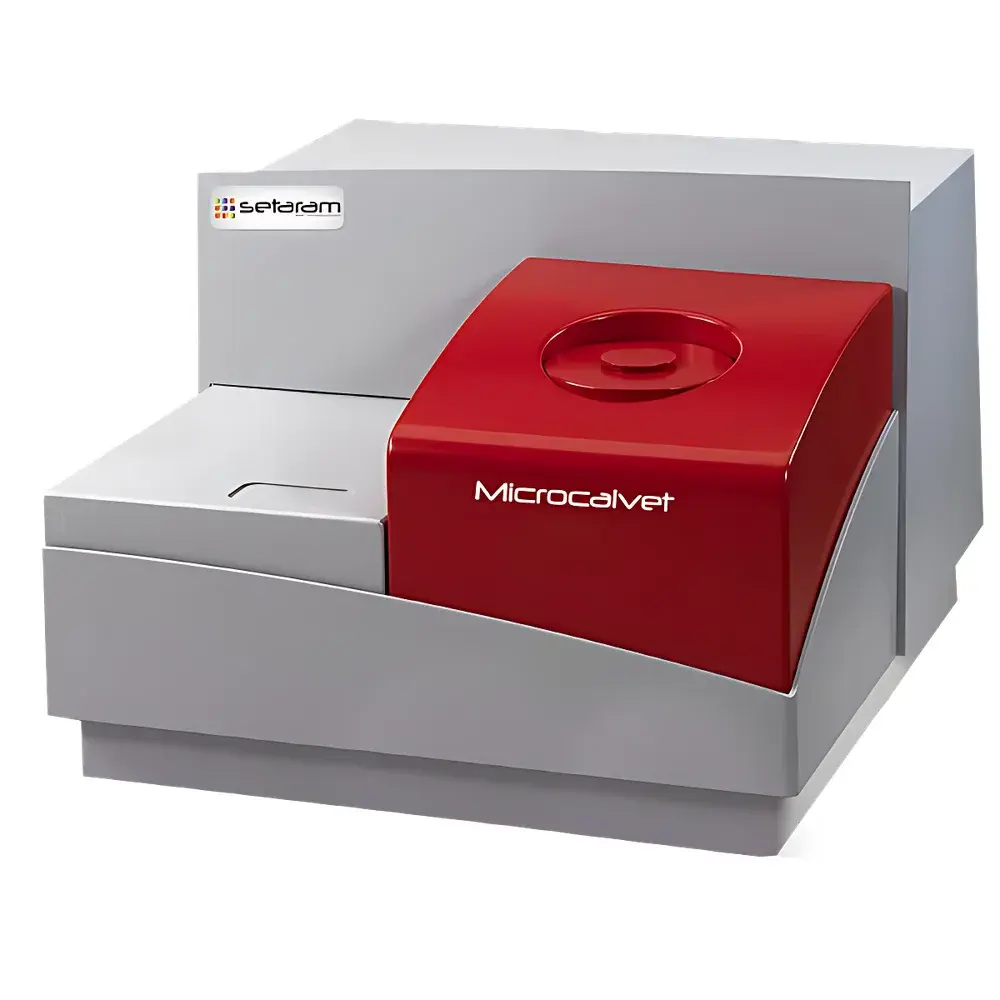
SETARAM Microcalvet 3D Calorimeter
| Brand | SETARAM |
|---|---|
| Origin | France |
| Model | Microcalvet |
| Instrument Type | Reaction Calorimeter |
| Measurement Principle | 3D Calorimetric Sensor with Joule Calibration |
| Temperature Range | −45 °C to 120 °C |
| Accuracy | ±0.15% |
| Sample Capacity | Variable (micro-to-milligram scale) |
| Pressure Capability | Up to 1000 bar (with optional high-pressure cells) |
| Compatibility | Vacuum, inert atmosphere, reactive gas environments |
| Thermal Control | Peltier-based 3-axis symmetric heating/cooling |
| Interface | Modular coupling with BET analyzers, gas sorption systems, humidity generators, and high-pressure gas controllers |
Overview
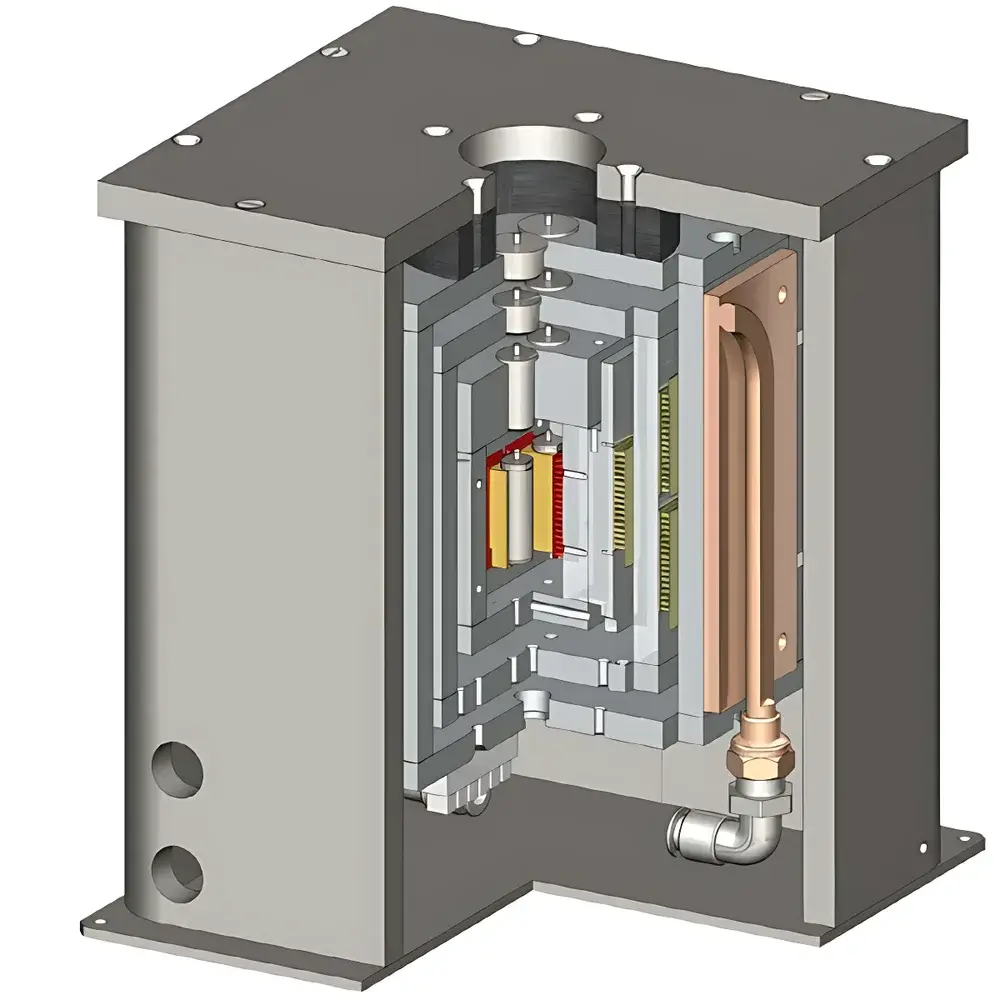
The SETARAM Microcalvet is a high-precision, three-dimensional (3D) heat-flow calorimeter engineered for quantitative thermodynamic characterization of chemical, physical, and biological processes under controlled temperature, pressure, and atmospheric conditions. Unlike conventional differential scanning calorimeters (DSC) or isothermal titration calorimeters (ITC), the Microcalvet employs a patented symmetric 3D Calvet sensor architecture—based on Peltier thermoelectric elements—where both sample and reference are simultaneously embedded in a common thermal block. This design ensures near-zero thermal lag, exceptional baseline stability, and direct heat-flow measurement via Joule calibration, eliminating reliance on empirical calibration standards. The instrument operates across a wide temperature range (−45 °C to 120 °C), enabling studies from cryogenic hydration kinetics to elevated-temperature polymer curing or catalytic reaction enthalpies. Its micro-scale sensitivity (sub-milliwatt resolution) supports investigations of low-energy transitions—such as protein folding, lipid phase behavior, or gas hydrate formation—without requiring large sample masses, thereby preserving precious biological or synthetic materials.
Key Features
- 3D Calvet sensor architecture with symmetrical thermal enclosure for minimized thermal gradients and high signal-to-noise ratio
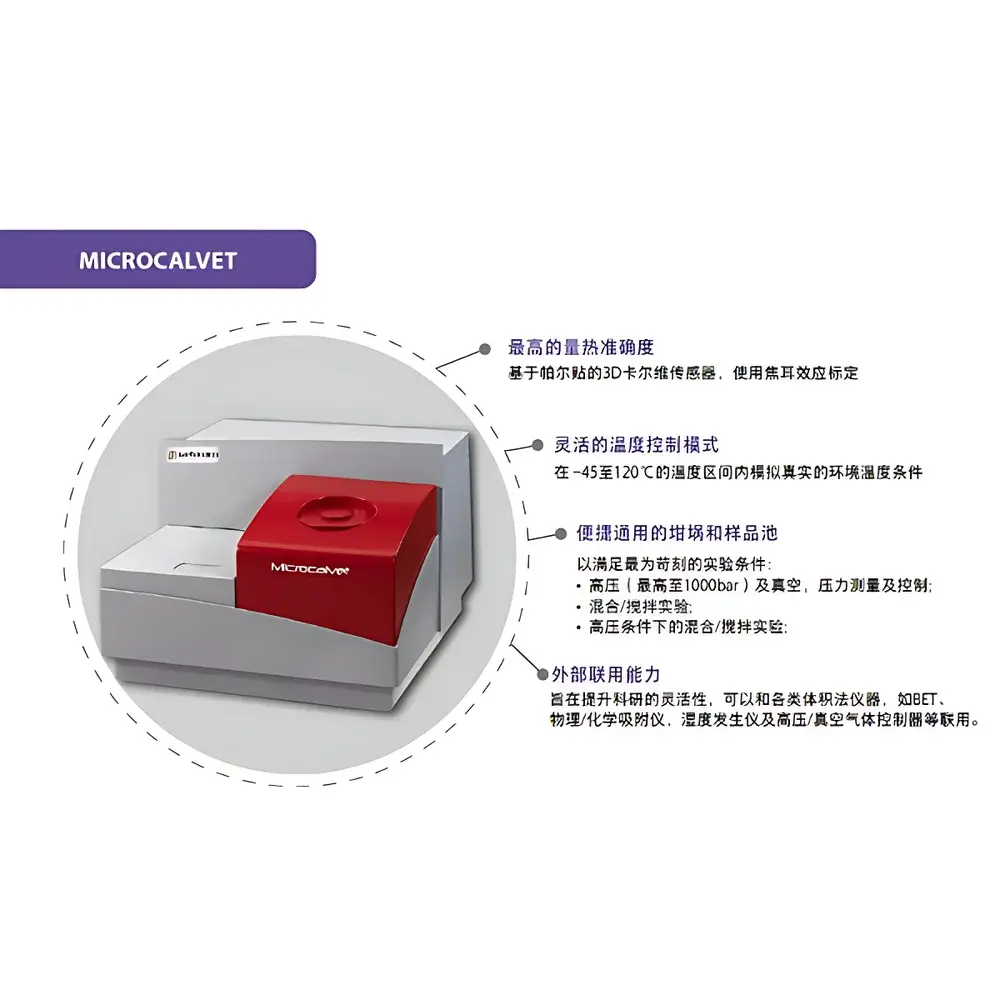
- Joule-effect calibration traceable to SI electrical units, ensuring absolute heat-flow accuracy of ±0.15% without reference material dependency
- Integrated Peltier-based temperature control delivering precise ramping, isothermal hold, and dynamic cycling between −45 °C and 120 °C
- Modular cell design supporting interchangeable sample vessels: standard sealed cells, high-pressure cells (up to 1000 bar), stirred reactors, vacuum-compatible chambers, and gas-permeable membranes
- Real-time pressure monitoring and active pressure regulation via integrated piezoresistive transducers and electro-pneumatic valves
- Multi-environment compatibility: operation under inert gas, oxidizing atmospheres, saturated vapor, or ultra-high vacuum (down to 10−6 mbar)
Sample Compatibility & Compliance
The Microcalvet accommodates diverse sample forms—including powders, gels, suspensions, viscous liquids, thin films, and heterogeneous solids—across life sciences, materials chemistry, and energy research domains. Its robust mechanical design meets ISO 17025 requirements for laboratory accreditation when operated under documented SOPs. High-pressure configurations comply with PED 2014/68/EU and ASME BPVC Section VIII Division 2 for safety-critical applications. Data acquisition adheres to ALCOA+ principles (Attributable, Legible, Contemporaneous, Original, Accurate, Complete, Consistent, Enduring, Available) and supports 21 CFR Part 11-compliant electronic signatures when paired with validated software modules. All thermal and pressure protocols are fully audit-trail enabled for GLP/GMP-regulated environments.
Software & Data Management
Control and analysis are performed using SETARAM’s Calisto software suite, a Windows-based platform offering real-time visualization, multi-parameter synchronization (T, P, dQ/dt, dV/dt), and automated protocol scripting. Raw heat-flow data are stored in HDF5 format with embedded metadata (instrument ID, operator, timestamp, calibration history). Batch processing tools enable comparative kinetic modeling (e.g., isoconversional analysis via Friedman or Ozawa–Flynn–Wall methods), thermodynamic integration (ΔH, ΔCp, Tonset), and statistical uncertainty propagation. Export options include CSV, ASCII, and MATLAB-compatible binaries; API access enables integration into LIMS or ELN systems via RESTful endpoints.
Applications
- Hydration thermodynamics and gas hydrate stability in offshore flow assurance studies
- Enthalpy-driven binding affinities and conformational stability of therapeutic proteins and nucleic acids
- Cure kinetics and exothermic decomposition profiling of epoxy resins and battery electrode materials
- Adsorption enthalpies and pore-filling energetics in MOFs and activated carbons under variable p–T conditions
- Reaction calorimetry of catalytic hydrogenation, oxidation, and polymerization under industrially relevant pressures
- Thermal stability mapping of food matrices (e.g., starch gelatinization, fat crystallization) under controlled humidity
FAQ
What distinguishes the Microcalvet from conventional DSC instruments?
The Microcalvet measures absolute heat flow via a symmetric 3D sensor with Joule calibration, whereas DSC relies on temperature differentials and requires frequent recalibration with reference standards.
Can the Microcalvet perform simultaneous calorimetry and gas sorption measurements?
Yes—its modular interface allows synchronized operation with BET surface area analyzers, gravimetric sorption systems, and humidity-controlled gas dosing units via TTL and analog I/O triggers.
Is high-pressure operation limited to static conditions?
No—dynamic pressure modulation (ramping, cycling, stepwise changes) is supported up to 1000 bar with sub-bar resolution and closed-loop feedback control.
How is data integrity ensured during long-duration experiments (e.g., >72 h)?
Calisto implements automatic baseline correction, drift compensation algorithms, and continuous checksum validation of all acquired data packets, with redundant storage on local SSD and network-attached backup.
Does the system support Good Manufacturing Practice (GMP) workflows?
When deployed with validated Calisto IQ/OQ documentation packages and 21 CFR Part 11 add-ons, the Microcalvet meets FDA expectations for regulated pharmaceutical and biologics development labs.



