
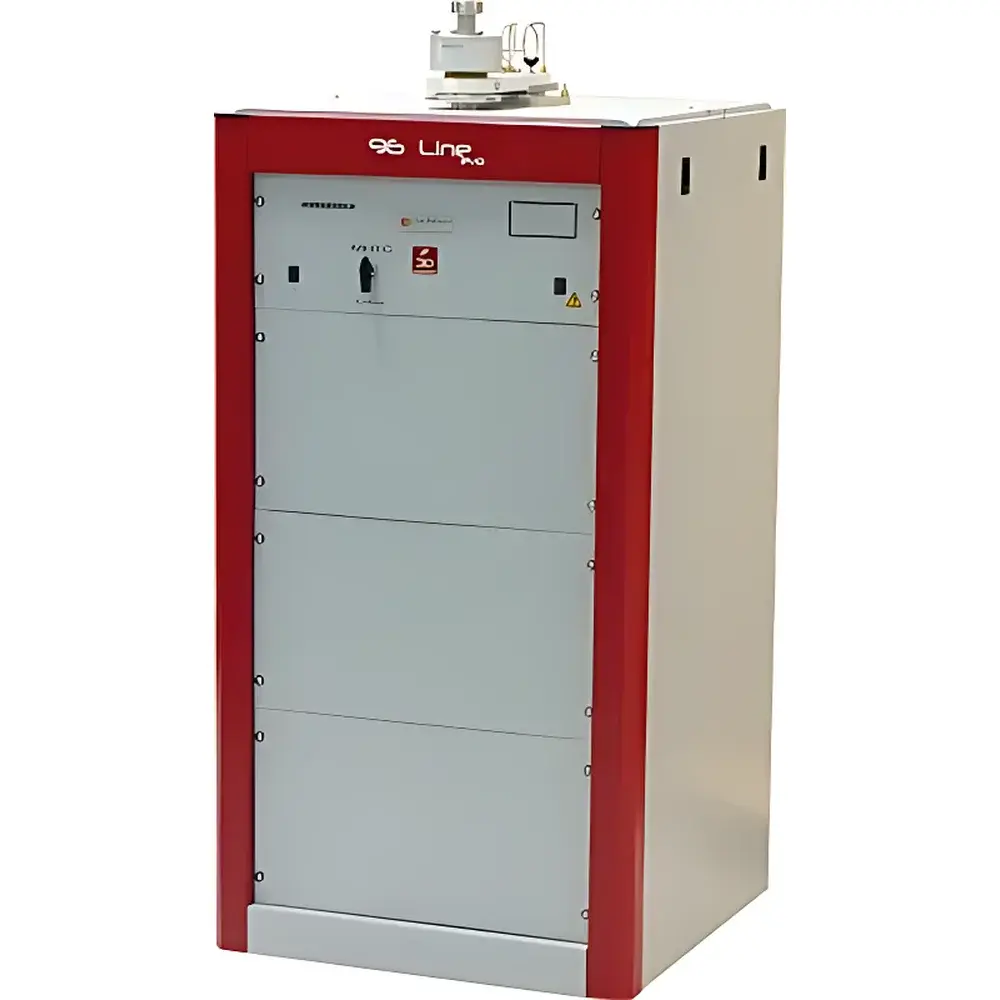
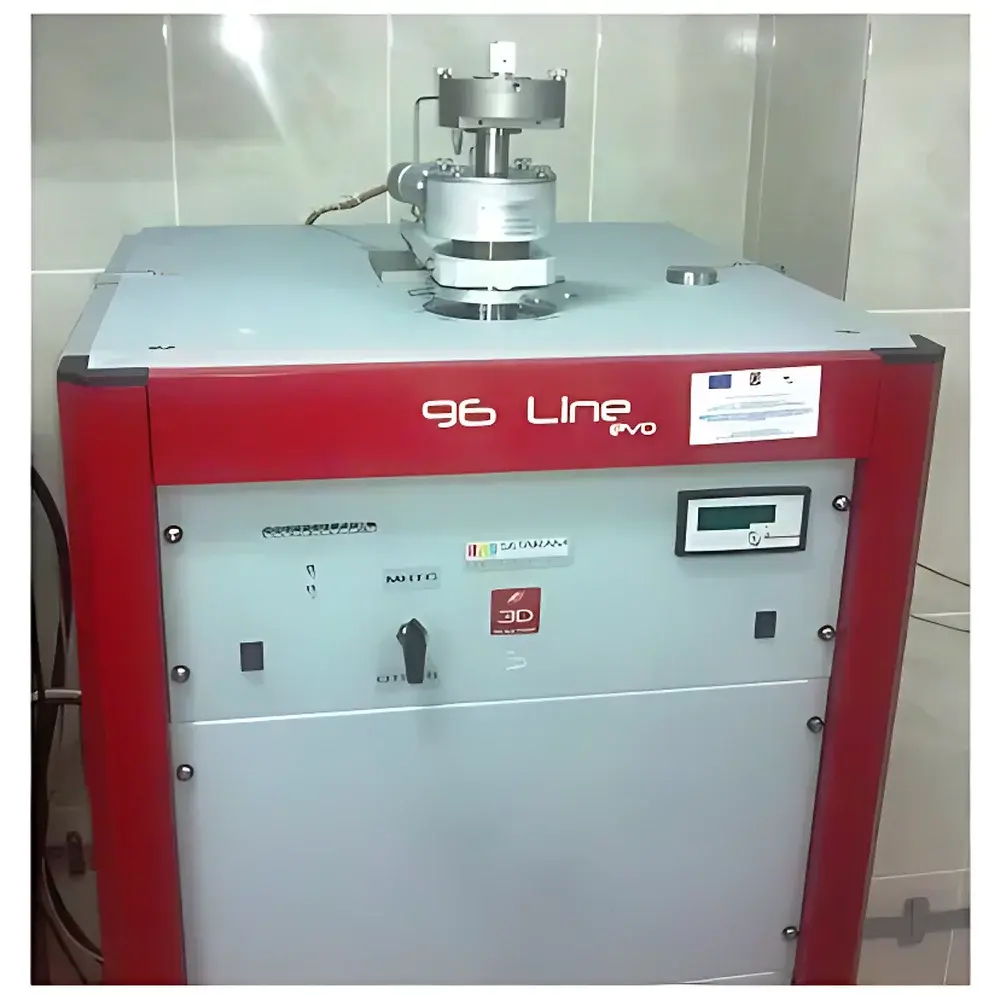
SETARAM 96 Line High-Temperature Large-Sample Simultaneous Thermal Analyzer
| Brand | SETARAM |
|---|---|
| Origin | France |
| Model | 96 Line |
| Temperature Range | RT to 1750 °C (upgradable to 2100 °C) |
| Heating Rate | 0–100 K/min |
| TG Sample Capacity | 100 g |
| Max. TG Sample Dimensions | Ø20 mm × H80 mm |
| TG Resolution | 0.3 µg |
| Calorimetric Sample Volume | 5700 µL (Ø14.5 mm × H35 mm) |
| Specific Heat Accuracy | ±1% (relative) |
| TMA Stroke Range | ±6 mm |
| TMA Resolution | 1.6 nm |
| TMA Max. Sample Dimensions | Ø18 mm × H50 mm |
| Sensor Architecture | 3D microcalorimetric sensor with Drop method implementation |
| Modular Configurations | TG, TG-DSC, TG-DTA, TMA, 3D calorimetry |
Overview
The SETARAM 96 Line is a high-temperature, large-sample simultaneous thermal analyzer engineered for rigorous materials characterization under extreme thermal conditions. It integrates thermogravimetric analysis (TG), differential scanning calorimetry (DSC), differential thermal analysis (DTA), thermomechanical analysis (TMA), and proprietary 3D microcalorimetry into a single, fully modular platform. Unlike conventional STA systems limited by sample mass or temperature ceiling, the 96 Line operates from ambient to 1750 °C (optionally upgradable to 2100 °C), enabling direct investigation of refractory metals, ceramic composites, nuclear fuels, and advanced aerospace alloys. Its core innovation lies in the patented 3D calorimetric sensor—based on the classical “Drop” method—which measures specific heat capacity (Cp) of bulk, non-homogeneous, or geometrically irregular specimens with metrological traceability. This architecture eliminates assumptions inherent in indirect Cp estimation methods and supports first-principles thermodynamic modeling of phase transformations, oxide formation enthalpies, and alloy solidification behavior.
Key Features
- High-capacity suspension-type thermobalance with 100 g maximum load and sub-microgram resolution (0.3 µg), accommodating oversized or irregularly shaped samples without compromise in sensitivity.
- True 3D microcalorimetric sensor enabling direct, absolute specific heat measurement across the full operating temperature range—validated to ±1% relative accuracy per ISO 11357-4 and ASTM E1269.
- Modular functional interchangeability: users can reconfigure the system in situ between TG, TG-DSC, TG-DTA, TMA, and 3D calorimetry modes without hardware disassembly or recalibration.
- Corrosion-resistant atmosphere management system with optional gas modules for SO2, NH3, H2S, and reducing/oxidizing mixtures—fully compatible with ISO 8502-9 and ASTM G154 environmental exposure protocols.
- High-precision TMA module with ±6 mm stroke and 1.6 nm displacement resolution, supporting dimensional stability assessment of refractories, CMCs, and thermal barrier coatings under controlled atmospheres.
- Robust vacuum-tight furnace design with dual-zone temperature control, ensuring uniform thermal gradients and minimizing axial conduction artifacts during high-K/min ramping (0–100 K/min).
Sample Compatibility & Compliance
The 96 Line accommodates heterogeneous, multiphase, and macroscopic specimens—including sintered ceramics, cast ingots, fiber-reinforced composites, and geological cores—that exceed standard STA sample constraints. Its Ø20 mm × 80 mm TG chamber and Ø14.5 mm × 35 mm calorimetric crucible support representative sampling for industrial QA/QC and R&D validation. The system complies with ISO 11357 (Plastics—Calorimetry), ISO 7111 (Metals—Thermal Expansion), ASTM E1131 (TG), ASTM E1269 (Cp), and EN 14607 (Refractories). Full audit trail logging, electronic signature support, and user-access-level controls align with FDA 21 CFR Part 11 requirements for regulated environments conducting GLP/GMP-compliant thermal property certification.
Software & Data Management
SETARAM’s CALISTO software provides unified acquisition, real-time deconvolution, and thermodynamic modeling within a validated framework. It includes automated baseline correction, multi-step kinetic analysis (Friedman, Ozawa-Flynn-Wall), phase transition identification via derivative peak matching, and Cp-derived enthalpy integration. Raw data are stored in vendor-neutral HDF5 format with embedded metadata (instrument ID, operator, calibration certificate hash, atmospheric composition). Export modules support ASTM E1447-compliant reporting, LIMS integration via OPC UA, and batch processing for inter-laboratory round-robin studies.
Applications
- Aerospace: Oxidation kinetics of Ni-based superalloys at turbine inlet temperatures; CTE mapping of SiC/SiC composites under thermal cycling.
- Metallurgy: Quantification of latent heat during peritectic reactions in Fe–C–Cr systems; enthalpy of formation for complex oxides in slag chemistry.
- Nuclear Materials: Thermal stability and decomposition pathways of UO2–PuO2 mixed oxides up to 2000 °C.
- Refractories: Sintering onset, densification shrinkage, and creep resistance evaluation of MgO–C bricks under CO-rich atmospheres.
- Geoscience: High-temperature dehydration enthalpies of hydrated silicates relevant to mantle mineral physics.
FAQ
What distinguishes the 3D calorimetric sensor from conventional DSC sensors?
The 3D sensor measures heat flow orthogonally across three axes using differential thermopile arrays, enabling true volumetric heat capacity determination without geometric assumptions—critical for porous, fibrous, or layered samples.
Can the 96 Line perform quantitative gas evolution analysis?
Yes—when coupled with FTIR or QMS interfaces (optional), evolved gas analysis (EGA) is synchronized with mass loss and thermal events, supporting stoichiometric assignment per ASTM E2550.
Is calibration traceable to national standards?
All thermal, mass, and displacement calibrations are performed using NIST-traceable reference materials (e.g., SRM 720 for Cp, SRM 780 for melting points) with documented uncertainty budgets.
How is system modularity implemented physically?
Functional modules mount onto a common optical bench with precision kinematic couplings; sensor head exchange requires <5 minutes and triggers automatic configuration recognition via embedded EEPROM.
Does the platform support long-duration isothermal holds at 1800 °C?
Yes—the graphite furnace with SiC insulation and water-cooled flange enables stable 100-hour holds at 1800 °C with <±0.5 K drift, verified per ISO 17025 internal monitoring protocols.



