
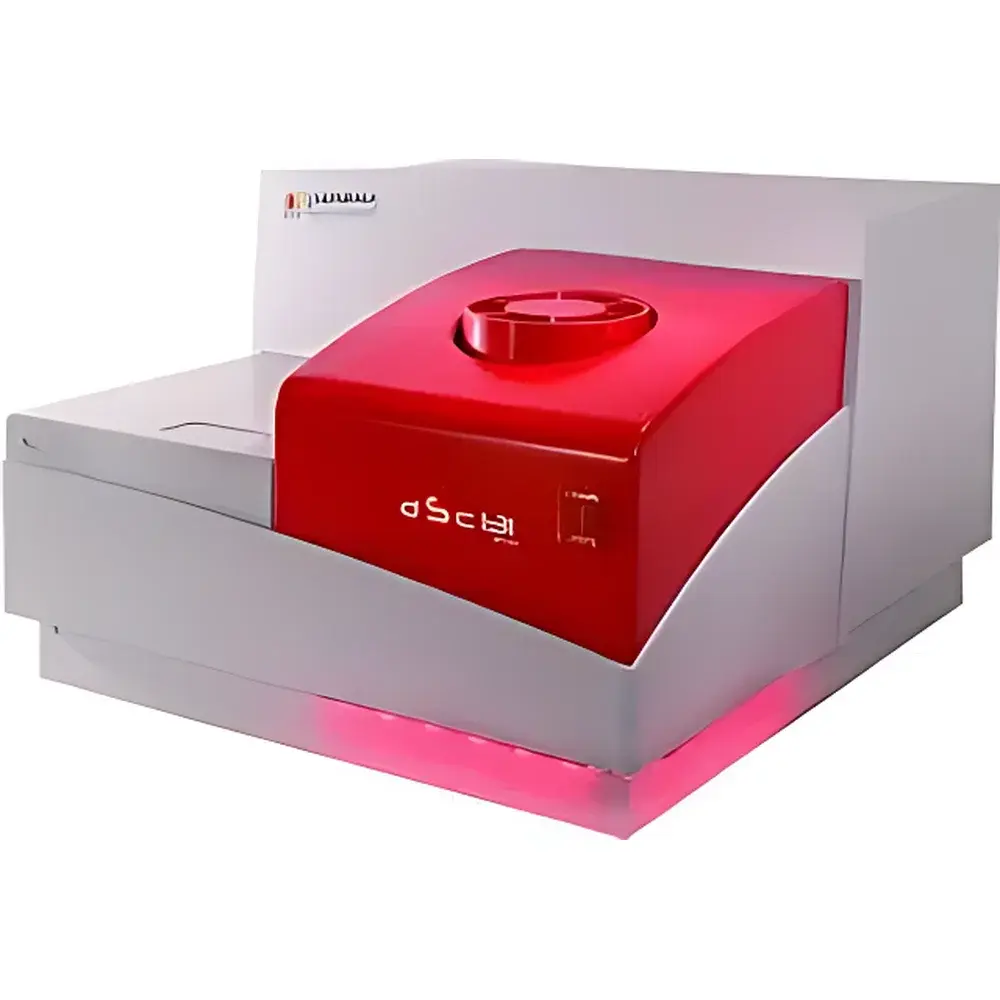
SETARAM DSC131 Evo Differential Scanning Calorimeter
| Brand | SETARAM |
|---|---|
| Origin | France |
| Model | DSC131 Evo |
| Temperature Range | −170 to 700 °C (LN₂ mode) / −80 to 500 °C (mechanical cooling) |
| Heating/Cooling Rate | 0–100 K/min |
| Dynamic Heat Flow Range | ±6000 mW |
| Gas Channels | 2 independent, software-controlled carrier gas lines |
| Pressure Rating | up to 500 bar with high-pressure crucibles |
| Sensor Type | removable heat-flux DSC sensor |
| Standard Software | CALISTO v5.x |
Overview
The SETARAM DSC131 Evo is a high-performance, heat-flux type differential scanning calorimeter engineered for precision thermal characterization across academic, industrial, and regulatory environments. Operating on the fundamental principle of measuring differential heat flow between a sample and inert reference under controlled temperature programs, the DSC131 Evo delivers quantitative thermodynamic data essential for material development, quality assurance, and process validation. Its dual-cooling architecture—supporting both mechanical refrigeration (−80 °C to 500 °C) and liquid nitrogen cooling (−170 °C to 700 °C)—enables broad applicability across low-temperature transitions (e.g., cryogenic polymer relaxations) and high-temperature events (e.g., metal alloy solidus/liquidus determination). The instrument’s robust mechanical design, thermally stable furnace core, and calibrated heat-flux sensor ensure long-term baseline reproducibility and minimal drift—critical for multi-day stability studies and GLP-compliant workflows.
Key Features
- Removable, field-serviceable heat-flux sensor assembly—reducing downtime and eliminating costly factory recalibrations
- Modular gas handling system with two independently programmable carrier gas channels (e.g., N₂, O₂, Ar, synthetic air), enabling automated atmosphere switching during single runs for oxidation induction time (OIT), decomposition kinetics, or purge-gas-dependent transition analysis
- High-pressure crucible option rated to 500 bar—supporting safe evaluation of volatile compounds, pressurized catalytic reactions, and supercritical fluid interactions
- Wide dynamic range (±6000 mW) and sub-milliwatt sensitivity—capable of resolving weak transitions in dilute biological samples or nanoscale phase changes in thin-film coatings
- Linear heating/cooling rates from 0 to 100 K/min—facilitating both conventional stepwise analysis and advanced modulated DSC (MDSC®-compatible) protocols
- Compact footprint and integrated thermal shielding—minimizing ambient influence and enhancing positional stability in shared lab spaces
Sample Compatibility & Compliance
The DSC131 Evo accommodates standard aluminum, gold, platinum, and high-purity graphite crucibles (hermetic and vented), as well as custom geometries for specialized applications such as fiber, powder, gel, or micro-volume liquid samples. It supports ASTM E794 (melting point), ASTM E1356 (glass transition), ISO 11357 (polymer thermal behavior), USP <1163> (drug polymorph screening), and ICH Q5C (protein thermal stability). Data acquisition and reporting comply with FDA 21 CFR Part 11 requirements when deployed with CALISTO’s audit-trail-enabled configuration—including electronic signatures, user access controls, and immutable raw-data archiving. Instrument qualification documentation (DQ/IQ/OQ/PQ) templates are provided per GMP and ISO/IEC 17025 laboratory accreditation standards.
Software & Data Management
CALISTO software—developed exclusively for SETARAM thermal analyzers—provides a unified platform for instrument control, real-time visualization, peak deconvolution, kinetic modeling (e.g., Ozawa-Flynn-Wall, Kissinger), and thermodynamic parameter extraction (ΔH, Cp, Tonset, Tpeak, Toffset). Its modular architecture supports batch processing of hundreds of files with customizable report generation (PDF, Excel, XML). Raw data is stored in vendor-neutral .cal format with embedded metadata (user, timestamp, method, calibration ID), ensuring traceability and interoperability with LIMS and ELN systems. Advanced features include baseline subtraction algorithms for overlapping transitions, automatic purity calculation via van’t Hoff analysis, and multi-run comparative overlays with statistical deviation mapping.
Applications
- Pharmaceuticals: Polymorph identification, excipient compatibility screening, degradation pathway assessment, and lyophilization cycle optimization
- Polymers: Crystallinity quantification, crosslink density estimation, cure kinetics of thermosets, and aging-related embrittlement analysis
- Metals & Alloys: Solid-state transformation temperatures (e.g., martensite start/end), precipitation hardening behavior, and thermal expansion coefficient derivation
- Foods & Biomaterials: Gelatinization enthalpy, lipid oxidation onset, protein denaturation profiles, and starch retrogradation kinetics
- Energy Materials: Thermal stability of battery cathode/anode composites, electrolyte decomposition thresholds, and phase-change material (PCM) cycling endurance
- Inorganics & Ceramics: Dehydroxylation, polymorphic transitions (e.g., α↔β quartz), and sintering onset detection
FAQ
What cooling options are available, and how do they affect measurement range?
The DSC131 Evo offers two interchangeable cooling modules: a mechanical cooler (−80 °C to 500 °C) for routine QA/QC use, and a liquid nitrogen system (−170 °C to 700 °C) for low-temperature glass transitions, cryocrystallization, or high-temperature ceramic decomposition studies.
Is the instrument compatible with regulated environments requiring audit trails?
Yes—when configured with CALISTO’s 21 CFR Part 11 module, it provides full electronic signature support, operation logs, and tamper-proof raw data storage compliant with pharmaceutical and medical device quality systems.
Can the sensor be replaced by the user without service intervention?
Yes—the patented plug-and-play heat-flux sensor is fully user-replaceable and self-calibrating via built-in reference materials, reducing mean time to repair (MTTR) to under 15 minutes.
Does the system support high-pressure experiments?
With optional high-pressure crucibles (rated to 500 bar), the DSC131 Evo enables controlled-pressure thermal analysis of reactive gases, compressed solvents, or pressurized formulations—fully integrated with gas flow and pressure monitoring.
What level of technical support and warranty is included?
SETARAM provides a standard 36-month parts-and-labor warranty, remote diagnostics, annual calibration verification services, and application-specific training delivered by certified thermal analysts.



