GOM ATOS 5 Industrial-Grade Optical 3D Scanner
| Brand | GOM (a ZEISS Company) |
|---|---|
| Country of Origin | Germany |
| Model | ATOS 5 |
| Instrument Type | Blue-Light Structured Light 3D Scanner |
| Measurement Speed | Up to 50% faster than previous generation |
| Single-Capture Time | 0.2 s |
| Maximum Measuring Volume | Up to 1000 mm |
| Data Processing | GPU-accelerated via GOM Inspect Pro software |
| Compliance | Designed for ISO/IEC 17025-compliant metrology labs, supports GLP/GMP traceability workflows, and integrates with FDA 21 CFR Part 11–enabled validation environments |
Overview
The GOM ATOS 5 Industrial-Grade Optical 3D Scanner is a high-precision, blue-light structured light measurement system engineered for full-field 3D digitization of complex industrial parts. Operating on the principle of triangulation-based fringe projection, the ATOS 5 projects calibrated sinusoidal light patterns onto the object surface and captures their deformation using two high-resolution industrial cameras. This dual-camera stereo vision architecture enables sub-pixel accuracy in point cloud generation, delivering dense, noise-resistant 3D data even from challenging surfaces—including highly reflective (e.g., polished metal), low-reflectivity (e.g., black anodized or matte carbon fiber), and geometrically intricate features such as sharp edges, thin ribs, small radii (<0.2 mm), and flanged transitions. With a maximum measuring volume of 1000 mm and single-capture acquisition time of just 0.2 seconds, the ATOS 5 achieves both speed and metrological rigor required in production-integrated quality assurance.
Key Features
- Blue-light LED illumination system optimized for stable, repeatable fringe projection—minimizing ambient light interference and enabling robust operation in shop-floor environments.
- Dual high-dynamic-range CMOS cameras with synchronized global shutter capture, delivering up to 12 MP resolution per view and enabling precise stereo matching under variable surface reflectivity.
- GPU-accelerated real-time point cloud reconstruction via GOM Inspect Pro software—leveraging parallel processing to reduce post-capture computation time by >60% versus CPU-only workflows.
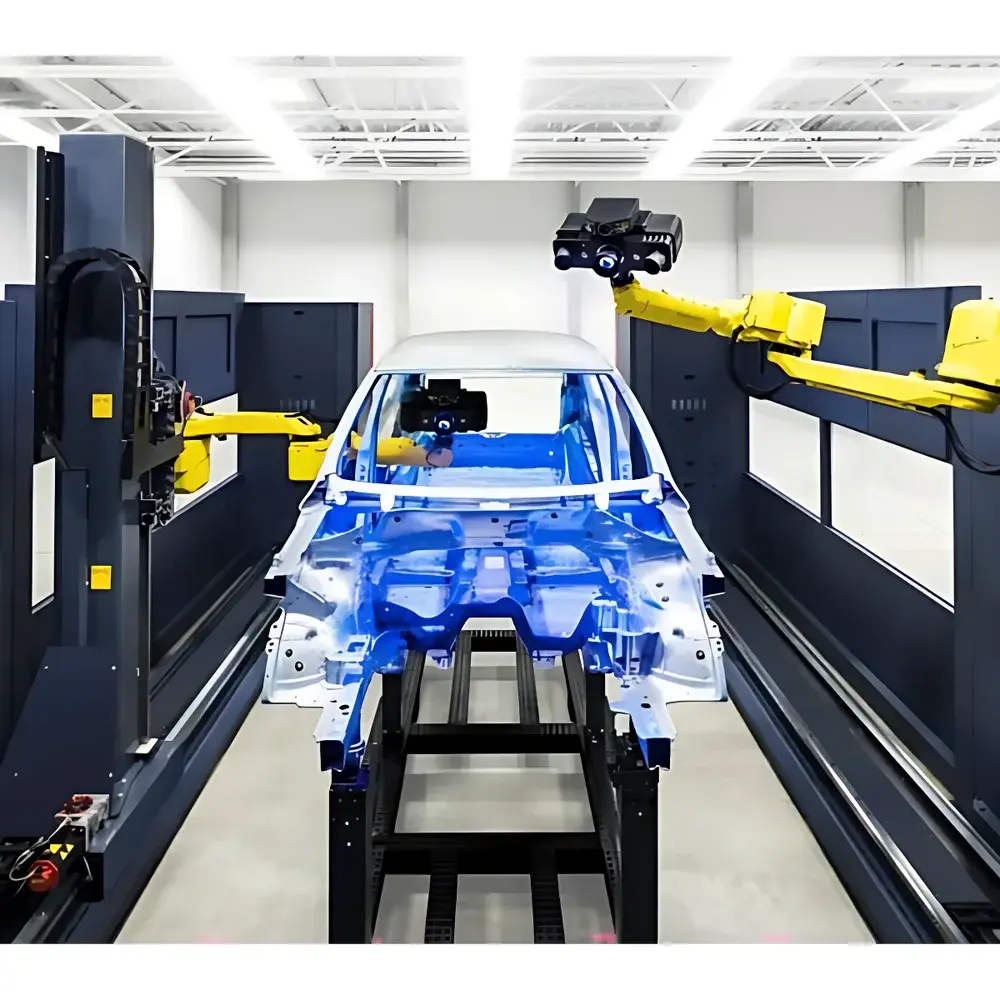
- Fiber-optic data interface supporting cable lengths up to 30 m—ensuring electromagnetic immunity and deterministic latency for integration into automated inspection cells or robotic scanning stations.
- Self-monitoring hardware architecture with built-in thermal drift compensation and automatic calibration verification—maintaining traceable measurement uncertainty across shifts and environmental fluctuations.
- Modular sensor design compatible with fixed-mount, portable handheld, and fully automated ScanBox integration—adapting seamlessly to metrology lab, CMM room, or inline production line deployment.
Sample Compatibility & Compliance
The ATOS 5 is validated for dimensional metrology of metallic and non-metallic components across automotive, aerospace, medical device, and energy sectors. It supports measurement of castings, forgings, sheet metal stampings, injection-molded plastics, turbine blades, composite layups, and additively manufactured parts—including those with internal lattice structures accessible via CT-assisted hybrid workflows. The system complies with ISO 10360-8 (coordinate measuring machines—performance verification of optical 3D scanning systems), ASTM E2924 (standard guide for 3D scanning in manufacturing quality control), and supports audit-ready documentation per ISO 9001, IATF 16949, and AS9100. All measurement reports include full uncertainty budgets traceable to NIST-traceable artifacts, and software workflows are configurable for 21 CFR Part 11 compliance (electronic signatures, audit trails, role-based access control).
Software & Data Management
GOM Inspect Pro serves as the unified metrology platform for the ATOS 5—providing end-to-end functionality from scan planning and acquisition to GD&T evaluation, deviation analysis, and automated reporting. Its parametric measurement tree ensures full repeatability and version-controlled process definitions. The software natively imports CAD formats (STEP, IGES, JT, CATIA V5/V6) and exports industry-standard mesh files (STL, PLY, OBJ) and metrology datasets (QIF, DMIS). For digital twin applications, it generates fully annotated 3D PDFs and HTML-based interactive reports with embedded color-coded deviation maps, cross-sections, and statistical process control (SPC) charts. Data archiving follows ISO 14721 (OAIS) principles, with optional integration into PLM (Teamcenter, Windchill) and MES (Siemens Opcenter, Rockwell FactoryTalk) ecosystems.
Applications
- Tool & Die Manufacturing: Full-surface validation of mold cavities, core inserts, and electrode geometry; shrinkage and warpage analysis of first-article castings and injection-molded parts.
- Sheet Metal & Stamping: Real-time thickness mapping, springback quantification, and flange alignment verification against Class-A surfacing requirements.
- Additive Manufacturing: As-built vs. as-designed comparison of AM parts—including support structure removal assessment, porosity localization, and lattice density validation.
- Aerospace Structural Components: Dimensional conformity checks of turbine blades, wing ribs, and composite fuselage sections—supporting EASA Part 21G and FAA AC 21.303 compliance documentation.
- Reverse Engineering & Adaptive Manufacturing: Generation of watertight, topology-optimized STL meshes directly usable for CNC re-machining or generative design iteration—bypassing manual CAD reconstruction.
FAQ
What surface finishes can the ATOS 5 accurately measure without spray application?
The ATOS 5 reliably captures data from bare machined aluminum, electroplated steel, matte-black composites, and transparent polycarbonate—without developer spray—using adaptive exposure control and multi-frequency fringe encoding.
Is the system suitable for in-line production metrology?
Yes—its IP54-rated enclosure, fiber-optic isolation, and <100 ms system response time enable direct integration into automated guided vehicle (AGV) cells, robotic arms (e.g., KUKA, ABB), and conveyor-based inspection lines.
How does ATOS 5 ensure traceability in regulated industries?
Each measurement includes embedded calibration certificate IDs, temperature/humidity logs, and full audit trail metadata; all exported reports comply with ISO 17025 clause 7.8.2 for result reporting.
Can ATOS 5 data be used for finite element analysis (FEA) input?
Yes—the native polygon mesh output maintains geometric fidelity down to 5 µm feature resolution and supports direct import into ANSYS Mechanical, Simcenter 3D, and HyperMesh via neutral format conversion.
What is the recommended maintenance interval for factory recalibration?
GOM recommends annual verification using certified reference artifacts (e.g., GOM TRITOP Calibration Box); in-house daily verification with check spheres is supported via integrated self-diagnostic routines.