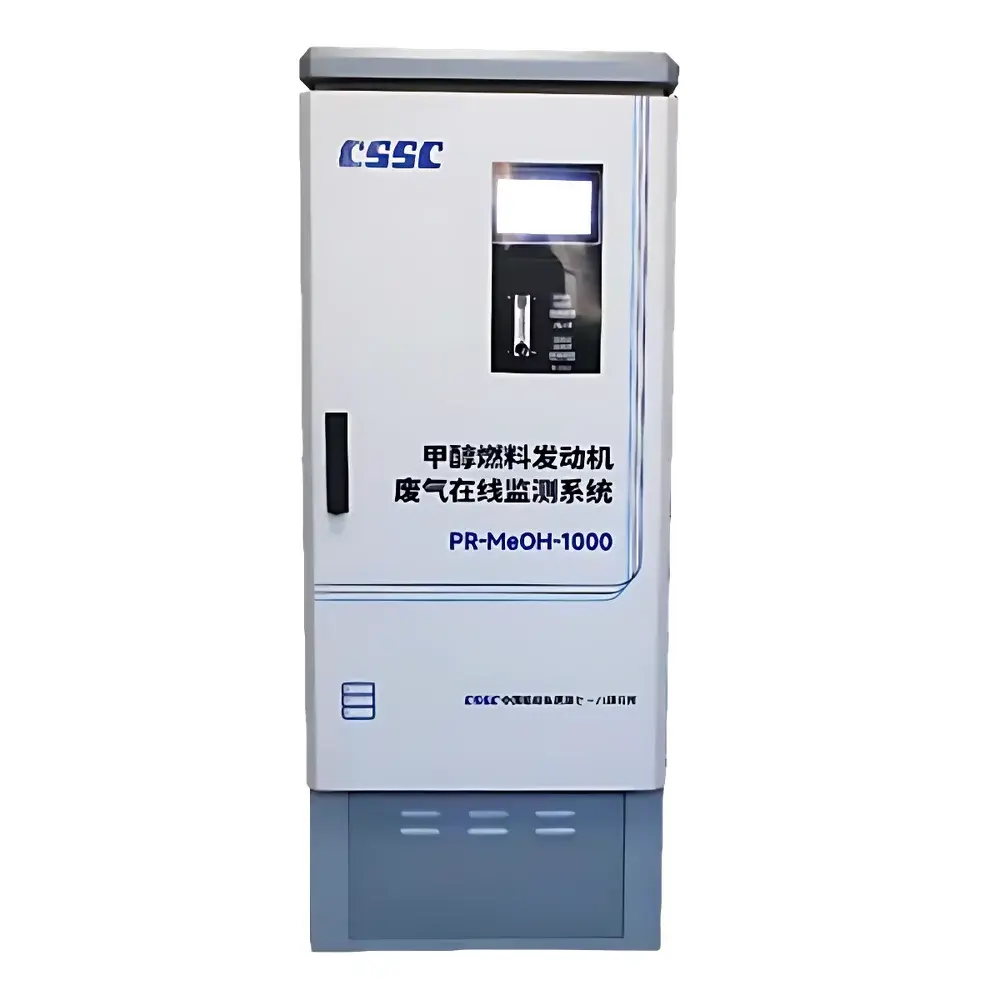
PERIC PR-MeOH-1000 Online Methanol & Formaldehyde Emission Monitoring System for Marine Engine Exhaust
| Brand | PERIC |
|---|---|
| Origin | Hebei, China |
| Manufacturer Type | Manufacturer |
| Country of Origin | Domestic (China) |
| Model | PR-MeOH-1000 |
| Price | Upon Request |
| Measurand | Methanol (0–1000 ppm), Formaldehyde (0–1000 ppm) |
| Response Time | ≤30 s (each) |
| Accuracy | ±5% FS (each) |
| Measurement Principle | UV-DOAS (Formaldehyde, hot/wet sampling), NDIR (Methanol, chilled/dry sampling) |
| Operating Temperature | −10 to 50 °C |
| Operating Humidity | 0–90% RH (non-condensing) |
Overview
The PERIC PR-MeOH-1000 is a purpose-built, fully integrated online gas analyzer engineered for continuous, real-time monitoring of methanol and formaldehyde in exhaust streams from marine diesel engines retrofitted or designed for methanol fuel operation. As global maritime regulations—such as IMO MARPOL Annex VI and the EU FuelEU Maritime initiative—tighten limits on unregulated emissions, accurate quantification of oxygenated volatile organic compounds (OVOCs) becomes critical for compliance reporting, engine optimization, and occupational health risk assessment. The system operates on a dual-technology, extractive sampling architecture: formaldehyde is measured via Ultraviolet Differential Optical Absorption Spectroscopy (UV-DOAS) under hot/wet conditions to preserve reactive species integrity, while methanol is quantified using Non-Dispersive Infrared (NDIR) spectroscopy following active condensate removal. This hybrid approach mitigates cross-interference from water vapor, particulates, and co-emitted hydrocarbons—common challenges in high-humidity, transient marine exhaust environments.
Key Features
- Extractive sampling architecture with dual-path conditioning: hot/wet UV-DOAS channel for formaldehyde; chilled/dry NDIR channel for methanol.
- Xenon-pulsed broadband UV light source with >5,000-hour operational lifetime and no moving optical components—ensuring long-term photometric stability under vessel vibration and thermal cycling.
- Fiber-optic coupling between light source, spectrometer, and gas cell—enabling modular serviceability without realignment or recalibration.
- Integrated heated probe with self-cleaning reverse-pulse filtration (≥0.5 µm cut-off), minimizing maintenance intervals in high-particulate exhaust streams.
- Onboard humidity sensor and dynamic moisture correction algorithm for NDIR methanol measurement—compensating for residual water vapor effects post-drying.
- Automated zero/span calibration with programmable scheduling (e.g., daily, weekly), traceable to certified gas standards per ISO 6141 and ISO 6145-7.
- Embedded industrial-grade controller with dual Ethernet ports and optional 4G LTE module for secure remote access via TLS-encrypted protocols.
Sample Compatibility & Compliance
The PR-MeOH-1000 is validated for direct integration into marine exhaust ducting (typically 300–600 °C upstream of turbocharger or downstream of aftertreatment systems). Sample gas temperature at the probe inlet is managed via actively heated stainless-steel sampling lines (maintained at 180 °C) to prevent condensation and adsorption losses of polar analytes. The system meets IEC 61000-6-2 (immunity) and IEC 61000-6-4 (emissions) for industrial environments. Data integrity aligns with GLP and GMP principles: full audit trail logging (user actions, calibration events, alarm states), time-stamped raw spectra storage, and configurable data retention policies. While not intrinsically safe, the analyzer is suitable for Zone 2/Class I Division 2 installations when installed with appropriate barrier systems per ATEX/IECEx guidelines.
Software & Data Management
The embedded HMI runs a deterministic real-time OS with a web-accessible interface supporting OPC UA (IEC 62541) and Modbus TCP protocols for seamless integration into vessel SCADA or shore-side emission monitoring platforms (e.g., ClassNK NAUT-IC, DNV SeaTrust). All measurement data—including raw absorbance spectra, humidity-corrected concentrations, diagnostic flags (e.g., lamp intensity decay, cell contamination index), and calibration logs—are stored locally on redundant SD cards (min. 12 months at 1 Hz sampling). Remote firmware updates, spectral diagnostics, and fault-tree analysis are supported via encrypted SSH tunneling. Export formats include CSV, XML, and JSON; timestamping complies with ISO 8601 and UTC synchronization via NTP.
Applications
- Real-time compliance verification against upcoming IMO Tier III-equivalent methanol-specific emission limits.
- Engine development testing: correlation of formaldehyde/methanol ratios with air-fuel ratio, injection timing, and EGR rate.
- Onboard emission reporting for EU MRV and upcoming CII rating calculations where unregulated OVOCs may influence lifecycle carbon accounting.
- Workplace exposure monitoring in engine rooms and exhaust handling zones per OSHA PEL (methanol: 200 ppm; formaldehyde: 0.75 ppm) and ACGIH TLV® thresholds.
- Validation of oxidation catalyst efficiency in methanol-fueled auxiliary power units (APUs) and dual-fuel main engines.
FAQ
What sample gas temperature range can the PR-MeOH-1000 accommodate?
The heated probe and sampling line support inlet temperatures up to 600 °C; the internal gas conditioning system maintains optimal measurement conditions (≤50 °C for NDIR, ambient for UV-DOAS flow cell) regardless of upstream fluctuations.
Does the system require external calibration gases during routine operation?
Yes—zero gas (N₂ or synthetic air) and span gases (certified CH₃OH/N₂ and HCHO/N₂ mixtures) are required for automated calibration; all gas connections comply with ISO 8573-1 Class 2 purity standards.
How is interference from NO₂ or SO₂ handled in the UV-DOAS formaldehyde channel?
The UV-DOAS algorithm applies multi-component spectral fitting across 190–230 nm, mathematically deconvolving formaldehyde absorption from overlapping NO₂ and SO₂ bands using high-resolution reference spectra per HITRAN database.
Can the system be integrated with existing vessel CMS or Class society reporting portals?
Yes—via standardized OPC UA information models or custom API endpoints; integration packages include DNV GL Cyber Secure-compliant configuration templates.
Is the analyzer certified for use on classification society-approved vessels?
The PR-MeOH-1000 is supplied with full technical documentation (including EMC test reports, material declarations, and software V&V records) to support class approval processes; type approval by ABS, LR, or CCS requires vessel-specific installation review.