
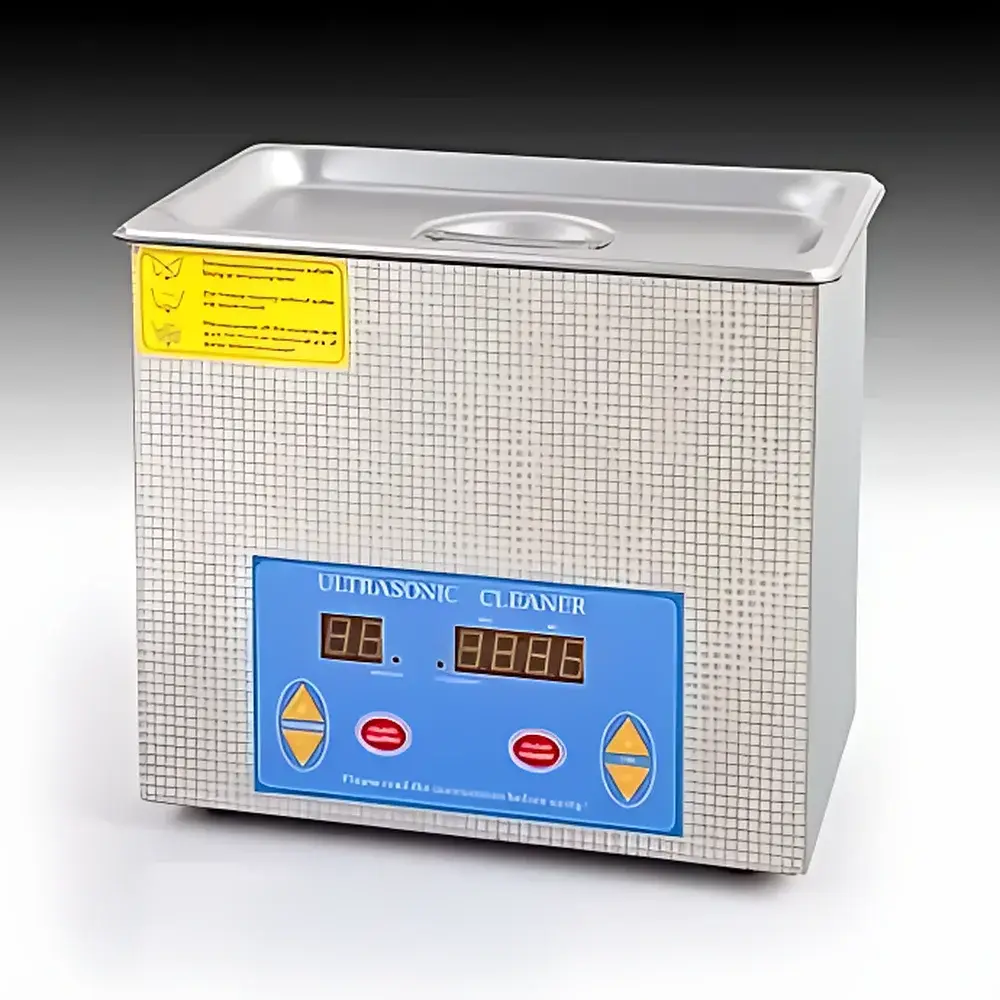
Truelab UC-T3D Benchtop Digital Ultrasonic Cleaner
| Brand | Truelab |
|---|---|
| Origin | Shanghai, China |
| Model | UC-T3D |
| Tank Capacity | 3.3 L |
| Ultrasonic Frequency | 40 kHz |
| Ultrasonic Power | 100 W |
| Heating Power | 100 W |
| Temperature Range | 0–80 °C |
| Timer Range | 1–99 min 59 sec |
| Adjustable Power | No |
| Adjustable Temperature | Yes |
| Adjustable Timer | Yes |
| Sound-Reducing Lid | Included |
| Drain Port | None |
| Construction | SUS304 Stainless Steel Tank & Housing |
| Control System | Industrial-Grade Microcontroller |
| Display | Digital LED (Time & Temperature) |
| Net Weight | ~5.5 kg |
Overview
The Truelab UC-T3D is a compact, benchtop digital ultrasonic cleaner engineered for precision cleaning of delicate and high-value laboratory components, electronic assemblies, optical parts, and small-scale biological or analytical samples. It operates on the principle of piezoelectrically generated cavitation: a 40 kHz ultrasonic transducer converts high-frequency electrical energy into mechanical vibrations transmitted through an aqueous or solvent-based cleaning medium. These vibrations induce controlled microbubble formation and implosion—cavitation events that generate localized shear forces capable of dislodging particulate contaminants, organic residues, oxides, and biofilms from surfaces and intricate geometries without mechanical abrasion. Designed for routine use in QC labs, R&D facilities, and university teaching laboratories, the UC-T3D delivers reproducible cleaning performance under defined thermal and temporal parameters—critical for method standardization and inter-laboratory comparability.
Key Features
- Fully welded SUS304 stainless steel tank (240 × 140 × 100 mm internal dimensions), eliminating seam-related corrosion or leakage risks common in stamped-and-brazed alternatives.
- Industrial-grade microcontroller with real-time digital display of both elapsed time and set temperature—enabling precise process documentation and repeatable protocol execution.
- Integrated sound-reducing lid minimizes airborne noise (typically < 65 dB(A) at 1 m) and suppresses solvent evaporation during heated operation.
- Adjustable heating system (0–80 °C) with independent PID-based temperature control ensures stable thermal conditions for temperature-sensitive cleaning protocols—including enzymatic decontamination or low-surface-tension solvent activation.
- Programmable timer (1–99 min 59 sec) supports unattended operation while preventing overexposure that may compromise sample integrity or transducer longevity.
- Stainless steel mesh basket (argon-welded construction) provides uniform suspension and acoustic coupling for consistent energy distribution across loaded samples.
- Front-panel tactile buttons offer intuitive, glove-compatible operation—designed for integration into ISO Class 5–7 cleanroom workflows where haptic feedback and minimal surface contact are essential.
Sample Compatibility & Compliance
The UC-T3D accommodates a broad range of sample types, including but not limited to: glassware (vials, cuvettes, pipette tips), metal components (sensors, calibration standards), PCBs and semiconductor wafers, dental and surgical instruments, histological slides, and microfluidic devices. Its non-contact, liquid-mediated cleaning mechanism preserves dimensional accuracy and surface finish—making it suitable for pre-analytical preparation prior to SEM, XRD, or ICP-MS analysis. While not certified to UL/CE for medical device reprocessing, the unit complies with general laboratory safety standards (IEC 61010-1) and supports GLP-aligned documentation when paired with external loggers for temperature/time traceability. Users performing validated cleaning procedures should reference ASTM D4163 (Standard Practice for Ultrasonic Cleaning of Metal Parts) and ISO 13485 Annex C for equipment qualification guidance.
Software & Data Management
The UC-T3D operates as a standalone analog-digital hybrid instrument with no embedded firmware update capability or network interface. All operational parameters are configured manually via front-panel controls; no proprietary software, drivers, or cloud connectivity are required. For audit-trail compliance in regulated environments (e.g., pharmaceutical QC labs operating under FDA 21 CFR Part 11), users must implement external procedural controls—such as manual logbooks or LIMS-integrated batch records—to capture settings, operator ID, date/time stamps, and verification checks. The unit’s stable thermal and timing performance enables straightforward validation per IQ/OQ protocols, particularly when verifying temperature uniformity (±2 °C across tank volume) and timer accuracy (±0.5 sec deviation over full range).
Applications
- Pretreatment of HPLC vials and autosampler components to eliminate carryover contamination between runs.
- Removal of flux residue and oxidation from printed circuit boards prior to solderability testing or AOI inspection.
- Cleaning of optical lenses and fiber-optic connectors where particle adhesion compromises signal transmission.
- Decontamination of reusable labware (e.g., centrifuge tubes, electrophoresis combs) in molecular biology workflows requiring RNase/DNase-free conditions.
- Supporting solvent-based extraction protocols—e.g., lipid recovery from tissue homogenates—by enhancing mass transfer kinetics without thermal degradation.
- Preparation of calibration standards for elemental analysis, ensuring absence of metallic particulates that could skew ICP-OES calibration curves.
FAQ
What cleaning solutions are compatible with the UC-T3D?
Aqueous alkaline, neutral, or mildly acidic detergents; ethanol, isopropanol, and acetone (with appropriate ventilation and compatibility verification). Avoid halogenated solvents unless explicitly approved by the manufacturer.
Can the UC-T3D be used for sterilization?
No. Ultrasonic cleaning removes bioburden but does not achieve sterility assurance levels (SAL ≤ 10⁻⁶). It serves as a critical precleaning step before autoclaving or ethylene oxide treatment.
Is the heating function independent of ultrasonic activation?
Yes. Temperature can be set and maintained without initiating ultrasonic output—enabling soak cycles or solvent preheating prior to cavitation onset.
How often should the cleaning solution be replaced?
Solution replacement frequency depends on load soiling level and chemistry; typical practice is daily for high-throughput labs or after every 3–5 cleaning cycles in low-use scenarios. Visual turbidity or odor change indicates immediate replacement.
Does the UC-T3D include a degassing function?
No dedicated degas mode is provided. However, initiating ultrasonic operation for 1–2 minutes prior to sample loading effectively removes dissolved air from fresh solvent—optimizing cavitation efficiency.



