
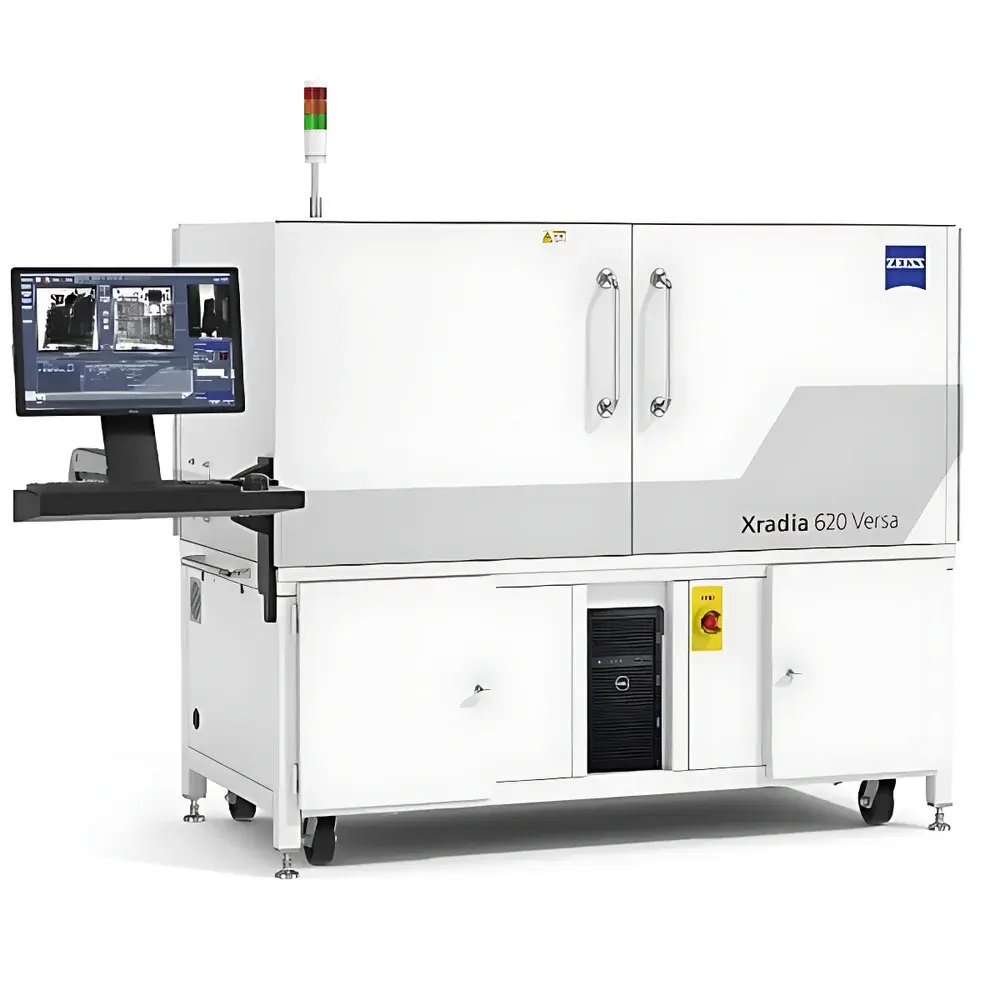
ZEISS Xradia 620 Versa 3D X-ray Microscope
| Brand | ZEISS |
|---|---|
| Origin | Germany |
| Detector Type | Scintillator-based Detector |
| Scan Mode | Translation-Rotation (TR) |
| Spatial Resolution | 0.5 µm |
| Minimum Voxel Size | 40 nm |
| Sample Dimensions (X/Y/Z) | 50 mm × 50 mm × 100 mm |
| Maximum Sample Weight | 25 kg |
| Dual Magnification Architecture | Optical + Geometric |
Overview
The ZEISS Xradia 620 Versa is a high-performance, laboratory-based 3D X-ray microscope engineered for non-destructive, sub-micron tomographic imaging across research and industrial applications. Unlike conventional micro-CT systems relying solely on geometric magnification, the Xradia 620 Versa implements a patented dual-stage magnification architecture—combining high-brightness microfocus X-ray source optics with high-resolution scintillator-based detection—to achieve true sub-500 nm spatial resolution while maintaining flexibility in working distance and sample size. This architecture enables quantitative 3D characterization of internal microstructures without sectioning or staining, preserving sample integrity and enabling longitudinal or in situ studies. The system operates on absorption contrast principles, enhanced by proprietary phase retrieval algorithms and optional propagation-based phase contrast, significantly improving soft-tissue and low-Z material visibility. Designed and manufactured in Oberkochen, Germany, the instrument complies with IEC 61000-6-3 (EMC) and IEC 61000-6-4 standards for laboratory equipment, and supports integration into GLP- and GMP-aligned workflows through audit-trail-capable software logging.
Key Features
- Dual-magnification imaging architecture delivering 0.5 µm spatial resolution and 40 nm minimum voxel size—achievable across variable working distances up to 150 mm.
- RaaD (Resolution at a Distance) technology enabling high-fidelity 3D imaging of dense, large-volume components (up to 100 mm tall, 50 mm diameter) without resolution compromise.
- Scintillator-based detector optimized for high dynamic range and low noise, supporting both fast macro-scan navigation (via optional Flat Panel X-ray—FPX—detector) and high-resolution region-of-interest (ROI) scanning.
- Translation-Rotation (TR) scanning geometry ensuring mechanical stability, thermal consistency, and superior reconstruction fidelity compared to cone-beam-only configurations.
- LabDCT Pro module for diffraction contrast tomography, enabling crystallographic orientation mapping and grain structure analysis in polycrystalline materials.
- Integrated environmental chamber compatibility for temperature-, load-, or atmosphere-controlled in situ and 4D experiments—including correlation with mechanical testing stages and electrochemical cells.
Sample Compatibility & Compliance
The Xradia 620 Versa accommodates samples up to 25 kg and 100 mm in height, with standard stage travel of ±25 mm (X/Y) and ±50 mm (Z). Its modular sample holder design supports custom fixtures for irregular geometries, including turbine blades, battery cells, geological cores, and additively manufactured parts. All hardware and motion control subsystems conform to ISO 14644-1 Class 5 cleanroom-compatible mechanical tolerances. The system meets CE marking requirements under the EU Machinery Directive 2006/42/EC and Electromagnetic Compatibility Directive 2014/30/EU. Data acquisition and reconstruction modules are validated for compliance with FDA 21 CFR Part 11 when deployed with ZEISS Scout-and-Scan Control software configured for electronic signatures and audit trails.
Software & Data Management
Acquisition, reconstruction, and analysis are unified within ZEISS Scout-and-Scan Control and XMReconstructor software platforms. Scout-and-Scan provides intuitive workflow-driven experiment setup—including automated ROI targeting using FPX-guided coarse scans—and real-time projection monitoring. XMReconstructor delivers GPU-accelerated filtered back-projection and iterative reconstruction (SART, OS-SART), with built-in ring artifact correction and beam-hardening compensation. Post-processing leverages ZEISS Dragonfly Pro, incorporating machine learning–based segmentation tools trained on multi-material datasets, pore network extraction, and quantitative morphometry (e.g., specific surface area, tortuosity, connectivity density). All processing steps are scriptable via Python API, supporting reproducible, version-controlled analysis pipelines aligned with FAIR data principles.
Applications
The Xradia 620 Versa serves as a cornerstone instrument in advanced materials science, energy research, geoscience, electronics reliability, and life sciences. It enables failure analysis of solder joints and void evolution in power electronics; quantification of electrode degradation and lithium dendrite growth in operando battery cells; 3D pore-network modeling in catalyst substrates and reservoir rocks; microstructural assessment of thermal barrier coatings and metal matrix composites; and non-destructive histology of mineralized tissues. Its ability to resolve features below 500 nm—without synchrotron access—makes it particularly valuable for labs requiring turnkey, high-reproducibility 3D metrology under ambient or controlled environmental conditions.
FAQ
What distinguishes the Xradia 620 Versa from earlier Versa models?
The 620 Versa introduces enhanced source stability, upgraded detector quantum efficiency, and native support for LabDCT Pro and RaaD-optimized scanning protocols—enabling higher throughput at maintained resolution.
Can the system perform time-resolved (4D) imaging?
Yes—when integrated with compatible in situ stages and environmental chambers, the system acquires sequential tomographic datasets with temporal resolution down to ~30 minutes per scan, depending on sample attenuation and desired SNR.
Is remote operation supported?
Fully supported via secure TLS-encrypted client-server architecture; users can monitor acquisitions, adjust parameters, and initiate reconstructions from off-site workstations.
Does ZEISS provide application-specific training and method development support?
Yes—ZEISS Application Scientists deliver on-site and virtual training covering experimental design, reconstruction parameter optimization, and quantitative analysis workflows tailored to user-defined materials systems.
How is data integrity ensured during long-duration scans?
Hardware-level watchdog timers, automatic resume-after-interruption logic, and checksum-verified raw projection storage ensure dataset completeness—even during multi-day acquisitions.



