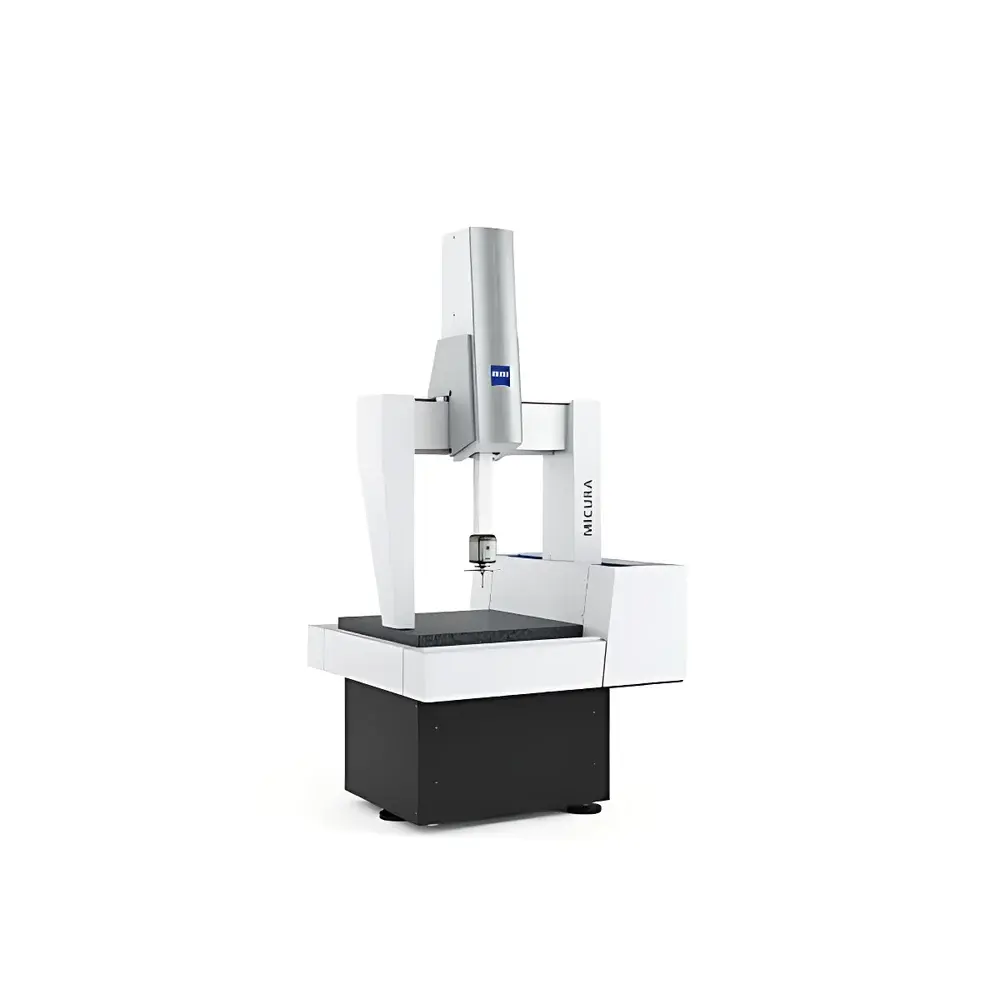
ZEISS MICURA Compact High-Precision Coordinate Measuring Machine for Small Components
| Brand | ZEISS |
|---|---|
| Origin | Germany |
| Model | MICURA |
| Configuration | Bridge-type |
| Operation Mode | Manual |
| Orientation | Vertical |
| Measurement Principle | Contact and Non-Contact Hybrid |
| Standard Ambient Temperature Range | 16–26 °C |
| Application Domain | Industrial Metrology |
| Structural Material | Granite Base with Ceramic Air Bearings |
| Probe System | VAST XT gold Scanning Sensor |
| Navigation Technology | VAST navigator |
| Measuring Volume | 500 × 500 × 500 mm |
| Minimum Probe Tip Diameter | 0.3 mm |
| Environmental Compensation | Dynamic Inertial Error Correction, Dual Workpiece Temperature Sensing, Active Force Control |
Overview
The ZEISS MICURA is a compact, high-precision bridge-type coordinate measuring machine (CMM) engineered specifically for the dimensional metrology of small, geometrically complex components in industrial production environments. Designed to meet the dual demands of miniaturization and metrological rigor—particularly in optics, microelectronics, precision mechanics, and medical device manufacturing—the MICURA integrates蔡司’s proprietary VAST XT gold active scanning probe with the adaptive VAST navigator control architecture. Its measurement principle combines tactile contact probing (with dynamic force regulation) and optional non-contact sensor integration (e.g., vision or laser line scanners), enabling traceable, ISO/IEC 17025-compliant verification of form, orientation, location, and runout tolerances per ISO 1101 and ASME Y14.5. The system operates within a tightly controlled thermal envelope (16–26 °C), and its granite base, ceramic air-bearing guideways, and four-sided air flotation support structure collectively suppress mechanical drift, vibration coupling, and thermal deformation—ensuring sub-micrometer repeatability across its full 500 × 500 × 500 mm volumetric envelope.
Key Features
- Bridge-type mechanical architecture with granite base and thermally stable ceramic linear guideways
- VAST XT gold active scanning probe with 0.3 mm minimum stylus tip diameter and real-time adaptive force control for delicate surfaces
- VAST navigator technology: intelligently modulates probe velocity based on local geometric complexity and tolerance requirements—slowing for tight-tolerance features, accelerating over nominal surfaces
- Integrated dual workpiece temperature sensors for real-time thermal expansion compensation in accordance with ISO 10360-7
- Dynamic inertial error correction algorithm compensates for acceleration-induced deviations during high-speed scanning
- Human-centered manual operation interface: dedicated touchscreen display and dual ergonomic joysticks enable full programming and measurement execution without external PC dependency
- Modular control cabinet, CALYPSO software suite, probe systems, and calibration artifacts are all ZEISS-manufactured and factory-integrated—guaranteeing hardware-software co-validation
Sample Compatibility & Compliance
The MICURA accommodates small to medium-sized machined parts, injection-molded polymer components, optical mounts, MEMS housings, semiconductor packaging substrates, and watch movement assemblies. Its hybrid contact/non-contact capability supports measurement of both hard metallic surfaces and soft, compliant materials—including elastomers and thin-film-coated substrates—without risk of indentation or deformation. The system complies with ISO 10360 series standards for CMM performance verification (including length measurement error, probing error, and scanning error assessment), and its software architecture supports audit-ready data logging aligned with FDA 21 CFR Part 11 requirements when deployed in regulated manufacturing environments (e.g., ISO 13485-certified medical device facilities). Calibration certificates are issued under ZEISS’s accredited metrology laboratory (DAkkS certificate no. D-K-19047-01-00), ensuring traceability to PTB (Physikalisch-Technische Bundesanstalt) primary standards.
Software & Data Management
CALYPSO metrology software—pre-installed and fully licensed—is the native platform for programming, execution, analysis, and reporting. It provides GD&T evaluation per ISO 1101 and ASME Y14.5, statistical process control (SPC) charting, multi-sensor alignment workflows, and automated report generation in PDF, Excel, or XML formats. All measurement programs include embedded uncertainty budgets calculated per GUM (JCGM 100:2008) principles. Data integrity is enforced through role-based user access control, electronic signatures, and immutable audit trails—including timestamped records of probe calibration, environmental parameter logging, and program modification history. Optional integration with ZEISS PiWeb SPC enables centralized dashboard monitoring across multiple MICURA units in networked production cells.
Applications
- Precision verification of miniature gears, micro-fluidic channels, and optical lens barrels in R&D and pilot-line validation
- First-article inspection and PPAP submission support for automotive electronics suppliers
- Form analysis (roundness, cylindricity, flatness, profile of a line/surface) on silicon wafers, ceramic substrates, and sapphire windows
- Geometric dimensioning and tolerance (GD&T) validation of medical implant components subject to ISO 14242 and ASTM F2503
- Tooling verification for micro-injection molds and EDM electrodes used in high-precision plastic part fabrication
- Post-process verification of additive manufactured micro-lattices and topology-optimized brackets
FAQ
What is the maximum permissible measurement uncertainty (MPE) for length measurements on the MICURA at 20 °C?
The stated MPEE0,MPE is ≤ (0.7 + L/600) µm, where L is the measured length in millimeters, verified per ISO 10360-2 Annex A.
Can the MICURA be integrated into an automated production cell?
Yes—via optional ZEISS Automation Interface (ZAI) module supporting PROFINET, EtherCAT, and OPC UA protocols for seamless PLC synchronization and robotic part loading/unloading.
Is CALYPSO software validated for use in GxP-regulated environments?
Yes—CALYPSO v7.10+ includes 21 CFR Part 11 compliance packages with electronic signature workflows, audit trail export, and IQ/OQ documentation templates.
Does the system support multi-sensor fusion (e.g., vision + touch probe)?
Yes—through ZEISS METROTOM integration or optional ZEISS VOSS vision sensor modules, enabling combined optical edge detection and tactile feature probing within a single alignment frame.
What environmental infrastructure is required for optimal performance?
A temperature-stabilized metrology lab (±0.5 °C/hour stability, 16–26 °C range), low-vibration floor (VC-E or better), and compressed dry air supply (ISO 8573-1 Class 2:2:2) for air bearings and probe actuation.